
A heron may look nothing like a Tyrannosaurus rex, but they are far more closely related than you might think. In fact, modern science is now clear on this point: birds are not just related to dinosaurs - they ARE dinosaurs. Over the past few decades, hundreds of fossils have been discovered that bridge the gap between feathered, flightless theropods and the earliest true birds. Birds inherited so many features from their theropod ancestors - wishbones, hollow bones, feathers, three-fingered hands, even the way they breathe - that scientists now classify all birds as a surviving branch of the dinosaur family tree. Every chicken, sparrow, eagle, and heron alive today is a living dinosaur.
Birds evolved from a group of small, agile, meat-eating theropod dinosaurs called maniraptorans - the same group that includes Velociraptor and Deinonychus. Compsognathus, a chicken-sized Late Jurassic predator, is one of the dinosaurs that most closely resembled early birds: it had a slender body, long legs, three-fingered grasping hands, and bird-like neck vertebrae. Modern molecular studies and fossil evidence both point to a Jurassic origin for true birds, around 160-150 million years ago. By the Late Cretaceous, the skies were full of true birds, including ducks, loons, and the ancestors of modern shorebirds.
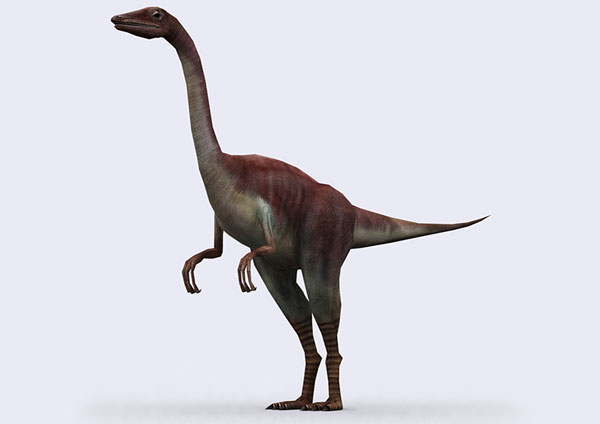
Compsognathus
The skeletons of theropod dinosaurs and modern birds share dozens of features. Many of the most striking are about reducing weight: both have hollow bones filled with air sacs that connect to the lungs, allowing efficient breathing while keeping the skeleton light. Both have a wishbone (furcula) formed from fused collarbones. Both walk on three forward-pointing toes with the equivalent of a backwards "thumb." Many theropods even sat on their nests like birds do. Comparing a chicken skeleton with a Velociraptor skeleton side by side, the similarities are unmistakable - the chicken just has a shorter tail and a beak instead of teeth.
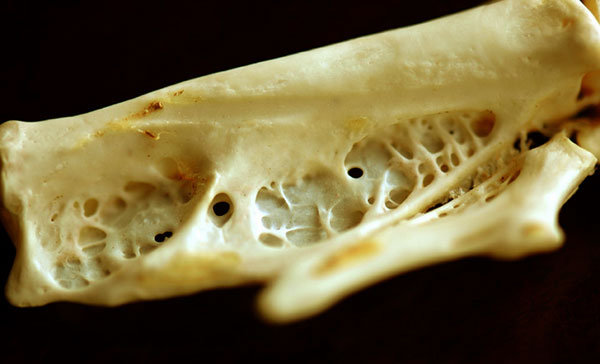
Lightweight bird bone
Archaeopteryx, from 150-million-year-old rocks in Bavaria, Germany, has long been considered the earliest known bird. It had fully feathered wings, a wishbone, and could probably fly short distances - but it also retained dinosaur features like teeth, a long bony tail, and clawed fingers on each wing. Even older possible birds, like Anchiornis from China (around 160 million years ago), are now also known. Confuciusornis, from Early Cretaceous China, is one of the first known birds with a true horny toothless beak - a hallmark of modern birds. By 120 million years ago, birds were already diverse and widespread.
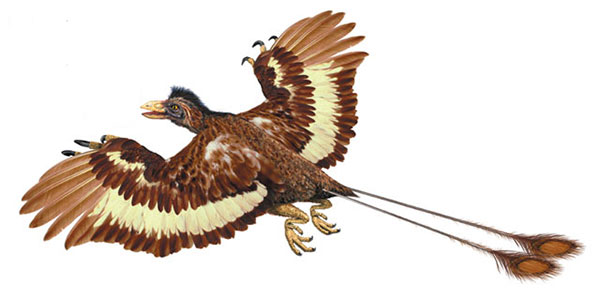
Confuciusornis
Several dinosaurs blur the line between dinosaur and bird so completely that classifying them is genuinely difficult. Shuvuuia, from Late Cretaceous Mongolia, had bird-like hollow bones, a coat of downy feathers, large eyes for night vision, and a long beak-like snout. Microraptor had four feathered wings - one set on the arms, one on the legs - and probably glided between trees. Anchiornis had feathered limbs that scientists can now reconstruct in colour - mostly black, grey, and white, with a striking russet crest. None of these dinosaurs were birds in the strict sense, but they show just how blurry the boundary became in the Late Jurassic and Cretaceous.
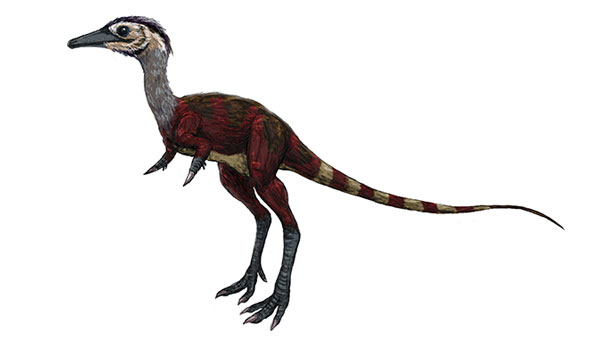
Shuvuuia
There are roughly 11,000 known bird species alive today, but the fossil record shows that many more existed in the past - some estimates suggest that the average bird species lasts only around 2-3 million years before going extinct. The recent extinctions, however, are accelerating - and most are caused by humans. The flightless dodo of Mauritius was wiped out in the 17th century within decades of its discovery by sailors, who hunted it and brought rats, pigs, and dogs that ate its eggs. The great auk, the passenger pigeon, and many other species have followed. Today, scientists estimate the bird extinction rate is roughly 100 times higher than the natural background rate - and habitat loss, climate change, and invasive species threaten roughly one in eight bird species.
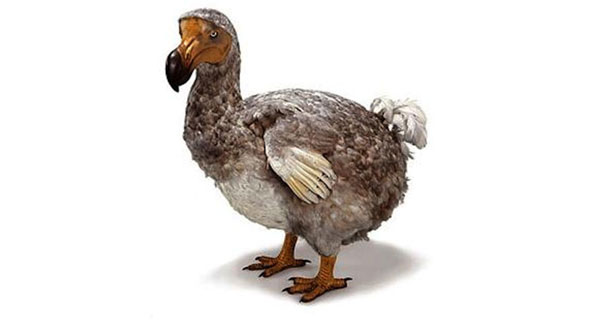
Dodo
In the 1993 film Jurassic Park, scientists revive dinosaurs using DNA extracted from blood-sucking mosquitoes preserved in amber. In real life, this is almost certainly impossible. DNA is a fragile molecule that breaks down over time, and the oldest DNA ever sequenced (from a Siberian mammoth) is only about 1.6 million years old - many millions of years too young to help. Even if some tiny fragments of dinosaur DNA were ever found, they would not contain anywhere near enough complete genetic information to rebuild a dinosaur. However, some scientists are working on a more limited version: by genetically modifying chicken embryos, they have already produced dinosaur-like features such as toothed jaws and longer tails. We may never see a real T. rex, but a "chickenosaurus" may not be quite so far-fetched.
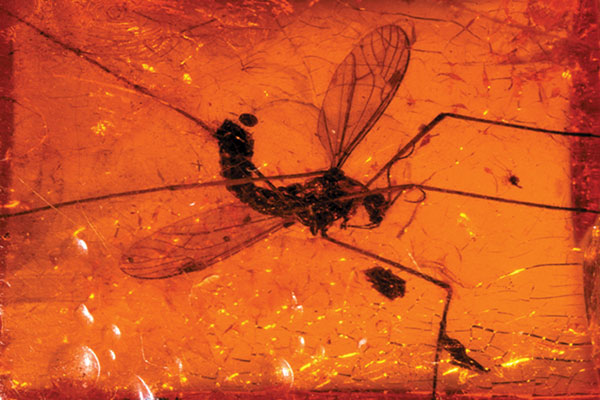
Insect preserved in amber