
Dinosaurs did not give birth to live young the way mammals do. Like nearly all reptiles - and like their modern descendants, birds - female dinosaurs laid eggs. Nests were usually made in shallow scrapes in the ground, lined with leaves and twigs, although some dinosaurs built mound nests like modern crocodiles. Dinosaur eggs came in many shapes and sizes, from oval to almost spherical, and ranged from the size of a chicken's egg to as large as a football. When ready, a baby dinosaur - such as this Troodon - cracked its way out of the shell using a small bony point on its snout called an egg tooth, just as baby birds and crocodiles do today.
Clutch sizes varied widely between species. A small theropod might have laid 12-20 eggs in a carefully arranged spiral inside the nest. Big sauropods sometimes laid 30-40 eggs at a time, often in long lines as they walked. Most dinosaurs probably laid eggs once a year, meaning a female could produce hundreds of babies over her lifetime - though only a tiny fraction would survive to adulthood. Predators, weather, and disease meant that mortality among hatchlings was extremely high, just as it is among modern reptiles and birds.
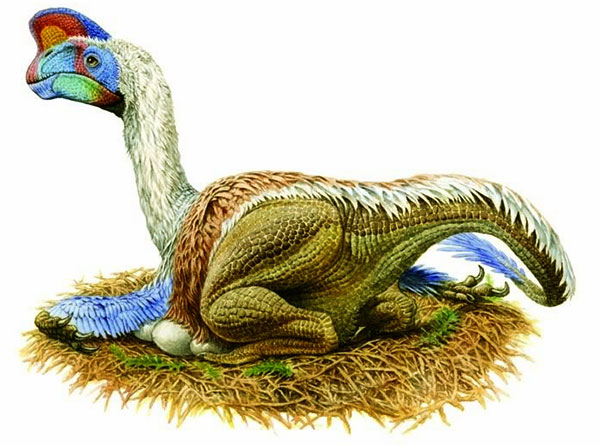
Oviraptor
Surprisingly, the biggest dinosaurs did not lay proportionally huge eggs. The largest known sauropod eggs are around 25-30 cm (10-12 in) across and weighed about 5-7 kg (11-15 lb) - only about twice the size of an ostrich egg, despite the mother being thousands of times heavier. The reason is shell thickness: an enormous egg would need such a thick shell that the baby inside could not get enough oxygen, and the chick would not be able to hatch out. Even so, the largest dinosaur eggs ever found - belonging to the theropod Macroelongatoolithus - were elongated and reached 60 cm (24 in) in length.
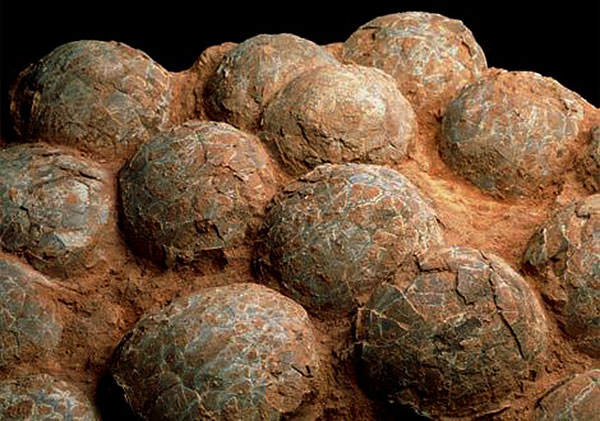
Sauropod Eggs
Yes - at least some did. A remarkable 80-million-year-old fossil from Mongolia shows an adult Oviraptor died directly over its nest, with its arms spread over the eggs in a brooding posture - just as a mother hen guards her chicks. This was a stunning discovery, because Oviraptor was originally accused of stealing eggs (its name means "egg thief"). It turned out the eggs the first fossil was found near were not stolen at all - they belonged to Oviraptor itself. Brooding fossils have also been found for other small theropods, suggesting that nest-sitting was widespread among the bird-like dinosaurs.
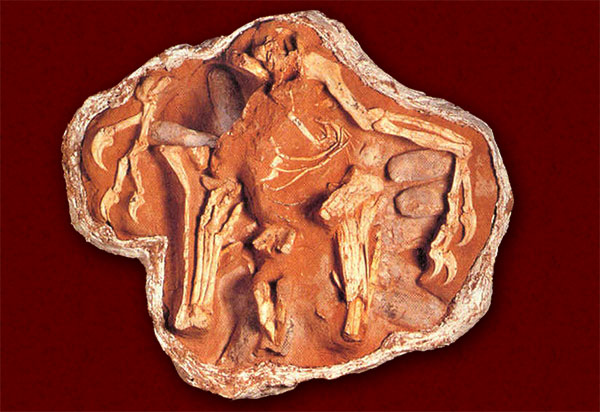
Oviraptor on its nest
Some certainly did. Maiasaura, whose name means "good mother lizard," is the best-known example. Fossil nesting sites in Montana, discovered by palaeontologist Jack Horner in 1978, show that Maiasaura nested in colonies and brought food back for its hatchlings, which were too underdeveloped to leave the nest on their own. Psittacosaurus and several other dinosaurs are also known from fossils of adults with groups of young. Other dinosaurs may have simply guarded their nests until the eggs hatched and then let the babies fend for themselves - the strategy used by modern crocodiles.
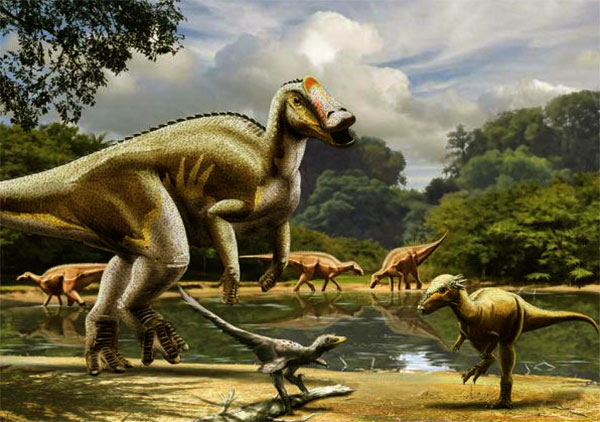
Young Maiasauras with mother
Most baby dinosaurs grew remarkably quickly - they had to, in order to escape predators. Fossil evidence from Maiasaura shows that hatchlings doubled in size in roughly six weeks, and a one-year-old was about 3 metres (10 feet) long. Studies of growth rings in T. rex bones show it gained as much as 2 kg (4.4 lb) per day during a teenage growth spurt, reaching its full 8-9 tonne adult size by around age 18-20. Most dinosaurs reached full size between 7 and 20 years old, depending on species - much faster than reptiles, but slower than birds.
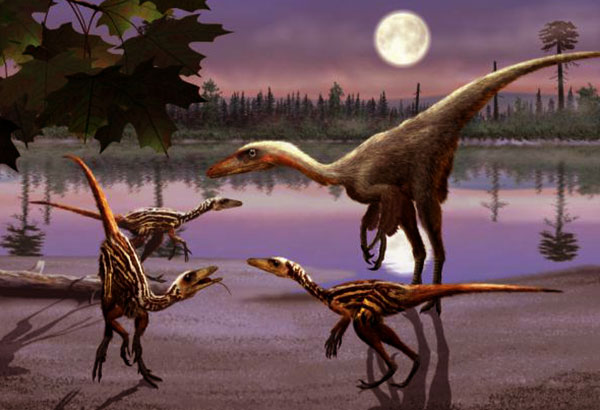
Troodon Babies