
When most people think of carnivorous dinosaurs, they picture a T. rex sinking its teeth into a Triceratops. But the meat-eating dinosaurs ate a far wider range of food than just other dinosaurs. Some were specialized fish-hunters with long, crocodile-like snouts and curved thumb claws. Others snatched up tiny mammals, lizards, and insects. A few - called omnivores - ate both meat and plants. Suchomimus, shown here, was a 11-metre fish-eating theropod from Cretaceous North Africa, whose name means "crocodile mimic." Its diet has been revealed by fossilized stomach contents, by the shape of its teeth and skull, and by the rich evidence preserved in coprolites (fossil droppings).
Some theropods evolved into highly specialized fish-hunters. Baryonyx, discovered in England in 1983, has a long, narrow, crocodile-like snout packed with conical teeth - perfect for snapping up slippery prey. Most strikingly, it had an enormous curved thumb claw about 30 cm (12 in) long, which palaeontologists believe it used to hook fish out of the water, much like a modern grizzly bear. The first Baryonyx skeleton was even found with the remains of a fish (Lepidotes) in its stomach - direct evidence of its diet. Its close relatives Suchomimus and Spinosaurus hunted in similar ways.
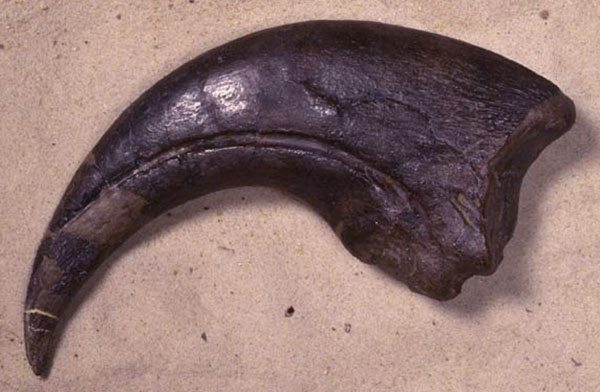
Baryonyx Claw
The fish-eating spinosaurids had skulls that looked far more like crocodile heads than typical theropod skulls. Their snouts were long and narrow, with about 60-100 pointed conical teeth (not blade-like serrated teeth) - ideal for gripping slippery prey rather than slicing flesh. Spinosaurus, the largest of them all at around 14-15 metres (46-49 feet) long, may have spent much of its time partly submerged in shallow water, snapping at fish with its long jaws. Recent fossil discoveries in Morocco have revealed it also had a paddle-like tail, suggesting it could swim - making it possibly the only known semi-aquatic dinosaur.
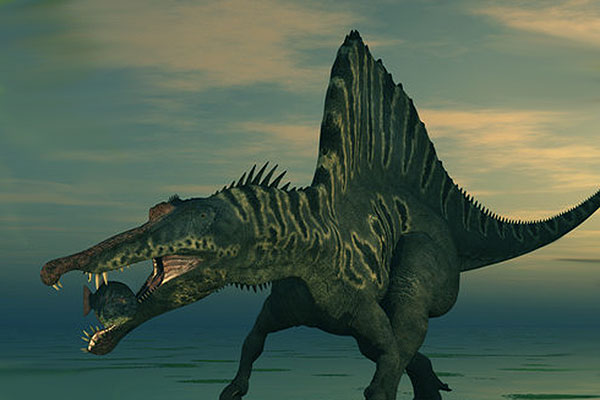
Spinosaurus fishing
Yes - small theropods like Syntarsus (now usually called Coelophysis rhodesiensis) and Compsognathus would happily snap up the tiny mammals that lived alongside the dinosaurs. One famous Mongolian fossil shows the dinosaur Repenomamus, a badger-sized early mammal, with the bones of a baby Psittacosaurus in its stomach - so the relationship sometimes went the other way too. Small theropods also ate lizards, snakes, frogs, insects, and the eggs of other dinosaurs. The shrew-like Megazostrodon, shown here, would have made a quick snack for many small Late Triassic predators.
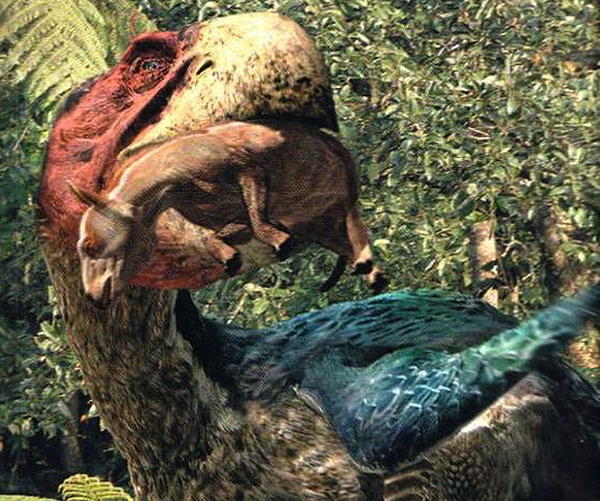
Syntarsus
Yes - several dinosaur groups appear to have been omnivorous, eating both plants and animals. The ornithomimosaurs ("bird mimics") like Gallimimus are the best-known example. With their toothless beaks, long necks, and ostrich-like bodies, they probably ate everything from leaves and seeds to lizards, eggs, and insects. The therizinosaurs, including the massive Therizinosaurus, may also have started as meat-eaters before switching to mostly plants. Oviraptor and Citipati, both feathered theropods with strong toothless beaks, were probably omnivores too - cracking open eggs, nuts, and shells as well as catching small prey.
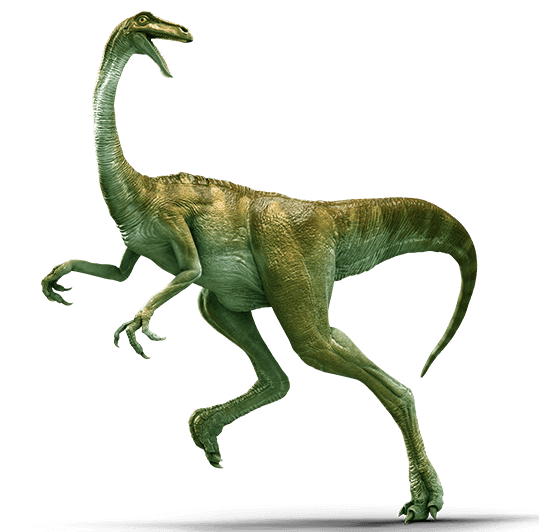
Gallimimus
Several lines of evidence reveal what dinosaurs ate. Tooth shape is the first clue: sharp serrated teeth mean meat, peg-like teeth mean plants, conical teeth mean fish. Stomach contents are sometimes preserved inside fossilized rib cages - the first Baryonyx, for example, had fish scales and bones inside. The richest source, however, is coprolites - fossilized droppings. A large carnivore coprolite from Saskatchewan, Canada (probably from T. rex) was packed with crushed bone fragments. Plant-eater coprolites contain leaf fibres, seeds, pollen, and sometimes even fungal spores. Modern techniques can even extract chemical isotopes from teeth to tell us what kinds of plants or animals a dinosaur ate.
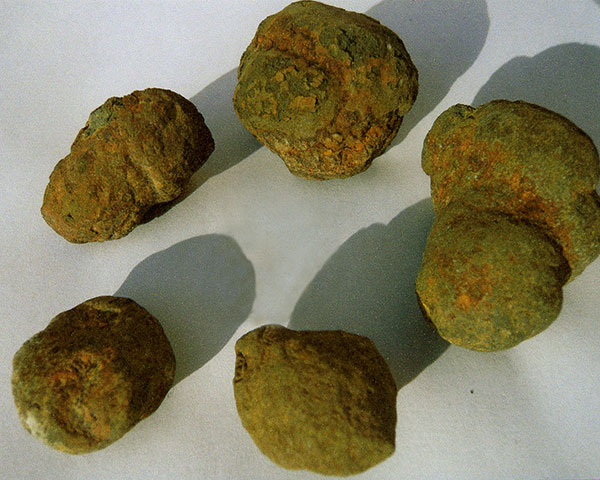
Coprolites (fossilized dinosaur droppings)