
No - dinosaurs were as varied as any group of animals alive today. Some were enormous, lumbering plant-eaters as big as buses. Others were long-necked giants taller than four-storey buildings. There were massive predators that nothing could challenge, and chicken-sized hunters that darted around their feet. Some had armour, some had frills, some had horns, and some had feathers. Chindesaurus, shown here, was a slender carnivore that lived during the Late Triassic Period, around 220 million years ago, in what is now Arizona. All the different dinosaurs, however, belonged to one of two main types - separated by a single feature: the shape of their hip bones.
Dinosaur fossils have been found on every continent, including Antarctica. When the first dinosaurs appeared in the Late Triassic, all the world's land was joined into one giant supercontinent called Pangaea, surrounded by a single great ocean called Panthalassa. Pangaea began breaking apart during the Jurassic, eventually forming the continents we know today. As the land split, different groups of dinosaurs became isolated and evolved in their own directions - which is why dinosaur faunas in Late Cretaceous North America look very different from those of South America or Asia.
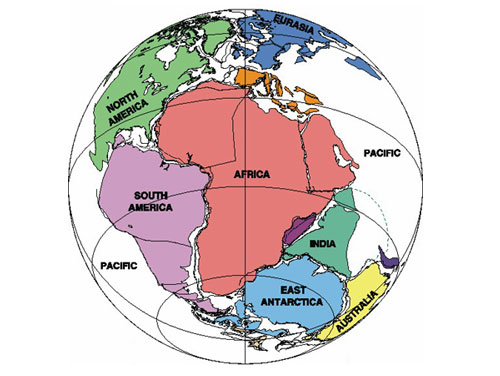
Pangaea
We can only estimate this from the fossil record, which gives us a biased snapshot of which animals happened to be preserved. By that measure, Protoceratops may have been one of the most abundant dinosaurs in Late Cretaceous Mongolia - so many of its skulls have been found in the Gobi Desert that it has been nicknamed the "sheep of the Gobi." In Late Cretaceous North America, mass burial sites of duck-billed hadrosaurs such as Edmontosaurus have been found containing tens of thousands of individuals, suggesting they roamed in vast herds.
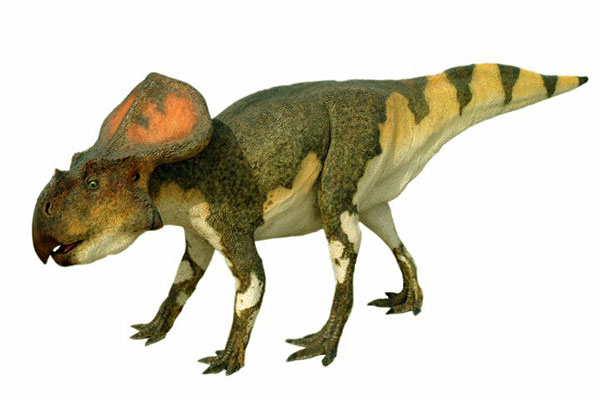
Protoceratops
Yes - mammals evolved at roughly the same time as the dinosaurs, around 225 million years ago. But for the entire Mesozoic Era, mammals lived in the shadow of the dinosaurs and almost all were small, often no bigger than a mouse or shrew. Eozostrodon, shown here, was an early mammal from the Late Triassic that probably hunted insects at night to avoid daytime predators. Only after the dinosaurs died out 66 million years ago did mammals finally diversify into the huge variety we see today - from bats and whales to elephants and humans.
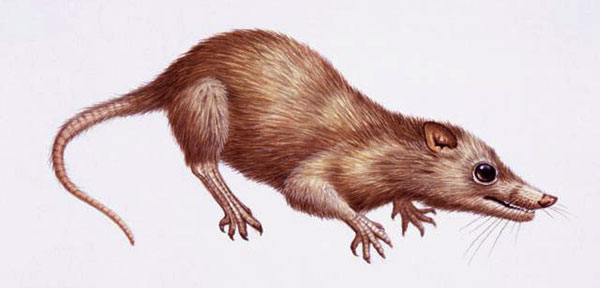
Eozostrodon
Therizinosaurus is a strong contender. Fossil hunts in 1940s and 1950s Mongolia turned up giant scythe-shaped claws nearly 1 metre (3.3 feet) long, attached to powerful arms. When the skeleton was eventually pieced together, it revealed a strange beast: a two-legged dinosaur up to 10 metres (33 feet) long, with a small head on a long neck, a pot-bellied body, and enormous claws on its hands. Despite its weapon-like claws, Therizinosaurus was actually a plant-eater - probably using the claws to pull foliage down or rip open termite mounds. Its name, meaning "scythe lizard," suits it perfectly.
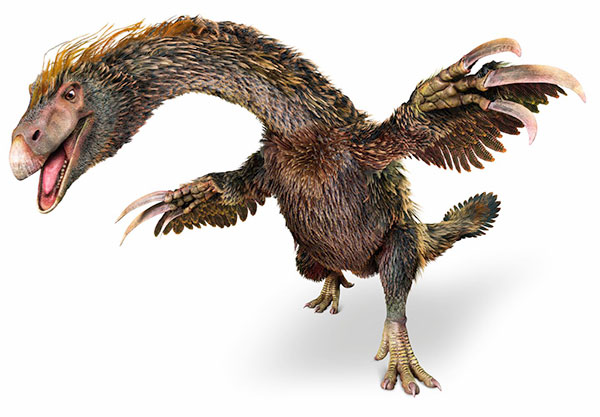
Therizinosaurus
Dinosaurs are traditionally divided into two great orders based on the arrangement of their hip bones. Saurischians ("lizard-hipped") include all the meat-eating theropods and the long-necked sauropods. Ornithischians ("bird-hipped") include the plated, horned, armoured, and duck-billed plant-eaters. Confusingly, modern birds evolved from saurischian theropods - not from the "bird-hipped" group whose name suggests otherwise. More than 1,500 distinct dinosaur species have now been named, although the total number that ever lived is estimated at around 1,500 to 2,500 known so far, with thousands more probably awaiting discovery.

Chindesaurus