
Dinosaurs were land-dwelling reptiles that lived during the Mesozoic Era, between roughly 252 and 66 million years ago. They had long tails, clawed hands and feet, and skin that was either scaly or, in some groups, covered in feathers. Some walked on two legs, others on four. Some were fearsome meat-eaters, while others quietly munched on plants. The word dinosaur means "terrible lizard," coined by the English scientist Sir Richard Owen in 1842. Experts believe dinosaurs out-competed their rivals thanks to their upright stance, their range of body sizes (from chicken-sized to longer than a tennis court), and their highly efficient weapons of attack and defence. Giganotosaurus, shown here, was one of the largest meat-eaters that ever lived.
Dinosaurs differed from other reptiles in one crucial way: their legs grew straight down from their bodies, just like the legs of mammals. Most reptiles, such as lizards and crocodiles, have legs that splay out sideways, giving them a sprawling, low-slung walk. Dinosaurs, by contrast, could stand tall and walk efficiently with their limbs directly beneath their bodies. This upright posture meant they could breathe and run at the same time, support more body weight, and cover ground far more quickly than sprawling reptiles - a key reason they came to dominate life on land.
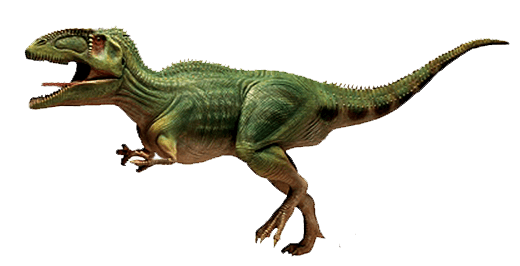
Giganotosaurus
Eoraptor is one of the earliest known dinosaurs. Its remains were discovered in 1991 in Argentina, in the Valley of the Moon, by the palaeontologist Paul Sereno. Eoraptor was a small, lightly built creature - only about 1 metre (3.3 feet) long - and lived around 231 million years ago, during the Late Triassic Period. South America is thought to be one of the places where dinosaurs first appeared, although Herrerasaurus, found in the same region, is also considered one of the earliest dinosaurs.
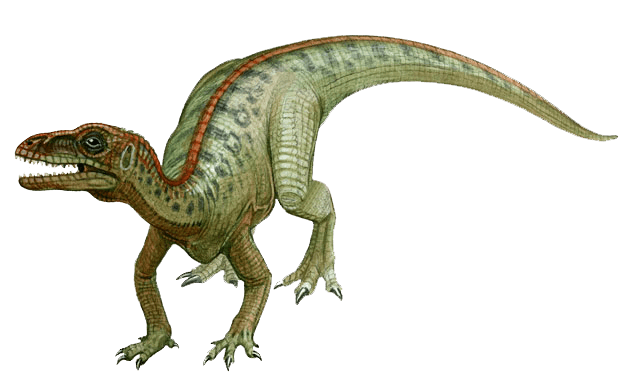
Eoraptor
Yes - every dinosaur had clawed hands or feet. Their claws came in many shapes and sizes, each suited to a particular lifestyle. Some, like those of Velociraptor, were curved like a hawk's talons and used for slashing prey. Others, such as the giant scythe-like claws of Therizinosaurus, may have been used for pulling down high branches or ripping into termite mounds. The wide, three-toed feet of the giant sauropods ended in flat, hoof-like claws that simply protected the toes from the immense weight above them. Many predators also had a single oversized claw on the second toe - a signature weapon of the dromaeosaurs.
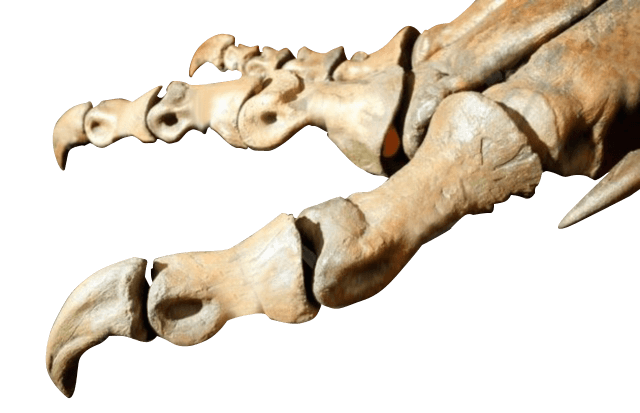
Bones of a dinosaur's foot
Strictly speaking, no - dinosaurs were land animals. The flying reptiles you may have seen in books and films were pterosaurs, a separate group whose name means "winged lizard." Pterosaurs lived alongside the dinosaurs for the entire Mesozoic Era. They ranged from the size of a sparrow to Quetzalcoatlus, which had a wingspan of around 10-11 metres (33-36 feet), making it the largest flying animal ever known. Rhamphorhynchus, shown here, was a long-tailed pterosaur about 1 metre (3.3 feet) long that snapped up fish from prehistoric seas using its narrow jaw and forward-pointing teeth.

Rhamphorhynchus
This is one of the great debates in palaeontology, and the answer has shifted over the decades. Modern reptiles such as snakes are cold-blooded, meaning their body temperature rises and falls with the surroundings. But evidence from fossilized bone tissue, the discovery of feathers on dinosaurs like Velociraptor and Yutyrannus, and the fact that birds (the living descendants of dinosaurs) are warm-blooded all suggest that many dinosaurs were warm-blooded too. Some experts now think most dinosaurs may have been mesothermic - somewhere between fully warm-blooded and fully cold-blooded - giving them the energy to stay active in many climates.
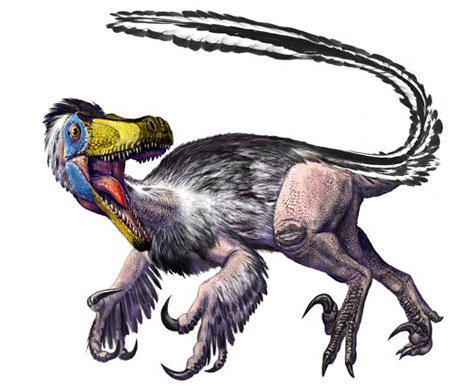
Velociraptor