
Stamp collection, also called philately, is a hobby enjoyed by many. Stamp collectors relish their hobby, and they actively seek out new and unusual stamps to add to their stamp collecting albums. If your are already feeling interested and before you get going and before you decide what to collect, it may be helpful to understand what kinds of stamps there are and how they are classified.
The Classification of stamps include:
·Stamp Types -- commemorative, definitive, and special
·Purpose -- regular, special delivery, postage due and airmail
·Formats -- sheet, coil and booklet
·Condition -- used, unused, or mint
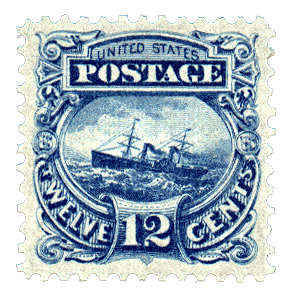
The terms "definitive" and "commemorative" are commonly used to define specific types of stamps, and for many years these terms seemed very clear. But lately some definitives and commemoratives have become harder to distinguish. While the general guidelines for distinguishing definitives and commemoratives are still useful, exceptions to these guidelines have become more common.
Definitive:- The world of stamps began with a definitive issue, Great Britain's "Penny Black" on May 6, 1840. The first U.S. stamps issued in 1847 were also definitives depicting George Washington and Benjamin Franklin. Initially all stamps were definitives picturing people -- royalty for most stamps from British Commonwealth countries and dead presidents and other famous people for the United States. In fact, it was 22 years before a U.S. postage stamp showed anything other than a portrait of George Washington, Benjamin Franklin, Abraham Lincoln, or Andrew Jackson. Today, many definitives still depict people although recently the U.S. flag and the White House have also been used. Definitives are generally described as small in size, plain in design and can be issued at the first-class rate or in different denominations to pay for different rates or to be used as makeup postage for when the rates go up. They are printed in large quantities and remain on sale for an indefinite period of time, usually until the first-class rate changes. Typically, when the supply of one of these stamps run out, more are printed, and if the printing plates wear out, new plates are created.
Commemorative:- It was only in the late 1800’s that the citizens began to question the post office to honor historical events. The first U.S. stamps issued to specifically commemorate history were issued in 1893 -- the Columbian Exposition issues -- to celebrate Christopher Columbus' discovery of the New World. Since then many stamps have been issued to commemorate statehood anniversaries, organizations, and promote causes. Commemoratives are usually printed in much smaller quantities, compared to billions of definitives. Once the initial printing of these commemorative stamps is all sold, they are not usually reprinted. Commemoratives are usually about twice the size of most definitives, and almost always pay the standard first class rate. They may show a person but when they do they are normally issued on the anniversary of their birth.
Special:- In recent years some collectors have defined a third type of stamp, which have in them characteristics of both definitives and commemoratives. These are known as Special. For the U.S. almost all of these are Love or Christmas stamps. Most often these stamps are larger in size like commemoratives. They also are issued for the common rates. Whenever the supply runs low they may be reprinted and they may remain on sale for longer periods of time.
The purpose for which the stamp was issued offers yet another way of classification. Most stamps are called "regulars" because they are intended for use on regular mail. However, very shortly after the first issuance of postage stamps, postage due stamps were printed to show the collection of money when insufficient postage was applied to a letter. U.S. postage stamps for Special Delivery service also were issued in the 1800's. Beginning in 1918 the United States issued stamps for airmail service. Stamps also have been issued for a number of other special services, including Registration and Parcel Post.
Another aspect on the basis of which stamps can be classified is the format in which they are issued. Originally almost all stamps were issued in sheets (or panes) of stamps. However, in the 1900's two other formats have become popular: coils and booklets. Coil stamps are issued in rolls for use in dispensers, as well as affixing and vending machines. Each coil stamp has two straight edges and two edges with either slit like cuts or little holes, called perforations. Booklets are convenient for customers as the stamps can be more easily kept in a wallet or purse.
A stamp that has not been used and is still in the same condition as when issued by the Postal Service is called mint. If a stamp has not been used but has been affixed to an album with a hinge, the gum has been disturbed so it is no longer in mint condition and is called unused. A stamp that has served its purpose of paying for the delivery of a letter, normally as evidenced by a postmark or cancellation is called used.
Stamps can also be divided based upon whether they have perforations. The type of printing or whether they have a watermark also can classify stamps. Now that you have been enlightened on the characteristics of stamps, its time to decide the type of the collection you want to begin with.
Stamp collection is pretty easy. You can save stamps from packages, letters and postcards. You can also ask your friends and family to save stamps from their mail for you. Start swapping stamps when you have doubles. You may also collect stamped envelopes from neighborhood businesses that get a lot of mail like stores, banks and travel agencies - might save their envelopes for you, too. Or, you can start your collection by choosing one or two favorite subjects and then, collect only stamps that fit your theme, which can range from art, history and sports to transportation or science. This is called topical collecting.
There are certain equipment that you may find helpful if you are really serious about taking up stamp collection as your hobby.
The worth of a particular stamp depends upon two aspects-it’s rarity and the condition it is in. The price listed in a stamp catalog gives you some idea of how rare it is. However, the stamp may sell at more or less than the catalog price, depending on its condition. Always go for the stamps, which are in the best possible condition. You can begin to judge the condition of a stamp by examining it’s front. Is the stamp clean, dirty or stained? Are the colors bright or faded? Is the stamp torn? Torn stamps are not considered "collectible." Is the stamp design centered on the paper, crooked or off to one side? Are all the perforations intact? Has the stamp been canceled? A stamp with a light cancellation is in better condition than one with heavy marks across it. Now look at the back of the stamp and see whether there is a thin spot in the paper? If so, it may have been caused by careless removal from an envelope or hinge.
Stamp collecting is a joyous pastime that offers the philatelist a chance to learn a little bit about art, history, and foreign places. Commemorative stamps are interesting in that they depict a moment, event, or significant person in history that is worthy of having a stamp made in their honor.
There are also collectible stamps that you can purchase and hang on to, hoping that over time they will continue to rise in value. Most people who collect stamps do so for the sheer fun of it, without putting too much thought into making a profit. Hobbyists who collect stamps love to learn about the stories behind their stamps, as well as explore the world behind the production of stamps. Every time you collect an old stamp, you will likely be curious enough about its origins and would definitely be interested in reading up the history of that stamp. Collecting stamps introduces history into your world, as you cannot help but wonder who was the first person to use the stamps in your collection.
 Father's Day
 Craft Ideas for Kids
 Benefits of Yoga for Kids
 Stories for Kids
 School Projects & Homework Help
 Hobbies
