

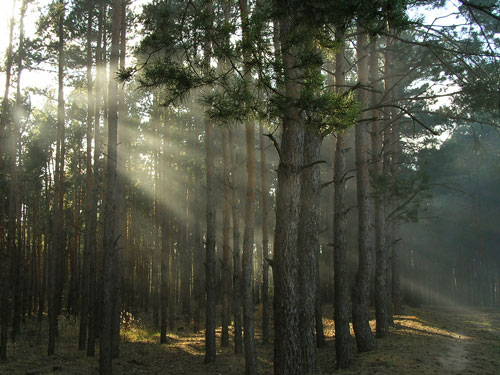
The broadleaved woodlands lie south of the coniferous belt and is a habitat for a wider variety of animals. Woodlice and millipedes munch the damp rotting wood of fallen branches. These offer nice homes for damp-loving snails, slugs and armies of insects. Up above on the trees are the roaming ground for the sawflies, aphids, mice, voles and birds. These branches are, however, not enough for the restless gray squirrels, one of the tiniest mammals of this region. On the ground hedgehogs, badgers browse happily. Larger mammals include white tailed, red, roe or fallow deer. In Europe wild boar grub for roots and fungi.
The predators include both the small and large mammals. Shrews munch worms and insects. Skunks, foxes and opossums eat a mixed diet of plant and animal foods. Weasels scamper after voles and mice.
These are common in rainy mountaintops of China, southern Japan and in parts of mountainous central Africa. Bamboo shoots form the favorite food of some animals found only in their dripping thickets. None is more famous than the giant panda, a scarce, bear-like beast that lives on remote mountainsides of south-western China. Colonies of rare golden monkeys share the panda's home and taste in food. Farther east, Japanese macaques also range high up in mountain forests.
In the gum tree forests of Australia bushes thickly coat the wet, lowland forest populated by the thick skinned eucalyptus trees. Small creatures of the forest floor include scorpions and the funnel-web spider, whose bite can kill an insect - or, even a man.
As against the familiar placental animals in other parts of the world marsupial animals are more common here. Kangaroos take the place of deer, phalanges play the part of squirrels. The bear like koalas browse on the gum tree leaves. A female koala gives birth to a single baby shorter than a man's thumb. For 6 months it lives and grows in its mother's pouch, and spends the next half year clinging to her back.
Wombats live like badgers living on vegetarian dishes. Marsupial mice and rat-like bandicoots eat plants and small creatures. The echidnas replace the common hedgehogs seen elsewhere.
Nowhere life is so plentiful and colorful as in the tropical rain forests of South America, Africa, and South East Asia. The low lands always receive heat and rain. Depending on the layers comprising the tropical forest the animal life keeps on thriving. Each layer has its own community.
The forest floor of an African rain forest is home to wild boar, antelopes and a range of hunting and herbivorous mammals. Also come in plenty snakes, termites, spiders and worms. Leopards and other wild cats, apes and tree frogs range through the shrubs and trees.
The entire green canopy is home and playground for the monkeys and many gaily colored birds.
The treetops are the nesting sites for the birds of prey.
Snakes include mighty, trunk like boas or pythons, slim, twig like tree snakes and common vipers on the ground. Python lie on branches waiting for unwary animals to come in range. It first brings the prey in its coil and then devours it up gradually. Snakes like this are also found in the Amazonian rain forest of South America. Called anaconda they can spend much time in water. These python like snakes may be even longer than their African counterparts and are more agile in attacking the prey.
In South East Asian forests live flying dragons, the lizards with skin flap 'parachutes' that help them glide from tree to tree. Komodo dragons are the largest of all lizards survive only in the forests of tiny Indonesian islands. They are equipped with fierce hook like claws and a very long sticky forked tongue and a highly venomous saliva to kill the preys.
The forest's moisture loving animals include the giant flatworms. They glide across damp soil blanketed with leaves, where leeches cling in wait for passing animals. South America's bird-eating spider and Hercules beetle are among the largest creatures of their kind.
Stick insects, crickets, bugs and mantis with weird shapes or colors are some of the insects camouflaged among the foliage.
The mammals of the dense tropical forest include the Indian elephant, rhinos,
African okapi, antelopes and capybara, the giant rodent of South America. The boar like tapirs also inhabit the Amazonian rain forest.
The hunting carnivorous include the mighty and ferocious Asian tigers with the Royal Bengal, the largest species roaming in the coastal jungle bordering India and Bangladesh.
The spotted and black jaguars are the big cats haunting the floors of Amazon forests.
The more moist swampy lands and marshes in Africa are the happy play ground for hippopotamus.
These huge amphibian mammals doze the day away buoyed up and kept cool by the water of a shallow lake of river. These are really veggies and emerge on land at night for gathering food.
The marshlands and the swamps are also the happy hunting ground for the mighty thick skin saw teethed crocodiles.
Rhinoceros too love these swampy places filled with stalky reeds and grasses. They are found in Africa, India as well as in the South Eastern forests.
Water buffaloes also frolic in these waterholes.
Up above is the home for another community. Grasping hands and feet, and eyes set forward on the head to help judge distance make monkey superb acrobats among the tree living animals. Also called primates because of the similarities they bear with human, Africa's chimpanzee and South Asia's orangutan and gibbon are also splendid climbers. So too are the small mammals such as the South Asian tarsiers, tree shrews and flying lemurs or colugos.
Try out the other sections
 Father's Day
 Craft Ideas for Kids
 Benefits of Yoga for Kids
 Stories for Kids
 School Projects & Homework Help
 Hobbies
