

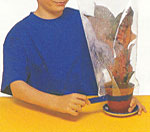
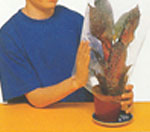
All plants need water to live. They do not take in food as animals do, but make their own using water from the ground, and carbon dioxide gas from the air. Water is absorbed through a plant's roots. It travels up through the stem or trunk into the leaves, shoots, and flowers. The water also carries the nutrients from the soil to all parts of the plant. In the leaves, nutrients and water are used for photosynthesis, the process of making energy from light. Excess water not needed by the plant evaporates back into air in the form of water vapor in a process called transpiration. You can see how much water vapor is transpired by a plant in the first experiment.
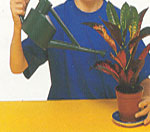
EVAPORATION IN ACTION
You will need :
1) House plant
2) Watering can
3) Clear plastic bag
4) Tape
5) Scissors
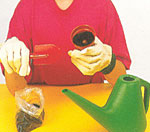
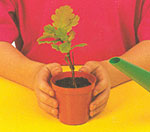
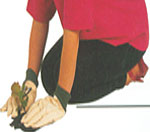
When a seed begins to grow, we say that it is has germinated. Germination occurs when conditions are warm and moist enough for the seed to swell and split its skin. A tiny root grows downward, and a thin shoot pushes upward toward the light. The second project shows you how to germinate a seed and help it grow into a tree. Germinating a seed this way takes about two months.
GERMINATE AN ACORN
You will need :
1) 4in (diameter) flower pot
2) Soil mix
3) Gloves
4) Acorns or another tree's seeds
5) Trowel
6) Watering can
CONVERTING ENERGY :
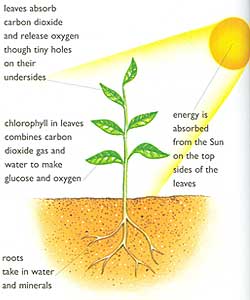
Photosynthesis is the process through which plants use the water in the ground and the energy in sunlight to make their food. Leaves take in carbon dioxide and water to make oxygen and glucose (sugar). Glucose flows to all parts of the plant, supplying energy for growth. Oxygen gas escapes through the holes on the underside of the leaves. The oxygen is released back into the air. We need oxygen to breathe.
SURVIVAL IN THE WETLANDS :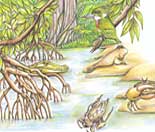 Swamps are places where the ground is permanently waterlogged, such as in muddy river estuaries. Most trees cannot survive in swamps, because they need fresh water and air around their roots. Some types of mangroves have breathing roots that grow upward, so that their tips are above the surface of the water. Mangrove swamps are home to kingfishers, giant water bugs, crabs, turtles, crocodiles, and mudskippers, a type of fish that spends much of its time out of water.
FLOATING WATER : Trees pass millions of gallons of water vapor into the water each day. The vapor forms thick clouds of tiny water droplets over the forest.
Try out the other sections
 Father's Day
 Craft Ideas for Kids
 Benefits of Yoga for Kids
 Stories for Kids
 School Projects & Homework Help
 Hobbies
