Rocks and minerals are the naturally occuring materials that make up planet Earth. Rocks are used for buildings, and many minerals are prized as jewels. Most people think of rocks as hard and heavy, but soft materials, such as sand , chalk and clay, are also considered to be rocks. Different rocks are made up from mixtures of different minerals. The minerals inside a rock form small crystals that are lock together to from a hard solid.
Geologists (scientists who study the earth and its rocks) use many different methods to identify minerals that make up rocks. These experiments will help you to discover which minerals are in a rock sample. You can also indentify rocks with a magnifying glass or from their hardless.
The acid test demontrates if a gas given off by the minerals. The second experiment is used to discover a rock sample’s specofic gravity. It comparesa mineral’s density to the density measure how compact the particles are that make up a sample. Every minerals has a different density, which means that samples of the same mineral will have the same density.
Acid test
You will need:
Vinegar, bowl, spoon, samples of different stones, magnifying glass, reference book.
Insects to watch
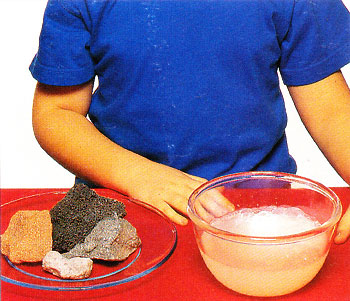
1. Pour some vinegar into a bowl. Drop rcok samples into the vinegar. If gas bubbles form, then the rock contains minerals called carbonates (such as calcite).
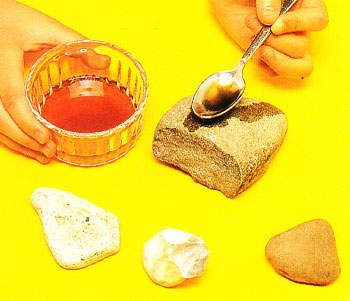
2. Alternatively , you can put a few drops of vinegar on each rock sample. Watch them carefully for clues to what they might be . Chalk marble and limestone make vinegar fizz.
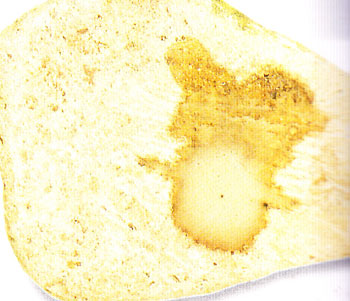
3. Limestone reacts with vinegar. Like chalk and marble, it reacys because it is a type of calcium carbonate. Common rocks such as flint,granite,and sandstone are unaffected.
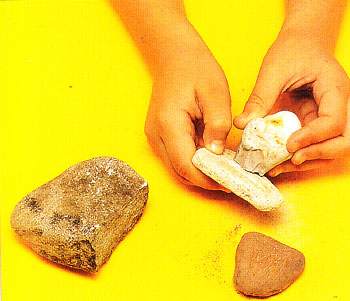
4. Now scratch one sample with another. Harder rocks leave marks on softer ones. Hardness also helps you to identify rocks . think how difficult it might be to crave the harder ones.
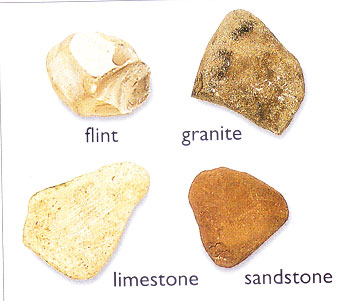
5. Arrange your rocks in order of hardness. Igneous rocks, such as granite, are usually the hardest. Sedimentary rocks, such as sandstone, are usually the softest.
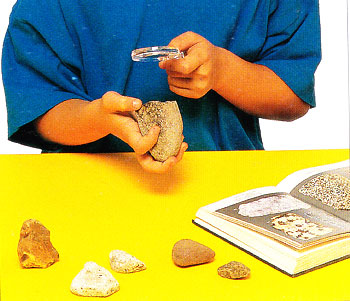
6. Use a lens to examine your rocks. There are sharp crystal minerals in igneous rocks. Metamorphic rocks have layers and tiny bits in them.
Density or specific gravity test
You will need:
Mineral or rock samples, accurate food scales, notebook , pen or pencil , measuring cup, water.
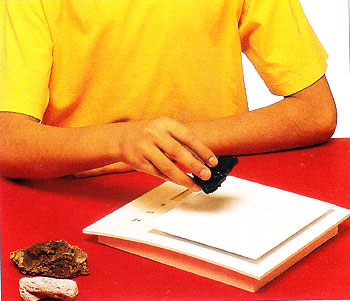
1. Choose a rock or mineral sample, and weigh it as accurately as you can to find its mass. The figure should be in ounces. Make a note of the mass in your notebook.
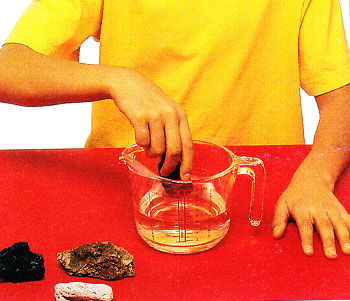
2. Fill a clear measuring cup to the 8fl oz mark with water. Choose your first rock or mineral sample and carefully place it in the water.
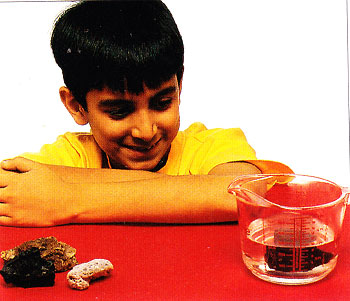
3. Look at the scale on the cup to read the new water level. Make a note of the level of the water in your notebook. Now subtract 8fl oz from that figure.

4. The new figure is the sample’s volume in fuild ounces. Now divide the mass by the volume. You can use a calculator to do this equation if you wish. This will give you the rock sample’s density, or specific gravity.
Back to School Projects Main



 Mother's Day
 Craft Ideas for Kids
 Rhymes & Poems
 Benefits of Yoga for Kids
 Stories for Kids
 School Projects & Homework Help