Soil is formed from decayed vegetable matter (dead leaves and plants), mineral grains, and larger pieces of rock. Creatures, such as earthworms, help the decomposition process by mixing the soil. The process by which rocks are often broken down into smaller pieces is called weathering . Chemical weathering occurs when minerals are dissolved by water. Some minerals break down or dissolve quickly. Others, such as quartz, are not dissolved but stay behind in the soil as stones. The action of burrowing animals, animals, insects, and growing plants is called physical weathering. Attrition (grinding down) is another kind of physical weathering and it occurs when wind-blown particles rub against each other. This kind of weathering occurs mainly in dry areas, such as deserts. You can see how attrition works simply by shaking some sugar cubes together in a glass jar.
ON THE HORIZON
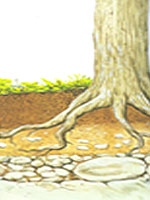
Soil occurs in layers, called horizons. There are four main horizons. The top horizon (also known as topsoil) is a layer of fine particles that supports the roots of plants and trees. The next two layers, beneath the topsoil, have larger soil particles. The bottom layer is partly solid rock.
WORMERY
You need :
1) Large and small plastic bottles.
2) Scissors
3) Funnel
4) Gloves
5) Damp soil
6) Sand
7) Six worms
8) Rotting leaves
9) Black paper
10) Sticky tape
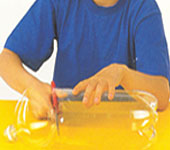 Step 1
Cut the top off the large, clear plastic bottle, as shown. Place the smaller bottle inside the larger one. Make sure the gap is evenly spaced all the way around the smaller bottle.
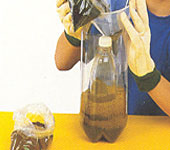 Step 2
Fill the gap with layers of soil and sand to the top. Press the soil down lightly. Gently place the worms on top of the soil, and cover them with rotting leaves.
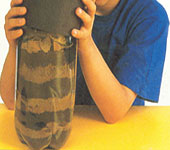 Step 3
Cover the sides with black paper. Keep the soil moist. After a few days, remove the paper to see how the worms have tunneled away and dragged leaves into their burrows.
WHAT IS IN SOIL?
You will need :
1) Gloves
2)Trowel
3) Soil
4) Sieve
5) Paper
6) Magnifying glass
7) Notebook, pen.
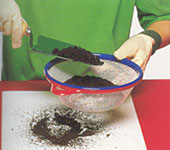 Step 1
Put on a pair of gardening gloves and place a trowel full of soil into the sieve. Shake the sieve over a piece of paper for about a minute or so.
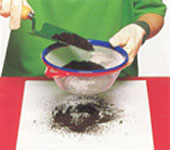 Step 2
Tap the side of the sieve gently, to help separate the different parts of the soil. Are there chunks that will not go through the sieve? Can you see if any of the chunks are rock?
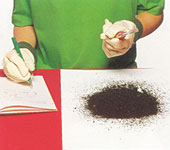 Step 3
Use a magnifying glass to examine the soil particles that fall onto the paper. Are there any small creatures or mineral grains? Make a note of what you see in your notebook.
BIG OR SMALL?
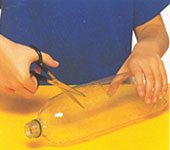 Step 1
Use a pair of scissors to cut the top off a large, clear plastic bottle. Ask an adult to help, if you need to. You can throw away the top part of the bottle.
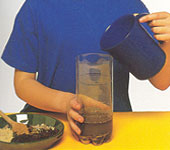 Step 2
Use a spoon to scoop some gravel, earth, and sand into the bottom of the bottle. Add water to the mixture, until it nearly reaches to the top of the bottle.
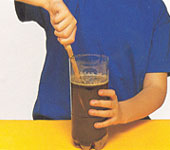 Step 3
Stir vigorously to mix the stones, earth, and sand with the water. In a river, soil and rock particles are mixed together and carried along by the moving water.
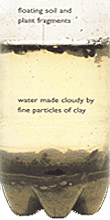 Step 4
Leave the mixture to settle. You should find that the particles settle into different layers, with the heaviest particles at the bottom, and the lightest at the top.
Back to School Projects Main


 Father's Day
 Craft Ideas for Kids
 Benefits of Yoga for Kids
 Stories for Kids
 School Projects & Homework Help
 Hobbies
