
By: Ruth Sawyer
ALL night long the snow fell, and when David wakened the hilltop was whiter than ever, if such a thing could be. The tiny prints in the snow that had marked the trail of the locked-out fairy were gone.
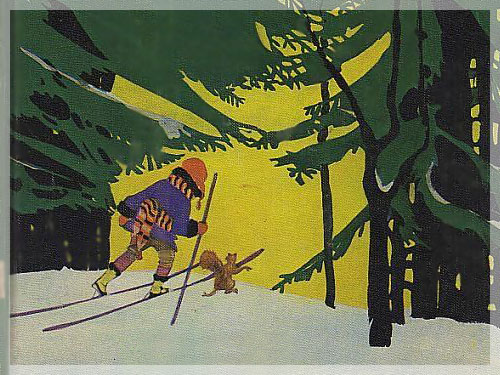
For a moment David wondered if he could have dreamed it all, and then he knew it could not be just a dream. It must be something more, to bring such good Christmas news that lasted all through the night and wakened him with a song in his heart and a gladness that a new day had come. And what a day it was! An orange sun was breaking the gray of the dawn; he could hear the soft push and pound of Barney's shovel clearing a pathway from the door to the road, and he knew he could be off early on his skees, down the hill to - where he did not know. But the fairy had promised that if he should start out seeking the way to Christmas he would help him.
He dressed quickly to the swinging rhythm of the reel Johanna was lilting in the kitchen below; for in a little lodge bedroom on a hilltop, with the thermometer outside many degrees below zero, one does not dally in putting on one's clothes. He came down to breakfast for the first time since he had left the old home without having to pretend anything in the way of feelings; and he found beside his plate a letter from father.
"Barney, the rascal, brought it back with him yesterday and carried it about in his pocket all evening, never thinking of it once," Johanna explained, shaking her fist at that guilty person just coming in.
"Sure, the two of us were that busy entertaining fairies last night we hadn't mind enough for anything else." And Barney winked at David knowingly.
David responded absent-mindedly. His thoughts and fingers were too busy with the letter to pay much attention to anything else. Father had little time for boys, as we have already said, but when he did take time the results were unquestionably satisfactory; the letter proved this. It was a wonderful letter, full of all the most interesting seeings and doings just the things a boy loves to hear about and yet it was written as any grown-up would write to another. That was one fine thing about father. When he did have time for boys he never looked down upon them as small people with little wisdom and less understanding; he always treated them as equals. But it was what came at the very last of the letter that brought the joyful smile to David's lips.
Johanna and Barney saw it and smiled to each other.
"Good news, laddy?" Johanna asked.
"There's nothing about coming home, but there's something about Christmas." David consulted the letter again. "Father says he's been looking around for some time for just the right present to send for Christmas, and he's just found it. He thinks I'll like it about the best of anything, and it ought to get here - unless the steamers are awfully delayed on Christmas Day."
"That's grand!" Barney beamed his own delight over the news. "What do ye think it might be, now?"
David shook his head.
"I don't know don't believe I could even guess. You see, father never bought me a Christmas present before - he always left mother to choose. He said she knew more about such things than he did."
"Then ye can take my word for it, if it's the first one he's ever got ye 'twill be the best ye ever had." Barney spoke with conviction, while Johanna leaned over David's chair and put a loving arm about his shoulder.
"There's some virtue in losing them ye love for a bit, after all, if it makes one o' them think about ye and Christmas. Sure, there's nothing better in life to put by in your memory than rare thoughts and fine letters. And, I'm mortal glad, myself, there's something good coming to ye, laddy, from over yonder, for many's the time Barney and I have been afeared 'twas a lonesome Christmas ye'd be finding up here."
And to the great surprise of every one, David included, David answered cheerfully:
"I don't believe it's half bad. Maybe there's more Christmas round than we know."
The orange sun had paled to yellow and climbed half the length of the tallest pine from the crest of the hill when David, bundled and furred, adjusted his skees outside the lodge door. Carefully he pushed his way over the level stretch of new snow, for one never knew with new snow just how far one might go down before striking the crust of the old. A few yards beyond the nearest clump of evergreen he stopped. From this point the mountain sloped down on three sides; the fourth carried over the ridge to the neighboring hill. Here David could look down on the encircling valley; and though the snow lay unbroken everywhere save on the road leading straight down to the "crossing" and the village beyond, he could almost vision paths branching out from where he stood and leading down to the three inhabited dwellings on the mountain's side.
Which way should he go? Where would he first strike his trail for Christmas? Would he follow the road or one of the invisible paths? He asked this silently at first, and then aloud, as if there might be some one near by to hear; and the answer came in the form of a little gray furry coat, a pair of alert ears and a long, bushy tail. Yes, David knew in a twinkling it was the locked-out fairy, come to keep his promise. He did not come close enough for David to see the round, roguish face under the squirrel cap; but he sat up and twitched his head in the direction of the road as if he were saying:
"Come along, David, ye couldn't be wishing for a braver day to go Christmas-hunting. Have ye fetched along your holiday fowling piece and your ammunition? For 'tis rare sport, I promise ye, a hundred times better than hunting your furred or feathered brothers. Come along!" And away he hopped down the road toward the crossing.
David followed, as you or I would, and never stopped till the fairy led him straight to the flagman's hut and disappeared himself behind the drifts beyond the track. Without a moment's hesitation David turned the knob of the door and walked in.
The hut was a small one-room affair, bare, but clean. The walls were whitewashed and held an array of flags and lanterns, maps and time-tables. An air-tight stove glowed red at one end of the room, and beside it, with his feet on the hob, tilted back in his chair, sat the flagman puffing away at an old meerschaum pipe. He was plainly surprised to see his visitor. His feet came back to the floor with a bang, his pipe came out of his mouth, and he stared at David incredulously for a full minute. Then the ends of his grizzled mustache bristled upward, his mouth opened and twisted the same way, while his eyes seemed to drop downward to meet it, all the time growing bluer and more friendly. David took the whole effect to be a smile of welcome and he responded with out-stretched mittened hand.
"Good morning, sir. it's a grand day!"
The knotted fist of the flagman accepted the mitten and shook it warmly.
"Vell it ees the knabelein from the hilltop come to see old Fritz Grossman. A child again it ees goot!"
He reached for a little stool, the only other piece of furniture in the room, and pushed it toward David.
"Come take off the greatcoat and seet down. It ees long since old Fritz has had a child to see him. In summer they come sometime from the big hotel, and from the veelage they used to many come. But now ach! Now, since the war, eet ees deefferent. Now I am the enemy the German and here every one hate the German!"
David felt about for something to say and repeated something he had once remarked: "War makes enemies."
"Ach, ja. But here there ees no war. Here we should all be Americans, and not hate peebles for the country where they were born. Gott in Himmel, can there not be one country kept clean of the hate!"
The blue eyes suddenly grew wet, and he blinked them hard and fast to keep the wetness from spilling over into disgraceful tears.
"Tsa! Old Fritz grow more old woman every day! I not mind but for the children not coming; and this time here and no little tongues to beg tales of the Krist Kindlein and the Weihnachtsman from old Fritz."
David drew closer and laid a friendly hand on the flagman's knee.
"I'd like to hear one - I'd like bully well to hear one!"
The flagman croaked gleefully deep down in his throat.
"Zo - but first I know the knabelein has a stomach got. All have."
He rose stiffly and reached back of the stove to where hung his own great bear-coat. From the pocket he brought out a large red apple and handed it to David.
"There, eat. And you shall hear the tale of anodder apple, a Chreestmas apple."
The flagman tilted back in his chair again and replaced his feet upon the hob. David sat with elbows on knees and ate slowly. There was no sound but the occasional dropping of coals in the stove and the soft, deep guttural of the flagman's voice. And here is the story as he told it to David - only the broken German accent and the dropping coals are missing.
Once on a time there lived in Germany a little clock-maker by the name of Hermann Joseph. He lived in one little room, with a bench for his work, and a chest for his wood, and his tools, and a cupboard for dishes, and a trundle-bed under the bench. Besides these there was a stool, and that was all - excepting the clocks. There were hundreds of clocks: little and big, carved and plain, some with wooden faces and some with porcelain ones - shelf clocks, cuckoo clocks, clocks with chimes and clocks without; and they all hung on the walls, covering them quite up. In front of his one little window there was a little shelf, and on this Hermann put all his best clocks to show the passers-by. Often they would stop and look and some one would cry:
"See, Hermann Joseph has made a new clock. It is finer than any of the rest!"
Then if it happened that anybody was wanting a clock he would come in and buy it.
I said Hermann was a little clock-maker. That was because his back was bent and his legs were crooked, which made him very short and funny to look at. But there was no kinder face than his in all the city, and the children loved him. Whenever a toy was broken or a doll had lost an arm or a leg or an eye its careless mtterchen would carry it straight to Hermann's little shop.
"The kindlein needs mending," she would say. "Canst thou do it now for me?"
And whatever work Hermann was doing he would always put it aside to mend the broken toy or doll, and never a pfennig would he take for the mending.
"Go spend it for sweetmeats, or, better still, put it by till Christmas-time. 'Twill get thee some happiness then, maybe," he would always say.
Now it was the custom in that long ago for those who lived in the city to bring gifts to the great cathedral on Christmas and lay them before the Holy Mother and Child. People saved all through the year that they might have something wonderful to bring on that day; and there was a saying among them that when a gift was brought that pleased the Christ-child more than any other He would reach down from Mary's arms and take it. This was but a saying, of course. The old Herr Graff, the oldest man in the city, could not remember that it had ever really happened; and many there were who laughed at the very idea. But children often talked about it, and the poets made beautiful verses about it; and often when a rich gift was placed beside the altar the watchers would whisper among themselves, "Perhaps now we shall see the miracle."
Those who had no gifts to bring went to the cathedral just the same on Christmas Eve to see the gifts of the others and hear the carols and watch the burning of the waxen tapers. The little clock-maker was one of these. Often he was stopped and some one would ask, "How happens it that you never bring a gift?" Once the bishop himself questioned him: "Poorer than thou have brought offerings to the Child. Where is thy gift?"
Then it was that Hermann had answered: "Wait; some day you shall see. I, too, shall bring a gift some day."
The truth of it was that the little clock-maker was so busy giving away all the year that there was never anything left at Christmas-time. But he had a wonderful idea on which he was working every minute that he could spare time from his clocks. It had taken him years and years; no one knew anything about it but Trude, his neighbor's child, and Trude had grown from a baby into a little house-mother, and still the gift was not finished.
It was to be a clock, the most wonderful and beautiful clock ever made; and every part of it had been fashioned with loving care. The case, the works, the weights, the hands, and the face, all had taken years of labor. He had spent years carving the case and hands, years perfecting the works; and now Hermann saw that with a little more haste and time he could finish it for the coming Christmas. He mended the children's toys as before, but he gave up making his regular clocks, so there were fewer to sell, and often his cupboard was empty and he went supperless to bed. But that only made him a little thinner and his face a little kinder; and meantime the gift clock became more and more beautiful. It was fashioned after a rude stable with rafters, stall, and crib. The Holy Mother knelt beside the manger in which a tiny Christ-child lay, while through the open door the hours came. Three were kings and three were shepherds and three were soldiers and three were angels; and when the hours struck, the figure knelt in adoration before the sleeping Child, while the silver chimes played the "Magnificat."
"Thou seest," said the clock-maker to Trude, "it is not just on Sundays and holidays that we should remember to worship the Krist Kindlein and bring Him gifts but every day, every hour."
The days went by like clouds scudding before a winter wind and the clock was finished at last. So happy was Hermann with his work that he put the gift clock on the shelf before the little window to show the passers-by. There were crowds looking at it all day long, and many would whisper, "Do you think this can be the gift Hermann has spoken of his offering on Christmas Eve to the Church?"
The day before Christmas came. Hermann cleaned up his little shop, wound all his clocks, brushed his clothes, and then went over the gift clock again to be sure everything was perfect.
"It will not look meanly beside the other gifts," he thought, happily. In fact he was so happy that he gave away all but one pfennig to the blind beggar who passed his door; and then, remembering that he had eaten nothing since breakfast, he spent that last pfennig for a Christmas apple to eat with a crust of bread he had. These he was putting by in the cupboard to eat after he was dressed, when the door opened and Trude was standing there crying softly.
"Kindlein, what ails thee?" And he gathered her into his arms.
"'Tis the father. He is hurt, and all the money that was put by for the tree and sweets and toys has gone to the Herr Doctor. And now, how can I tell the children? Already they have lighted the candle at the window and are waiting for Kriss Kringle to come."
The clock-maker laughed merrily.
"Come, come, little one, all will be well. Hermann will sell a clock for thee. Some house in the city must need a clock; and in a wink we shall have money enough for the tree and the toys. Go home and sing."
He buttoned on his greatcoat and, picking out the best of the old clocks, he went out. He went first to the rich merchants, but their houses were full of clocks; then to the journeymen, but they said his clock was old-fashioned. He even stood on the corners of the streets and in the square, crying, "A clock - a good clock for sale," but no one paid any attention to him. At last he gathered up his courage and went to the Herr Graff himself.
"Will your Excellency buy a clock?" he said, trembling at his own boldness. "I would not ask, but it is Christmas and I am needing to buy happiness for some children."
The Herr Graff smiled.
"Yes, I will buy a clock, but not that one. I will pay a thousand gulden for the clock thou hast had in thy window these four days past."
"But, your Excellency, that is impossible!" And poor Hermann trembled harder than ever.
"Poof! Nothing is impossible. That clock or none. Get thee home and I will send for it in half an hour, and pay thee the gulden."
The little clock-maker stumbled out.
"Anything but that anything but that!" he kept mumbling over and over to himself on his way home. But as he passed the neighbor's house he saw the children at the window with their lighted candle and he heard Trude singing.
And so it happened that the servant who came from the Herr Graff carried the gift clock away with him; but the clock-maker would take but five of the thousand gulden in payment. And as the servant disappeared up the street the chimes commenced to ring from the great cathedral, and the streets suddenly became noisy with the many people going thither, bearing their Christmas offerings.
"I have gone empty-handed before," said the little clock-maker, sadly. "I can go empty-handed once again." And again he buttoned up his greatcoat.
As he turned to shut his cupboard door behind him his eyes fell on the Christmas apple and an odd little smile crept into the corners of his mouth and lighted his eyes.
"It is all I have - my dinner for two days. I will carry that to the Christ-child. It is better, after all, than going empty-handed."
How full of peace and beauty was the great cathedral when Hermann entered it! There were a thousand tapers burning and everywhere the sweet scent of the Christmas greens and the laden altar before the Holy Mother and child. There were richer gifts than had been brought for many years: marvelously wrought vessels from the greatest silver-smiths; cloth of gold and cloth of silk brought from the East by the merchants; poets had brought their songs illuminated on rolls of heavy parchment; painters had brought their pictures of saints and the Holy Family; even the King himself had brought his crown and scepter to lay before the Child. And after all these offerings came the little clock-maker, walking slowly down the long, dim aisle, holding tight to his Christmas apple.
The people saw him and a murmur rose, hummed a moment indistinctly through the church and then grew clear and articulate:
"Shame! See, he is too mean to bring his clock! He hoards it as a miser hoards his gold. See what he brings! Shame!"
The words reached Hermann and he stumbled on blindly, his head dropped forward on his breast, his hands groping the way. The distance seemed interminable. Now he knew he was past the seats; now his feet touched the first step, and there were seven to climb to the altar. Would his feet never reach the top?
"One, two, three," he counted to himself, then tripped and almost fell. "Four, five, six." He was nearly there. There was but one more.
The murmur of shame died away and in its place rose one of wonder and awe. Soon the words became intelligible:
"The miracle! It is the miracle!"
The people knelt in the big cathedral; the bishop raised his hands in prayer. And the little clock-maker, stumbling to the last step, looked up through dim eyes and saw the Child leaning toward him, far down from Mary's arms, with hands outstretched to take his gift.
That night, back in the kitchen of the lodge after supper, David told the story again to Johanna and Barney. And when he had finished he saw them looking strangely at each other.
"To think," said Johanna, thoughtfully, "we've been living here for two years and we never got so much from the old man. And who'd have thought to find such a tale bundled up in an old bunch of heathen rags and language like him?"
"Maybe, now, he's not a heathen at all," laughed Barney.
And the others laughed with him.
Try out the other sections

 Mother's Day
 Craft Ideas for Kids
 Rhymes & Poems
 Benefits of Yoga for Kids
 Stories for Kids
 School Projects & Homework Help