

Long ago, in the great city of Baghdad during the days of the Abbasid caliphs, there lived two brothers, the sons of a poor merchant. When their father died, the elder brother, Cassim, married a rich wife and grew comfortable and well-to-do. But the younger brother, Ali Baba, married a poor woman and earned his bread as a humble woodcutter, going each morning into the forest with his donkeys to gather firewood.
One day, as Ali Baba was cutting wood at the forest's edge, he saw a great cloud of dust rising along the road.  Frightened, he climbed quickly into a tall tree and hid among its branches. From there he watched a band of fierce horsemen ride up to a great rock at the foot of the hill. He counted them carefully — there were forty in all, and by their hard faces and the heavy sacks they carried, Ali Baba knew at once that they were robbers.
The captain of the thieves dismounted, walked up to the bare face of the rock, and called out in a loud voice, "Open, Simsim!" To Ali Baba's amazement, a hidden door swung open in the solid stone. The thieves carried their sacks inside, and when the last of them had entered, the captain called, "Close, Simsim!" — and the rock sealed itself shut as though no door had ever been there.
Ali Baba stayed very still in his tree until the thieves rode away. Then, his heart beating fast, he climbed down, stood before the rock, and spoke the words he had heard: "Open, Simsim!" The door opened for him too. Inside, Ali Baba found a cave heaped with treasure — gold coins, silver, silk, and jewels piled higher than a man could reach. He did not take much, only a few bags of gold coins, for he was an honest man and wanted no more than his family needed. Then he spoke the words to close the cave and hurried home.
When Ali Baba poured out the gold before his wife, she was overjoyed — but the coins were so many that she wished to know their exact worth. She ran to Cassim's house to borrow a pair of weighing scales. Cassim's wife, curious about why her poor relations should suddenly need scales, secretly smeared a little wax on the bottom of the pan. When the scales were returned, a single gold coin had stuck fast to the wax.
Cassim's wife showed the coin to her husband, and Cassim was filled not with happiness for his brother but with envy. He went straight to Ali Baba and demanded to know where such wealth had come from. Ali Baba, being open-hearted, told him the whole secret of the cave and the magic words.
The very next morning, Cassim set out for the forest with ten mules, meaning to carry away as much treasure as he could. He found the rock, called "Open, Simsim!" and the door opened. But once inside, surrounded by so much gold, his greed swallowed his memory. When he wished to leave, he could not recall the word. He cried, "Open, Barley!" and "Open, Wheat!" and the name of every grain he could think of — but never "Simsim" — and the door stayed shut. When the forty thieves returned and found him trapped inside, they showed him no mercy.
When Cassim did not come home, Ali Baba went to the cave to search for him, and there he found his brother's body. Grieving, he carried it home wrapped in cloth. Now the task was to bury Cassim without letting the neighbours know he had died in so strange and shameful a way. For this, Ali Baba turned to Morgiana, a clever and loyal slave-girl in Cassim's household.
Morgiana was equal to the task.  First she went to an apothecary and bought medicine, telling everyone that Cassim was gravely ill, so that his sudden "death" would surprise no one. Then she sought out an old tailor named Baba Mustafa. She blindfolded him, led him through the streets so he could not find the way again, and paid him well to stitch Cassim's body so that it might be buried decently. Thanks to her cleverness, Cassim was laid to rest and no one suspected a thing.
But the thieves, returning to their cave, found the body gone — and knew at once that another person had learned their secret. They were determined to hunt that person down. One of the thieves slipped into the city and fell into talk with old Baba Mustafa, who boasted that he had lately stitched a dead man's body together. The thief begged to be shown the house. Baba Mustafa, blindfolded once more, retraced his steps by memory and found the door. The thief marked it with a chalk symbol and crept away, planning to return that night with all his comrades.
Morgiana, however, missed nothing. She saw the strange mark on the door, guessed its purpose, and quietly chalked the very same mark on every door in the street. That night the thieves came — and found a dozen doors marked alike, with no way to tell which was the right one. The captain, furious at the failure, put that thief to death. A second thief tried the same trick, this time chipping a piece from the stone step. Again Morgiana foiled him, chipping every doorstep in the street to match, and the second thief met the same fate as the first.
At last the captain decided to trust no one but himself. He came to the city, found Ali Baba's house, and studied it carefully until he knew it well. Then he formed a cunning plan. 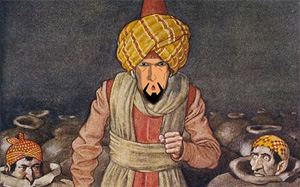 He bought a train of mules and thirty-eight great leather oil jars. One jar he filled with oil; in each of the other thirty-seven he hid one of his thieves. Disguised as an oil merchant, he came to Ali Baba's door at dusk and asked for shelter for the night. Ali Baba, kind and unsuspecting, welcomed him warmly and gave him a place to rest, never dreaming that his courtyard was full of armed robbers waiting for the household to fall asleep.
That evening Morgiana needed oil for her lamp. She went out to the jars in the courtyard — and as she came near the first one, a low voice whispered from inside, "Is it time?" Most servants would have screamed. But Morgiana, quick-witted as ever, answered in a gruff voice, "Not yet, but soon," and moved calmly to the next jar, and the next, until she understood the whole terrible plan. She found the one jar that held oil, heated it until it boiled, and poured it into each of the thirty-seven jars in turn. So the thieves were defeated before they ever drew a sword. When their captain crept out at midnight to wake his men, he found them all dead, and he fled the city alone, burning with the desire for revenge.
Some time later, the captain returned in a new disguise — this time as a friendly merchant. He set up a shop near the business of Ali Baba's son and slowly won the young man's trust, until at last he was invited to dine at Ali Baba's house. But Morgiana, serving at the table, looked closely at the guest and knew him at once for the captain of the thieves. She also noticed the dagger he kept hidden beneath his robe.
Morgiana asked leave to entertain the guests with a dance. She danced gracefully, holding a dagger of her own as part of the performance, turning and weaving about the room. Then, choosing her moment, she plunged the dagger straight into the heart of the disguised captain. Ali Baba was horrified — until Morgiana drew back the false merchant's robe and showed the hidden weapon, and revealed that this was the very captain of the forty thieves, come to murder them all.
Ali Baba's anger turned to deepest gratitude. Morgiana had saved his life not once but many times over. He granted her her freedom on the spot, and soon afterwards she was married to Ali Baba's son, joining the family she had served so faithfully and bravely.
And so Ali Baba was left as the only person alive who knew the secret of the treasure cave and the magic words that opened it. He used the riches wisely and shared them generously, and he and his family lived in happiness and comfort for the rest of their days. Thus the story ended well for everyone — everyone, that is, except the greedy Cassim and the forty thieves.
 CLAT Aspirants
 Back to School
 Craft Ideas for Kids
 Benefits of Yoga for Kids
 Fun and Jokes
 Stories for Kids
 School Projects & Homework Help
 Hobbies
