CSEET Paper 2: six accounts mock papers on the new CS foundation (CSEET) syllabus
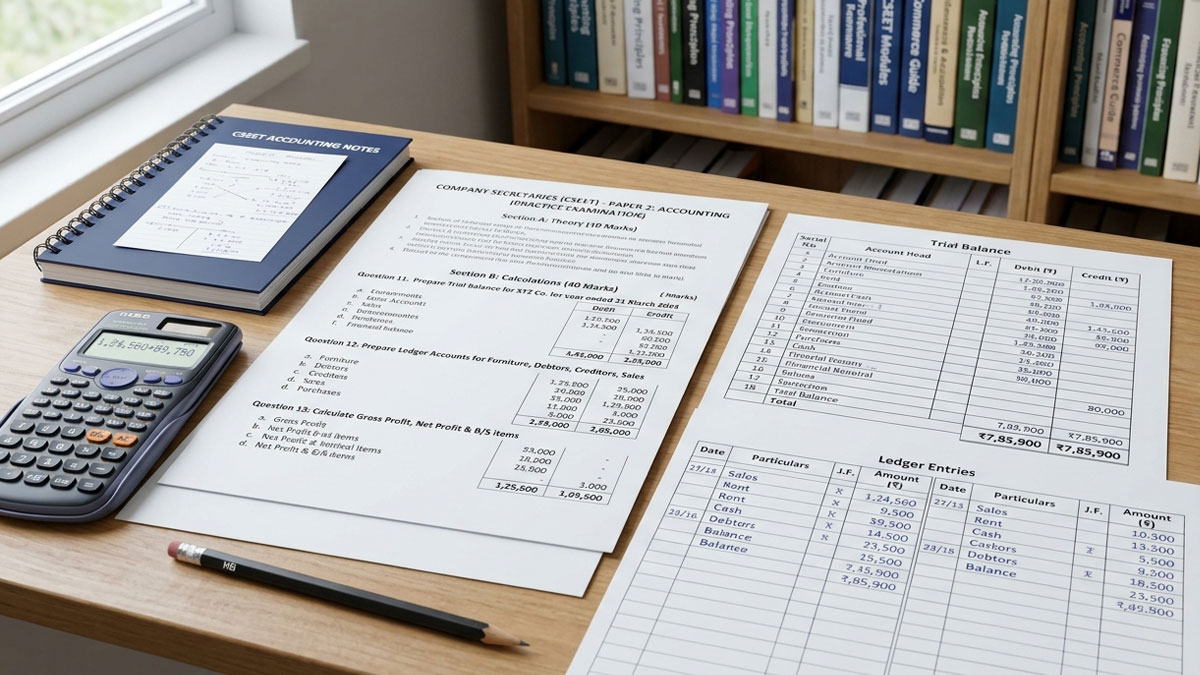
From the June 2026 sitting the entrance test to the Company Secretary course is a different examination, and one of its four papers is accounting written out in full. There is almost nothing behind it to practise on. These six sittings are what that gap is for.
What changed, and why it matters to you
The test used to be taken at home under remote supervision: two hours, two hundred marks, four options against every question, four windows a year. It set no accounting at all.
What replaced it is sat at a centre over four days, three of them written. Four papers now, a hundred marks each; Paper 2 is Fundamentals of Accounting and runs three hours. The windows moved to three a year, in February, June and October. The last sitting under the old arrangement was January 2026.
The practical consequence is simple and easy to miss. A candidate preparing for any other commerce examination can work through a decade of past papers. Here there is no such decade. Anything you find that describes a two-hour objective test is describing an examination that no longer runs.
What one of these six papers looks like
A hundred marks in three hours, with the twenty-mark compulsory question first and eight shorter ones after it.
| Question | What it asks for | Marks |
|---|---|---|
| Part A | ||
| 1 | Final accounts of a sole proprietor | 20 |
| Part B | ||
| 2 (i) | Not-for-profit organisation | 8 |
| 2 (ii) | Trial balance | 8 |
| 3 (i) | Depreciation | 8 |
| 3 (ii) | Bank reconciliation | 8 |
| 4 (i) | Cash book | 8 |
| 4 (ii) | Rectification of errors | 8 |
| 5 (i) | Company accounts | 8 |
| 5 (ii) | Partnership | 8 |
| 6 (i) | Partnership | 10 |
| 6 (ii) | Not-for-profit organisation | 6 |
| Total | 100 | |
The eight lessons
The syllabus runs from the first principles of double entry to company accounts, and the set reaches all of it — though not all of it inside the timed papers.
| Lesson | Where the set examines it |
|---|---|
| Accounting concepts and principles | The untimed set, which is where it can be marked |
| The accounting process, trial balance and rectification | Questions 2 (ii) and 4, in every paper |
| Bank reconciliation statement | Question 3 (ii), in every paper |
| Depreciation and amortisation | Question 3 (i), in every paper |
| Final accounts of a sole proprietor | Question 1, in every paper |
| Partnership and LLP accounts | Questions 5 (ii) and 6 (i), in every paper |
| Introduction to company accounts | Question 5 (i), in every paper |
| Not-for-profit organisations | Questions 2 (i) and 6 (ii), in every paper |
Where the theory went
A quarter or so of the real paper is answered in sentences: what a convention requires, how accounts are classified, what distinguishes a limited liability partnership from a firm. None of that can be marked by a machine reading figures, and inventing a question type for it would have been worse than leaving it out — on a paper this new, a candidate has no way of telling an invention from the real thing.
So it sits beside the six papers instead, as an untimed set of 37 statements to be judged true or false with the reasoning given in full afterwards. No clock, no score to beat. The timed papers carry a note saying plainly that they do not tell you whether you know this.
Where to sign up
This paper is not sold on its own. It comes with whichever board you are sitting at school, together with CA Foundation Paper 1, on one account and one subscription — which is how most candidates actually meet it, in the same year as a board examination.
Questions
Has anybody sat this paper yet?
Only the sittings since the change. Accounting entered this entrance test with the restructure, so the stock of past papers that exists for every other examination a commerce student meets does not exist here, and will not for a while. That absence is the reason this set was built from the lesson list outwards rather than from old papers backwards.
Why does so much of what I read online describe a two-hour test?
Because it has not been rewritten. The earlier test was taken from home under remote supervision, ran two hours, carried two hundred marks and was answered by choosing between four options — and it contained no accounting whatever. A good deal of published guidance still describes that test. Check the date on anything you read.
Six papers rather than ten — why fewer?
This syllabus is narrower and the questions are shorter, so the same reasoning error comes round often enough within six sittings for a rate to mean something. Where a paper is wide and long, more sittings are needed to say anything honest about a habit; where it is not, more sittings are just more evening.
Is the accounting here the same as the board’s?
It overlaps and then parts. The partnership and company work will feel familiar from Class 12. The sole proprietor’s final accounts, the cash book, the trial balance and the reconciliation are Class 11 material returning with real marks attached, which is the part candidates are most often caught by.