

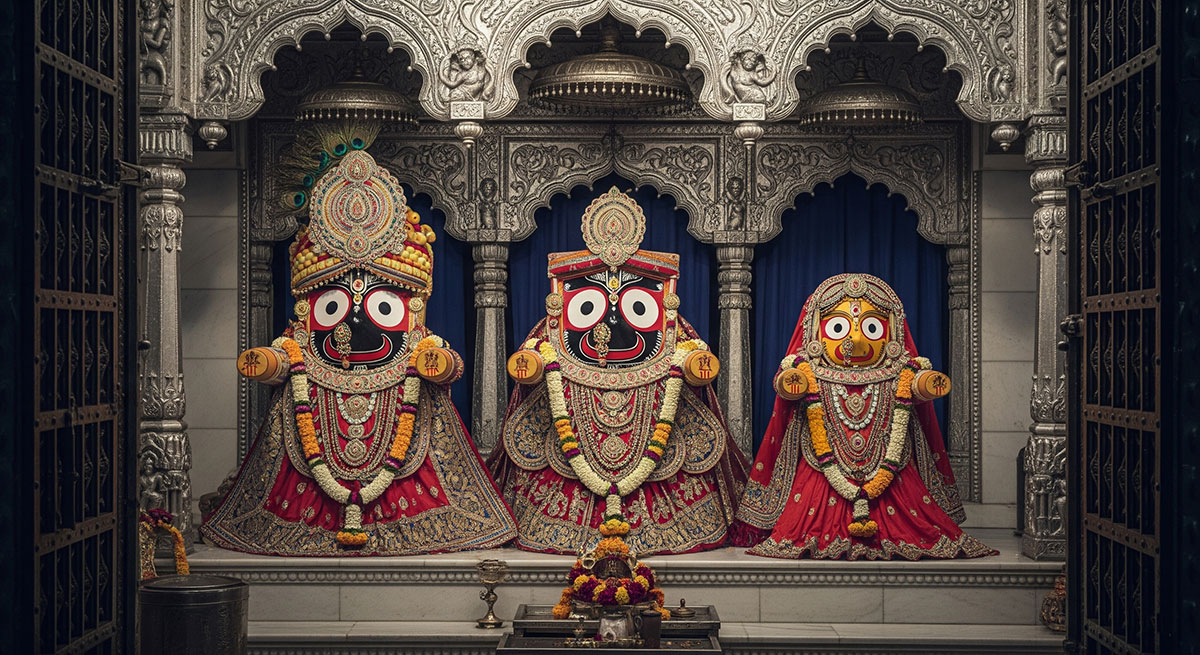
In the ancient lore of India, preserved in the Skanda Purana and the Puri temple tradition, lies the origin story of Lord Jagannath — the wooden deity worshipped as a form of Vishnu and Krishna, alongside his elder brother Balabhadra (Balarama) and his sister Subhadra. The legend explains both the deities' unusual appearance and the world-famous Rath Yatra of Puri.
The King and the Divine Log
The legend tells of King Indradyumna, a pious ruler of the ancient Malava (Avanti) kingdom, who longed to behold the Lord in a form he could worship. Guided by a dream and by his messengers, he learned of a radiant log of daru (sacred neem wood) destined to wash ashore near Puri, on the shore of the Nilachala hill.
The Carpenter Who Asked Not to Be Disturbed
When the king recovered the glowing log, the question arose of who could carve so sacred a form. According to the legend, an aged carpenter appeared and offered to do it — by tradition understood to be Vishwakarma, the architect of the gods, or the Lord himself in disguise. He set one condition: he would work alone behind closed doors, and no one was to disturb him until he was finished, however long it took.
For days the sound of his tools came from within the chamber. Then the sounds stopped. The anxious queen, fearing the old craftsman had fallen ill or died, persuaded the king to open the doors. The carpenter was gone — and the three deities stood unfinished, with great round eyes and only stumps where arms and feet would be.
Far from a flaw, devotees came to cherish this as the Lord's own chosen form. Jagannath, Balabhadra and Subhadra are worshipped to this day exactly as they appeared in that moment — the only major Hindu deities made of wood rather than stone or metal.
The Meaning Behind the Form
The unusual shape of the deities carries layers of meaning in the tradition:
The All-Seeing Eyes
Jagannath's large, round, unblinking eyes are understood to represent his all-seeing nature — the Lord who watches over the whole of creation at once.
The Form Without Hands or Feet
That the Lord needs no hands to receive a devotee's love, and no feet to go anywhere, is read as a sign that he is ever-present and ever-accessible, seated permanently in his shrine for all who come to him.
The Wooden Body
The neem-wood body expresses the belief that the divine can dwell even in humble, natural materials — that God appears wherever devotees call, whether in stone, metal or wood.
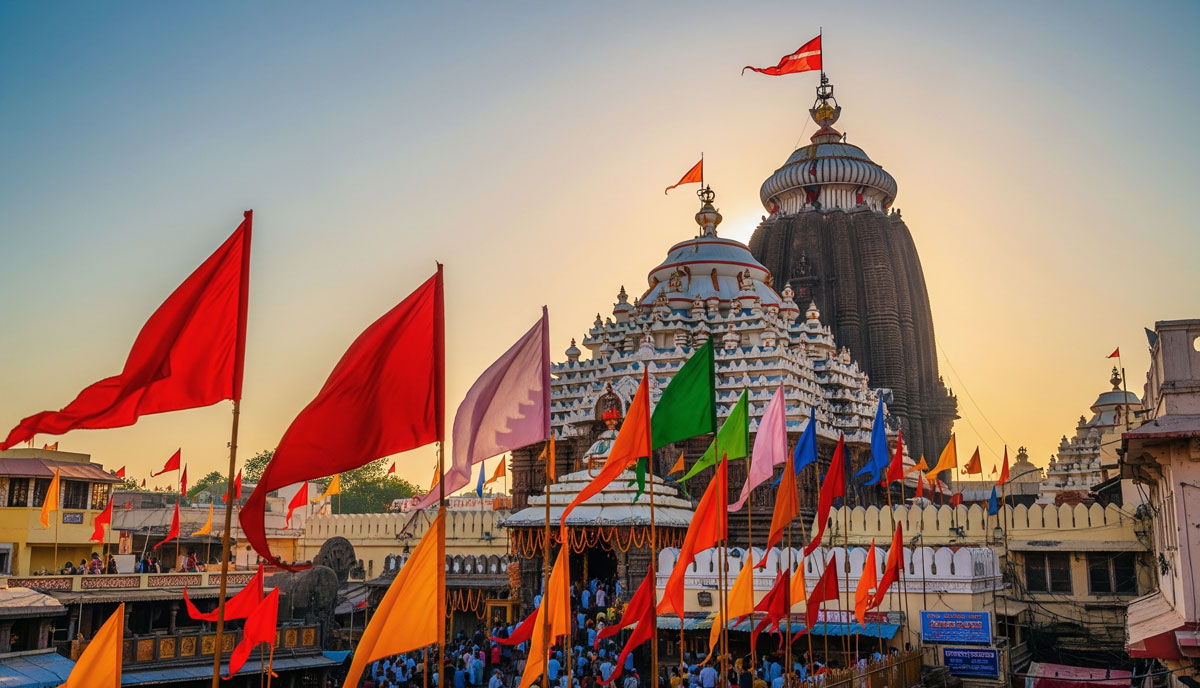
The Jagannath Temple of Puri
The shrine that grew around this legend is one of the four sacred Char Dham pilgrimage sites of Hinduism and one of the oldest functioning temples in India. While tradition credits King Indradyumna with founding worship at the site, the great temple standing today was built much later in the medieval period.
Begun in the 12th century by King Anantavarman Chodaganga Deva and completed under his successor Anangabhima Deva around 1198 CE, the temple is a towering example of Kalinga architecture. Atop its spire sit the Neelachakra (the blue wheel) and a flag, and the whole structure has stood as the spiritual heart of Odisha for some eight centuries.
The Mysteries and Miracles of the Temple
Beyond its history, the Jagannath Temple is renowned for a set of wonders that pilgrims hold sacred and that visitors still describe today. They are part of the living devotional tradition of Puri rather than settled scientific findings, but they are central to how the temple is experienced.
The Flag That Flies Against the Wind
The flag atop the spire is famously said to flutter in the opposite direction to the breeze blowing in from the sea — a sight devotees take as a sign of the Lord's presence.
The Daily Flag-Changing Climb
Every single day, a member of a hereditary family of climbers scales the roughly 214-foot spire by hand and without any harness or safety gear to change the flag on the Neelachakra. Tradition holds that should this daily ritual ever be missed, the temple would have to remain closed.
The Temple That Casts No Shadow
It is widely said that the main tower casts no visible shadow on the ground at any time of day — attributed by devotees to the Lord's presence and by others to the temple's design.
The Sudarshana Chakra That Always Faces You
The great wheel mounted on the spire appears to face the viewer from every direction in Puri, however far away one stands — an effect known as the Nila Chakra's "eye of the Lord."
The Kitchen Where the Top Pot Cooks First
In the temple's vast kitchen — said to be among the largest in the world — the Mahaprasad is cooked over firewood in seven earthen pots stacked one above the other, and by tradition the topmost pot cooks first. The offering is said never to fall short, however many pilgrims arrive.
The Silence of the Sea at the Gate
Pilgrims often note that the roar of the ocean seems to fall silent once you step through the Singhadwara (Lion Gate) into the temple, only to return the moment you step back out.
The Rath Yatra: The Great Chariot Festival
The most famous event at Puri is the Rath Yatra, or chariot festival — one of the oldest and largest religious processions on earth, drawing well over a million people each year. Once a year, in the month of Ashadha (June–July), the three deities leave their sanctum and travel out among the people.
By tradition, the journey carries Jagannath, Balabhadra and Subhadra from the main temple to the nearby Gundicha Temple, where they stay for several days before the return journey, called the Bahuda Yatra. The festival is the rare occasion when the Lord comes out of the shrine to be seen and reached by everyone.
The Three Giant Chariots
Each deity rides a separate, towering wooden chariot, newly built every year from specific kinds of wood and pulled along the Grand Road by thousands of devotees hauling on thick ropes:
The chariots are dismantled after the festival, and their timber is traditionally reused. It is from these great rolling chariots — rath — that the English word "juggernaut," meaning an unstoppable force, is derived.
Navakalevara: When the Deities Are Renewed
Because the deities are made of wood, they are ceremonially replaced with newly carved forms in a rare and solemn ritual called Navakalevara ("new body"). This takes place only in special years — at intervals of roughly 8, 12 or 19 years — when a sacred neem tree bearing the right signs is sought out, and the mysterious "life-substance" is transferred from the old deity to the new in deep secrecy. It is one of the most extraordinary living rituals in the Hindu world.
The Heart of the Legend
The story of Jagannath teaches that the divine appears in unexpected forms, that true vision sees past outward shape, and that — above all — God comes down to the level of his people. In the unfinished wooden eyes of Jagannath, and in the chariots that everyone may pull, devotees find a Lord who belongs to all.
Frequently Asked Questions
Who is Lord Jagannath?
Lord Jagannath, whose name means Lord of the Universe, is a form of Lord Vishnu and Krishna worshipped in Puri, Odisha, alongside his brother Balabhadra and sister Subhadra. Unusually, the three deities are carved from neem wood rather than stone or metal.
Why is Lord Jagannath shown without complete hands and feet?
According to legend, the divine carpenter who was carving the deities asked to work behind closed doors undisturbed, but the doors were opened before the work was finished. The deities were left in their unfinished, limbless form, which devotees came to revere as the Lord's chosen appearance.
Who built the Jagannath Temple in Puri?
The mythological founder of worship at Puri is King Indradyumna. The present temple was built by King Anantavarman Chodaganga Deva of the Eastern Ganga dynasty, begun in the 12th century, and completed by his successor Anangabhima Deva around 1198 CE. It is built in the Kalinga style.
What is the Rath Yatra of Puri?
The Rath Yatra is the annual chariot festival of Puri, when Jagannath, Balabhadra and Subhadra are placed on three giant wooden chariots and pulled by thousands of devotees to the Gundicha Temple, where they stay for a few days before returning. It is one of the oldest and largest processions in the world.
What are the famous mysteries of the Jagannath Temple?
The Jagannath Temple is famous for several wonders that devotees hold sacred: the flag atop the spire is said to flutter against the direction of the wind, the temple is said to cast no shadow, the Sudarshana Chakra on the spire appears to face you from every direction, and the temple kitchen cooks its offerings in seven stacked pots in which the top pot cooks first.
What is the daily flag ceremony at the Jagannath Temple?
Every day, a member of a hereditary family of climbers scales the temple's tall spire without any harness or safety gear to change the flag on the Neelachakra by hand. Tradition holds that if this daily ritual is ever missed, the temple would have to remain closed.