
The Earth Shelters Sita - The Final Act of Sita's Exile
Introduction:
The story of Sita returning to Mother Earth is one of the most emotional moments in the Ramayana. It marks the end of her journey of sacrifice, devotion, and unwavering purity.
Reunion with Lava and Kusha
The tale of Sita's return to the Earth is one of the most emotional and tragic moments in the Ramayana. Sita, after enduring years of hardship and isolation, is finally reunited with her sons, Lava and Kusha, whom she had raised in the hermitage of Sage Valmiki. Despite this joyous reunion, a shadow looms over her heart as her husband, Rama, now a king of Ayodhya, is torn between his duty as a ruler and his personal love for Sita.
Rama's Dilemma as a King
Rama, though deeply moved by the sight of his sons, becomes conflicted when he thinks of the people of Ayodhya. He wonders whether they would ever accept Sita as his queen, especially since she had been held captive by Ravana and had lived among the rakshasis for so long. It is not a question of her virtue, but of public opinion. In the face of his royal duty, Rama feels compelled to reject Sita and asks her to leave.
Sita's Final Decision
Heartbroken but understanding of Rama's duty, Sita does not retaliate. Instead, she appeals to the Earth, her mother, in a final moment of profound sorrow. She calls out to Mother Earth, asking for refuge. She beseeches the Earth to take her in if she has remained pure in heart and mind, as she has always been devoted to Rama, and if her sin lies in the judgment of others.
The Earth Accepts Sita
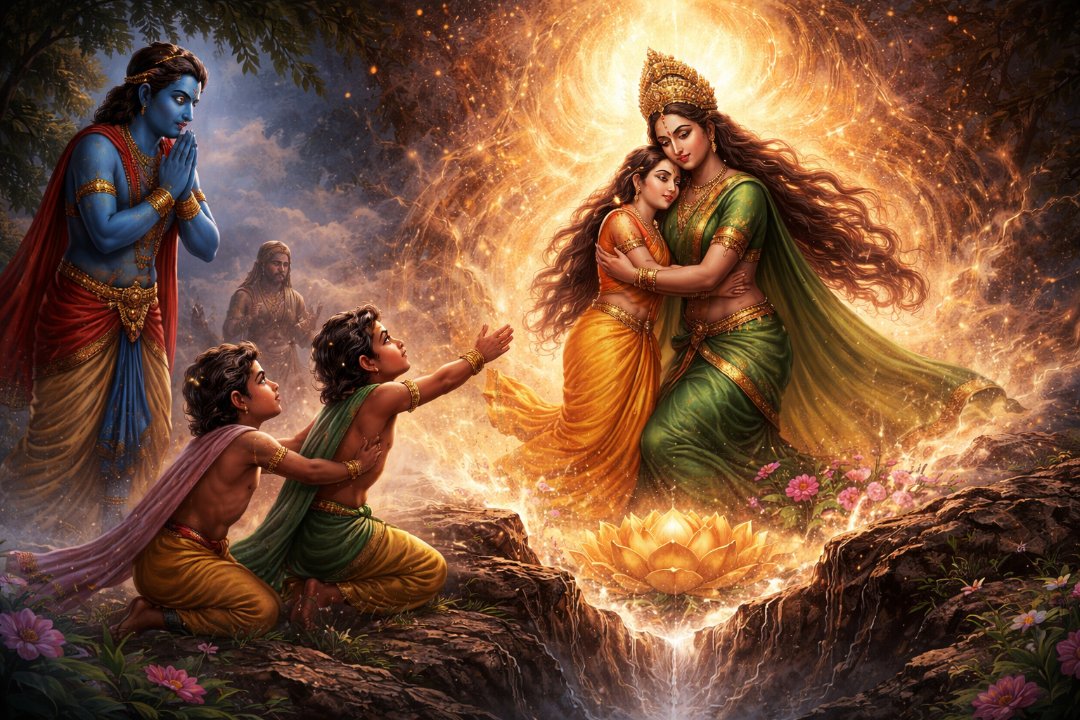
In response to Sita's plea, the Earth itself parts open, and from beneath, a divine being emerges. Mother Earth, personified as a goddess, rises from the depths, seated on a throne of great beauty. She then welcomes Sita into her lap, offering her the final sanctuary she had so desperately sought. With her children, Lava and Kusha crying for their mother, and with Rama's eyes filled with tears of regret, Sita is gently taken back into the Earth, disappearing into its embrace forever.
Her departure marks the ultimate resolution of her tragic journey, symbolizing purity and the surrender to the forces beyond human understanding. This moment represents the culmination of Sita's suffering and purity, and her return to the Earth symbolizes a final, peaceful resting place for her. Her sacrifice stands as a testament to her virtue and strength, as well as the deeply intertwined fates of the gods, humanity, and nature.
Lessons from the Story
This story teaches timeless lessons:
- True purity lies within the heart
- Sacrifice and dignity are powerful virtues
- Duty and love can sometimes conflict
- Truth ultimately prevails
SHARE NOW


 Back to School
 Craft Ideas for Kids
 Benefits of Yoga for Kids
 Fun and Jokes
 Stories for Kids
 School Projects & Homework Help
 Hobbies
