
Air is what we breathe, and it is what supports life on planet Earth. Plants need it to grow, and it is all around us. In fact, air surrounds our planet like a blanket. This blanket is called the Earth's atmosphere. Air is a mixture of many gases. The two most abundant are nitrogen (about 78%) and oxygen (about 21%). It also contains a small amount of carbon dioxide, tiny traces of gases such as argon, and some water in the form of water vapour.
No, we cannot see air, because it is made up of colourless gases. Nitrogen, the gas that makes up about 78% of the air we breathe, is colourless, and so is oxygen. Because these gases do not reflect a colour of their own, we cannot see air with our naked eyes. We can, however, feel and see its effects — the way trees, clothes and flags move or bend when the wind blows.
By sweating, the body keeps itself cool. When the body gets too warm, it releases moisture as tiny droplets of water through the skin. As this sweat evaporates, it carries heat away and cools us down. Sweat also helps remove some waste substances that the body does not need. We have two kinds of sweat glands: eccrine glands, found all over the body, produce watery sweat that cools us; apocrine glands, mostly under the arms, release a thicker fluid that bacteria on the skin can break down, which is why sweat can sometimes smell. The palms and soles have the greatest number of sweat glands.
Wind is simply air on the move. The Sun heats the Earth unevenly — some places receive more direct sunlight and become warmer, while others stay cooler. Warm air is lighter than cool air, so it rises. Cooler, heavier air then flows in to take its place. This constant movement of air from cooler areas towards warmer areas is what we feel as wind.
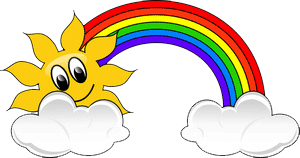
White is not a single, fundamental colour of light. White light is actually a mixture of many colours. This was famously shown by the scientist Sir Isaac Newton. When he passed a beam of white light through a glass prism, it split into a band of colours — red, orange, yellow, green, blue, indigo and violet.
A rainbow is an arc of light made up of a spectrum of colours — red, orange, yellow, green, blue, indigo and violet — which together make up the Sun's white light. A rainbow appears when the Sun shines while it is still raining. As sunlight enters a raindrop, it bends and separates into its band of colours. The light then reflects off the back of the raindrop and bends again as it leaves the front. Millions of raindrops doing this together create the curved rainbow we see.
When the Sun shines on a puddle, the water slowly changes from a liquid into a gas called water vapour. This process is called evaporation. The water vapour then mixes into the air, and the puddle gradually dries up. This is the very same process that dries our wet clothes when we hang them out in the sun.
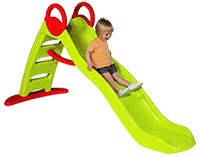
When we slide, our body rubs against the surface of the slide. If the surface were rough, there would be a lot of friction — the force that resists movement — and we would not slide smoothly. Slides are therefore made from smooth materials so that there is very little friction, allowing us to slide down easily and quickly.
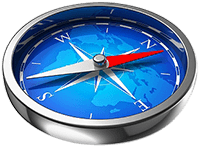
A magnet is used in a device called a compass, which has a small magnetised needle. The Earth itself behaves like a giant magnet with a magnetic North and South pole. The Earth's magnetic field pulls the compass needle so that it always points in a north–south direction. Travellers, sailors and explorers use a compass, along with a map, to know which way they are heading and to find their way.
A mirror has a surface that is extremely smooth and polished. When light falls on such a smooth surface, it bounces straight back, or reflects, in an even, orderly way. The light that reflects off us bounces off the mirror and back to our eyes, and so we see a clear image of ourselves.
We are able to see because of light. Light travels from a source, bounces off objects around us, and enters our eyes, which send signals to the brain. When there is no light at all, objects have no light to reflect, so no signal reaches the eye and we cannot see. With even a very dim light, we can see a little, but our eyes cannot pick out colours well in dim light, so things appear mostly in shades of grey.
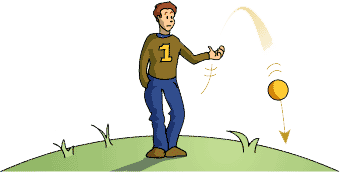
We fall down because of a force called gravity. Gravity is the invisible pull that the Earth exerts on everything near it, always pulling objects towards its centre. That is why anything we drop falls to the ground, and why we fall downwards — not upwards — when we slip.
We cannot see electricity itself, but we can see what it does — it lights our lamps, runs our fans and powers our gadgets. Electricity is a flow of extremely tiny particles called electrons. Electrons are far too small to see, and so the electricity they carry is invisible to us.
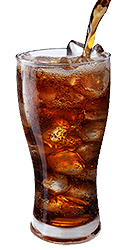
To give fizzy drinks their fizz, a gas called carbon dioxide is dissolved into the liquid under high pressure and the container is sealed. While the bottle or can is closed, the gas stays trapped in the drink. The moment you open it, the pressure is released and the trapped carbon dioxide escapes as the bubbles you can see and hear.

Try out the other sections



 CLAT Aspirants
 Durga Puja
 Craft Ideas for Kids
 Benefits of Yoga for Kids
 Fun and Jokes
 Stories for Kids
 School Projects & Homework Help
 Hobbies