
3D Architectural Modelling: A Geometry Masterclass
Applying Geometry to Real-World 3D Architectural Design


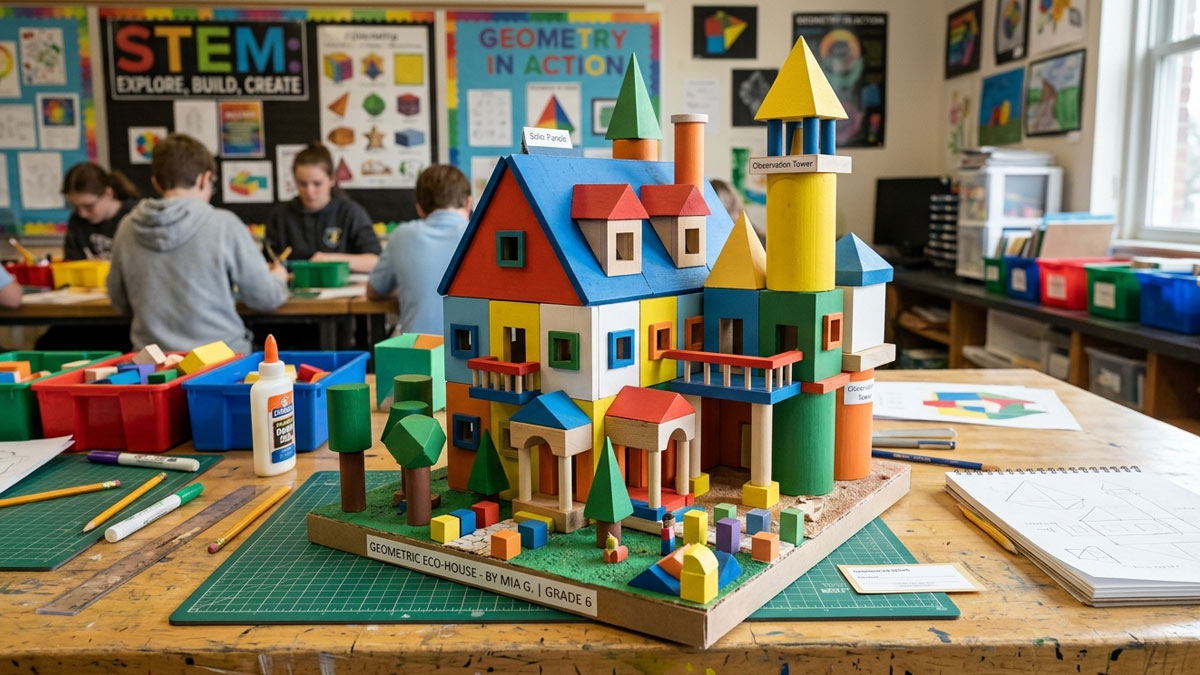
From Blueprints to 3D Reality. This project bridges the gap between abstract geometry and civil engineering. By designing a composite house model, students apply formulas for prisms, pyramids, and cylinders to calculate real-world material volumes and surface costs.
The Core Concept: Composite Solids
In modern architecture, buildings are rarely a single shape. They are "Composite Solids"—a combination of multiple 3D shapes. For this project, you will construct a house where each section is a distinct mathematical entity.
Geometric Breakdown & Formulas
| Component | Geometric Shape | Volume Formula | Surface Area Formula |
|---|---|---|---|
| Main House Body | Rectangular Prism | $l \times w \times h$ | $2(lw + lh + wh)$ |
| The Roof | Triangular Prism | $\text{Area of Triangle} \times \text{Length}$ | $\text{Sum of all faces}$ |
| The Chimney | Cylinder | $\pi r^2 h$ | $2\pi r^2 + 2\pi rh$ |
| Entrance Porch | Square Pyramid | $\frac{1}{3} \times \text{Base Area} \times \text{Height}$ | $\text{Base Area} + \frac{1}{2} \times \text{Perimeter} \times \text{Slant Height}$ |
Construction Steps
- Design the Blueprint: Draw a 2D layout of your house. Assign specific dimensions ($l, w, h$) to each part.
- Shape Construction: Use cardboard or foam board to create the net of each shape. Fold and secure with adhesive.
- Assembly: Join the components to form the final structure. Ensure the "hidden" faces (where the roof meets the walls) are subtracted from your final surface area calculation.
- Volume Analysis: Measure the final dimensions and use the formulas above to determine the "Total Living Space" (Volume).
Real-World Industry Applications
- Cost Estimation: Quantity Surveyors use these exact surface area calculations to determine how much paint, siding, or glass is required for a skyscraper, preventing waste.
- HVAC Engineering: Heating and cooling specialists calculate the **Volume** of a building to determine the size of the air conditioning unit required to regulate temperature effectively.
- Packaging Design: Companies like Amazon use 3D modeling to minimize the surface area of boxes while maximizing volume to reduce shipping costs and cardboard waste.
Frequently Asked Questions
Q: Why do we subtract internal surface areas?
A: When you glue a chimney to a roof, the bottom of the chimney is no longer an "exposed" surface. In real construction, you wouldn't paint or insulate that hidden part, so it must be subtracted for accuracy.
Q: What units should I use for my project?
A: It is standard practice to use centimeters (cm) for the model and then use a 1:100 scale to convert your findings into meters (m) for the final report.
Verified Curriculum Content for Standard X-XII.
 Durga Puja
 CLAT Aspirants
 Craft Ideas for Kids
 Benefits of Yoga for Kids
 School Projects & Homework Help
 Hobbies: Philately, Fishing, Camping
 Fun and Jokes