
Benford's Law: The Fingerprint of Natural Data
School Project on Benford's Law & Fraud Detection


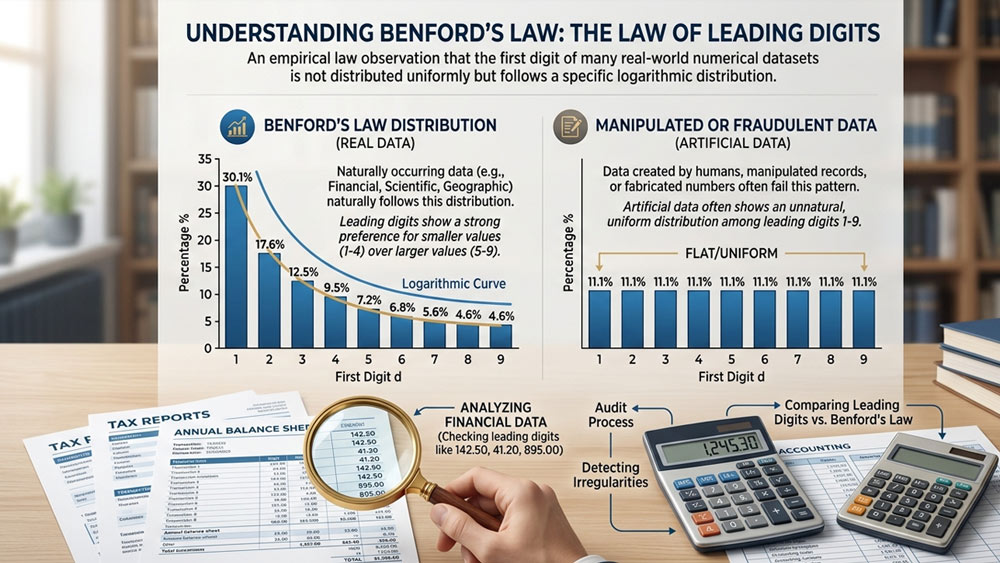
How do tax investigators catch fraudsters? They use math. **Benford's Law** predicts the frequency of leading digits in large, organic datasets. If a company's financial records don't match this distribution, it's a "red flag" for manipulation.
The Mathematical Rule
The probability $P$ of a digit $d$ being the first leading digit is given by:
Case Study: Detecting Financial Fraud
In this project, students will analyze a dataset (like town populations or stock market volumes) and compare the observed leading digits against the Benford curve. If someone "invents" numbers, they tend to use digits 1-9 equally, creating a flat line that stands out against the natural Benford curve.
Frequently Asked Questions
Q: How does Benford's Law help detect financial fraud?
A: Investigators compare real financial records with the expected Benford digit distribution. If the leading digits appear unnaturally uniform or significantly different from the Benford curve, it may indicate manipulated or fabricated numbers.
Q: Which datasets follow Benford's Law?
A: Datasets such as population numbers, stock market volumes, river lengths, electricity bills, and financial records often follow Benford's Law because they span multiple scales naturally.
Q: Why do fabricated numbers fail Benford's Law tests?
A: When people invent numbers, they tend to use digits 1 through 9 more evenly. This creates a flat distribution that differs from the naturally uneven Benford distribution, making suspicious patterns easier to detect.
Q: Who uses Benford's Law in real life?
A: Benford's Law is used by accountants, auditors, tax investigators, forensic analysts, and data scientists to identify unusual patterns and possible fraud in large datasets.
 Durga Puja
 CLAT Aspirants
 Craft Ideas for Kids
 Benefits of Yoga for Kids
 School Projects & Homework Help
 Hobbies: Philately, Fishing, Camping
 Fun and Jokes