
The Brachistochrone: The Curve of Fastest Descent
How the cycloid becomes the fastest path under gravity.


Is the shortest distance between two points always the fastest? In the world of gravity, the answer is a resounding 'No'. This project explores the mathematical marvel that outruns the straight line.
1. The Historical Challenge
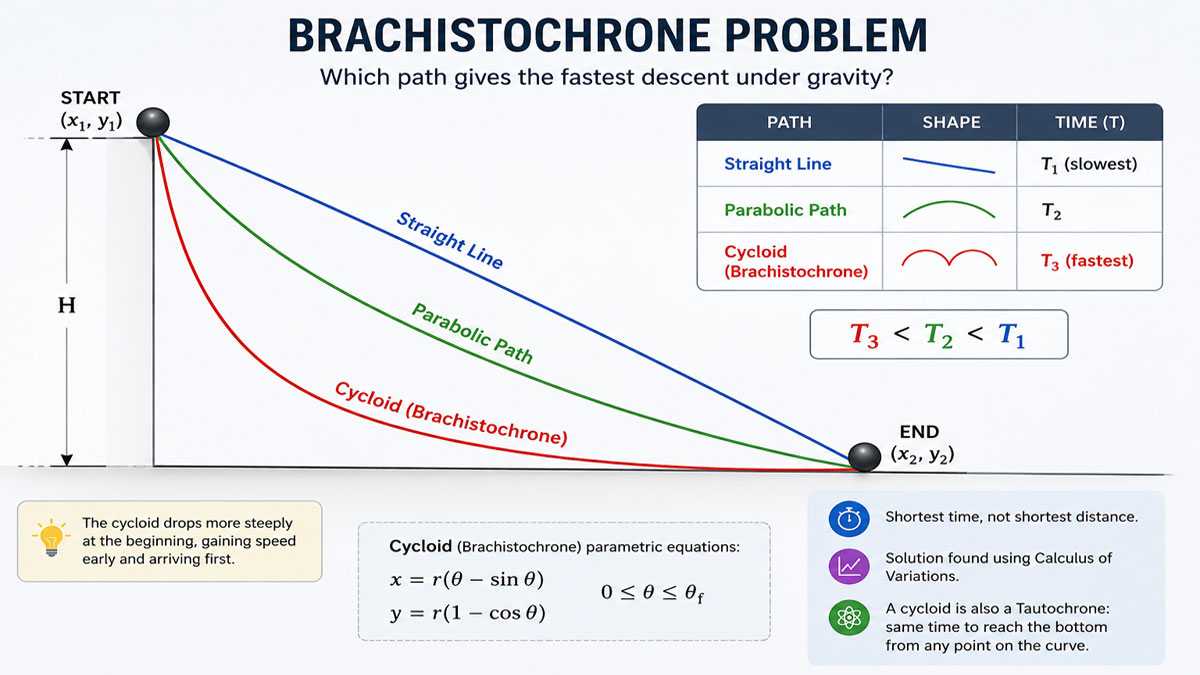
In 1696, Johann Bernoulli posed a challenge to the greatest mathematicians of Europe: "Find the path between two points, at different heights, that a marble will travel in the shortest possible time under the influence of gravity alone."
While intuition suggests a straight line, the solution is the Cycloid—the curve traced by a point on a rolling wheel. This problem gave birth to the Calculus of Variations.
2. Theoretical Framework
To solve for the fastest time ($T$), we must minimize the integral of time over the path. Using the principle of conservation of energy, the velocity $v$ at any point is $v = \sqrt{2gy}$.
$T = \int_{x_1}^{x_2} \frac{ds}{v} = \int_{x_1}^{x_2} \frac{\sqrt{1 + (y')^2}}{\sqrt{2gy}} dx$
Using the Euler-Lagrange Equation, we find that the curve that minimizes this integral is a cycloid defined by the parametric equations:
$y = r(1 - \cos\theta)$
3. Investigative Experiment
For your Standard XII project, you can validate this theory by building a physical comparison track.
Apparatus
- Flexible track (PVC or cardboard)
- Identical marbles or steel balls
- High-speed camera (Smartphone)
- Stopwatch or Motion Sensor
Procedure
- Set up a straight incline track.
- Shape a second track into a cycloid curve using the parametric coordinates.
- Release both marbles simultaneously.
- Analyze the frame-by-frame footage to record times.
4. Real-World Applications
- Skatepark Design: Professional half-pipes are often shaped using cycloidal geometry to allow skaters to gain maximum speed quickly.
- Roller Coasters: Engineers use these curves to create "speed boosts" at the start of a drop without increasing the height of the lift hill.
- Transit Systems: Some proposed high-speed "gravity vacuum" trains use Brachistochrone-like tunnel paths to minimize travel time between stations.
Frequently Asked Questions
Q: Is the Brachistochrone the same as the Tautochrone?
A: Yes! A cycloid is also a Tautochrone, meaning an object released from any point on the curve will reach the bottom in the exact same amount of time.
Q: Where is the Brachistochrone principle used in real life?
A: It is applied in roller coaster design, skateparks, transport systems, and engineering optimization problems.
Q: What is the difference between a cycloid and a parabola?
A: A parabola is a quadratic curve, while a cycloid is generated by a rolling circle and provides the fastest descent under gravity.
Q: Can the Brachistochrone problem be tested experimentally?
A: Yes! You can compare marble travel times on straight, curved, and cycloid tracks.
 Durga Puja
 CLAT Aspirants
 Craft Ideas for Kids
 Benefits of Yoga for Kids
 School Projects & Homework Help
 Hobbies: Philately, Fishing, Camping
 Fun and Jokes