
The Clinometer Project: Height & Distance
Use trigonometry and a simple clinometer to measure real-world heights.


In classical surveying, measuring a tall structure doesn't require a ladder; it requires Trigonometry. This project involves constructing a "Clinometer"—a tool for measuring angles of elevation—and using the Tangent function to calculate heights of objects like school buildings, flags, or trees.
1. The Mathematical Principle
This project is a direct application of Right-Angled Trigonometry. When you sight the top of an object through a clinometer, you create an imaginary right triangle between your eye, the object's top, and its base.
Where:
- $H$: Total height of the object.
- $D$: Horizontal distance from the observer to the base.
- $\theta$: Angle of elevation (measured by the clinometer).
- $h_e$: Height of the observer's eye from the ground.
2. Building the Device
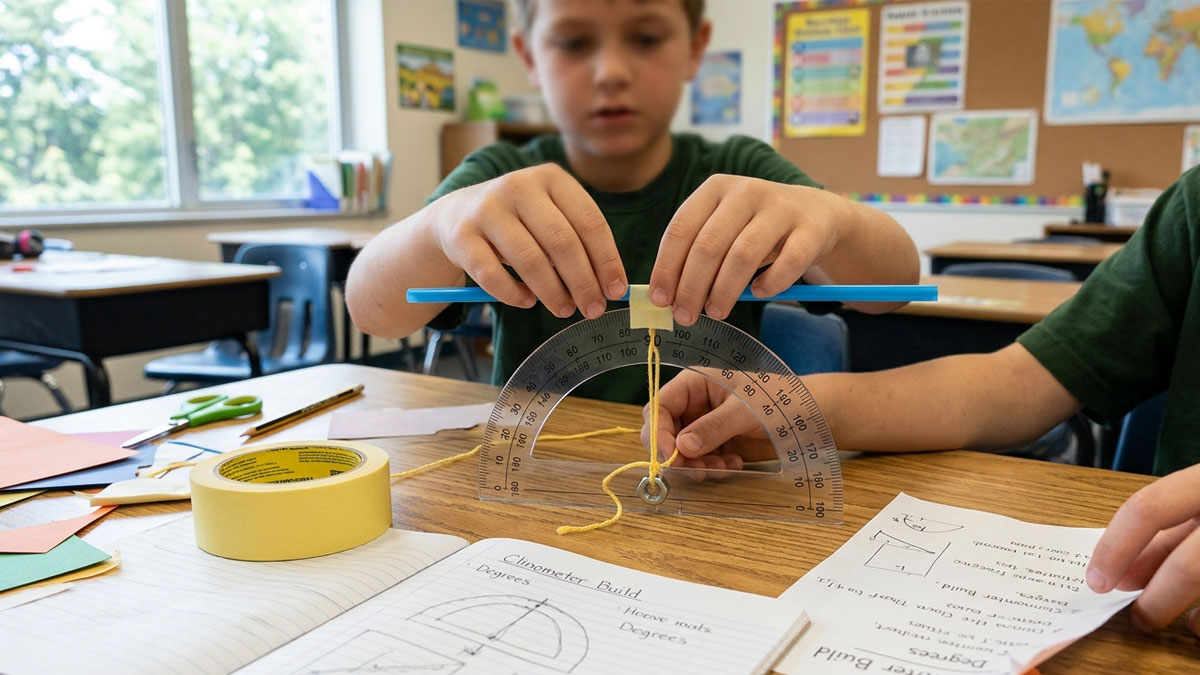
- The Frame: Attach a large 180° protractor to a flat piece of cardboard or wood.
- The Sighting Tube: Fix a straight drinking straw exactly along the 90° line (the base line) of the protractor.
- The Plumb Line: Hang a thread with a small weight (like a nut or eraser) from the center point of the protractor.
- The Zero-Check: When the straw is level, the string should point to 90° (which we treat as 0° elevation).
3. Field Investigation Procedure
- Stand at a distance ($D$) from the building and measure this distance using a measuring tape.
- Look through the straw and align the top of the building in your view.
- Hold the string in place and record the angle ($\theta$).
- Measure your own height up to your eyes ($h_e$).
- Use the Tangent table or a calculator to solve for $H$.
Real-World Industry Use
Modern civil engineers and foresters use digital clinometers to assess slope stability and tree height. In aviation, pilots use similar principles to determine the "Glide Slope" during landing to ensure they clear obstacles safely.
 Durga Puja
 CLAT Aspirants
 Craft Ideas for Kids
 Benefits of Yoga for Kids
 School Projects & Homework Help
 Hobbies: Philately, Fishing, Camping
 Fun and Jokes