
Conic Sections in Architecture: Geometry that Holds the World
A Geometry School Project on Conic Sections


Beyond the Circle. While circles are common, the most impressive architectural feats utilize the unique properties of the Parabola, Ellipse, and Hyperbola. From the acoustics of a whispering gallery to the strength of a suspension bridge, Conic Sections provide the mathematical blueprint for modern civil engineering. This project explores the derivation of these curves and their structural necessity.
1. The Four Conic Sections
A conic section is the intersection of a plane and a double-napped cone. Depending on the angle of the plane, you get four distinct curves:
The Parabola
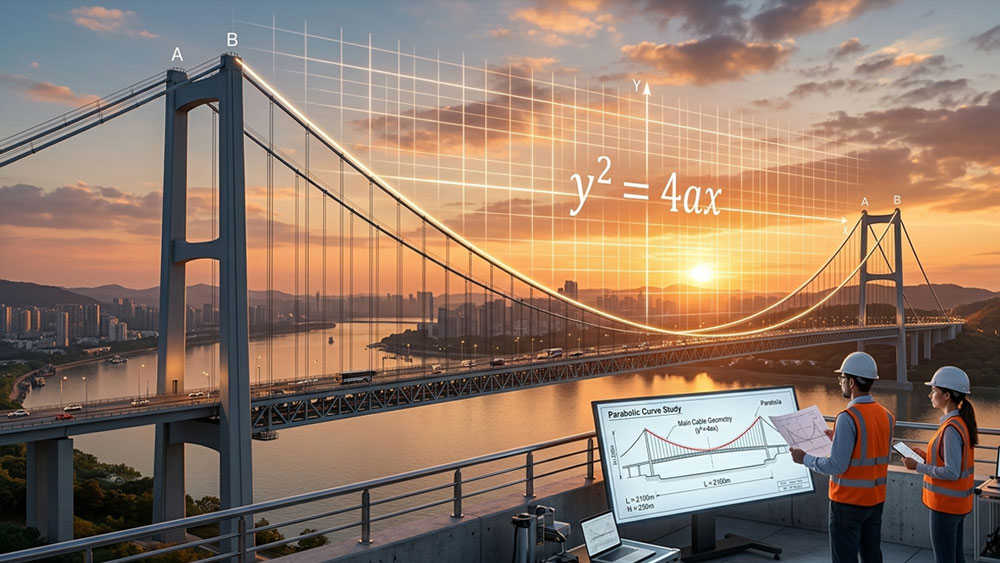
$y^2 = 4ax$Found in suspension bridges and satellite dishes.
The Ellipse
$\frac{x^2}{a^2} + \frac{y^2}{b^2} = 1$Found in whispering galleries and orbits.
The Hyperbola
$\frac{x^2}{a^2} - \frac{y^2}{b^2} = 1$Found in cooling towers and sonic booms.
2. Parabolas: Distributing the Load
When a cable is suspended between two towers and supports a uniform bridge deck, it takes the shape of a **Parabola**. If the cable were only supporting its own weight (like a hanging chain), it would be a "Catenary," but the added weight of the road forces it into a parabolic curve.
- Reflective Property: Every signal hitting a parabolic surface reflects to a single point (the **Focus**). This is why radar and satellite dishes are parabolic.
3. Ellipses: The Magic of Sound
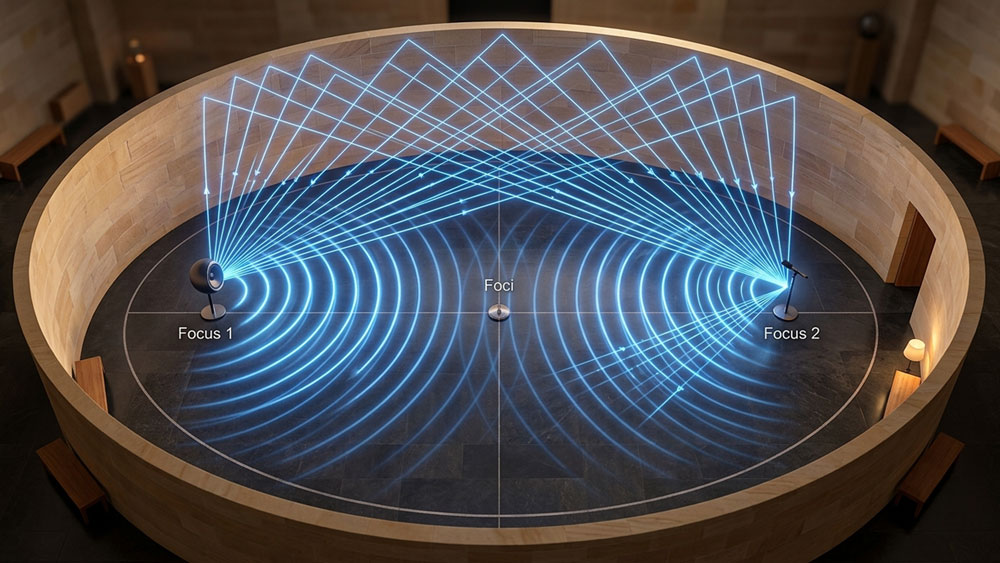
An ellipse has two focal points. Any sound or light emitted from one focus will reflect off the walls and hit the second focus. This creates "Whispering Galleries" (like in St. Paul's Cathedral), where a whisper on one side can be heard perfectly on the other.
4. Hyperbolas: Structural Efficiency
Nuclear cooling towers are built as **Hyperboloids of Revolution**. This shape is incredibly strong and requires less material than a straight cylinder. Because it is a "ruled surface," it can be built with straight steel beams even though it looks curved.
Real-World Industry Applications
- Optical Engineering: Telescope mirrors are parabolic to focus light from distant galaxies into a single clear image.
- Medical Technology: Lithotripsy machines use elliptical reflectors to focus high-energy shock waves from one focus to a kidney stone at the second focus, shattering it without surgery.
- Aviation: When a plane breaks the sound barrier, the shock wave forms a cone. The intersection of this cone with the ground is a **Hyperbola**, defining the "sonic boom" path.
Frequently Asked Questions
Q: What is eccentricity ($e$)?
A: Eccentricity measures how "stretched" a conic section is. For a circle, $e=0$. For an ellipse, $0 < e < 1$. For a parabola, $e=1$, and for a hyperbola, $e > 1$.
Q: Why don't we use circles for cooling towers?
A: A hyperbolic shape is much more resistant to wind pressure and uses significantly less concrete than a cylinder of equal strength.
Standard XI Mathematics & Civil Engineering Integration.
 Durga Puja
 CLAT Aspirants
 Craft Ideas for Kids
 Benefits of Yoga for Kids
 School Projects & Homework Help
 Hobbies: Philately, Fishing, Camping
 Fun and Jokes