
Fractals & Chaos: The Koch Snowflake
A Fascinating Fractal Geometry School Project on the Koch Snowflake


Nature isn't made of perfect circles and squares. To describe the shape of a cloud, a coastline, or a mountain, we need **Fractals**. This project explores the **Koch Snowflake**, a recursive shape that challenges our understanding of measurement by proving that a shape can have an infinite boundary but occupy a finite space.
1. Construction: The Iterative Process
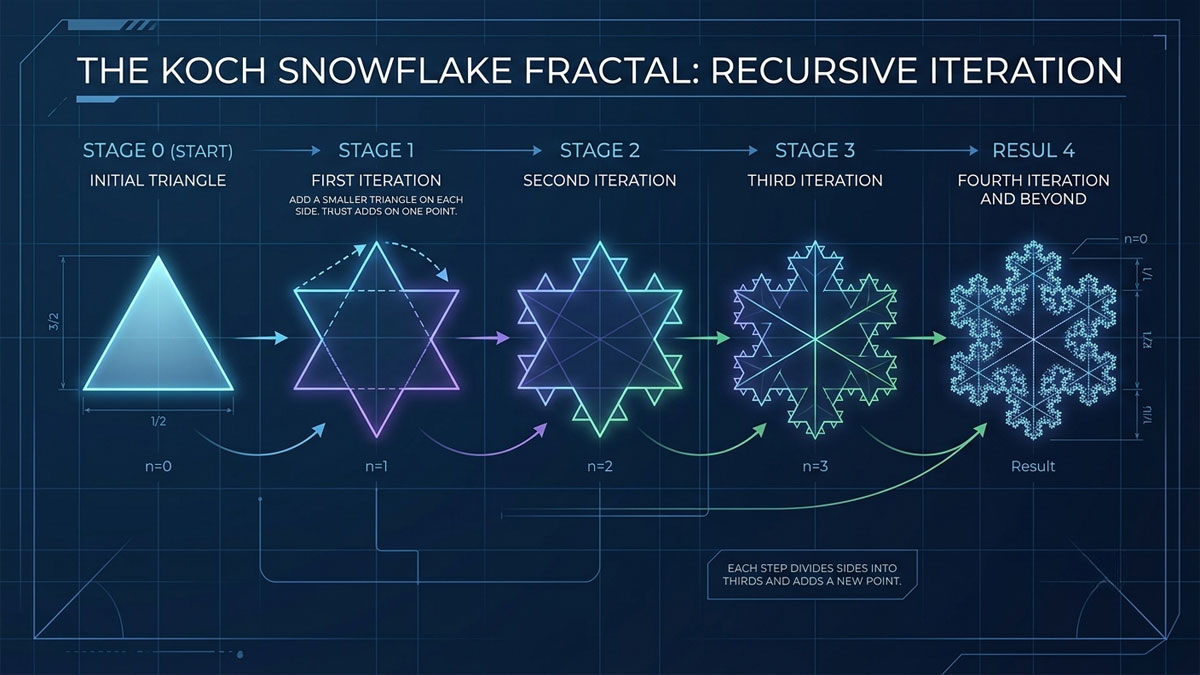
The Koch Snowflake is created by following a simple recursive rule on each side of an equilateral triangle:
- Iteration 0: Start with an equilateral triangle.
- Iteration 1: Divide each side into three equal segments. Remove the middle segment and replace it with two sides of a smaller equilateral triangle pointing outward.
- The Loop: Repeat this process for every new line segment created. As the number of iterations ($n$) approaches infinity, the shape becomes a fractal.
2. The Mathematical Paradox
Infinite Perimeter: At each step, the length of the boundary increases by a factor of $4/3$. As the iterations continue, the perimeter grows toward infinity.
Finite Area: Despite the infinite edge, the snowflake never grows beyond a circle drawn around the original triangle. The total area is limited to exactly $8/5$ times the area of the original triangle.
This is a practical application of Geometric Series and Limits, core topics in Standard XII Calculus.
3. Connection to Chaos Theory
Chaos Theory studies systems that are highly sensitive to initial conditions (The "Butterfly Effect"). Fractals are the visual traces of these chaotic systems. Like a snowflake, small changes in the starting "seed" of a mathematical equation can result in vastly different, infinitely complex patterns.
Real-World Industry Applications
- Antenna Design: "Fractal Antennas" use Koch-like shapes to maximize their surface area in a tiny space, allowing your smartphone to pick up a wide range of frequencies (GPS, Bluetooth, 5G) with a single internal part.
- Digital Landscaping: Filmmakers use fractal algorithms to generate hyper-realistic mountain ranges and terrain for movies like *Avatar* and *Star Wars*.
- Medicine: The branching of human lungs and the network of blood vessels are fractals. Doctors use fractal dimensions to measure the health of these systems and detect early signs of disease.
Frequently Asked Questions
Q: What is a Fractal Dimension?
A: Most shapes are 1D (line), 2D (plane), or 3D (volume). The Koch Snowflake exists in between dimensions—it has a dimension of approximately **1.26**, meaning it is more than a line but not quite a 2D area.
Q: Can we see a true fractal in real life?
A: Not a "perfect" one. In math, fractals go on forever. In nature (like a Romanesco broccoli), the pattern eventually stops when it reaches the atomic level.
 Durga Puja
 CLAT Aspirants
 Craft Ideas for Kids
 Benefits of Yoga for Kids
 School Projects & Homework Help
 Hobbies: Philately, Fishing, Camping
 Fun and Jokes