
The Golden Ratio in Nature: Earth's Mathematical Signature
Explore nature's hidden math patterns in this exciting school project.


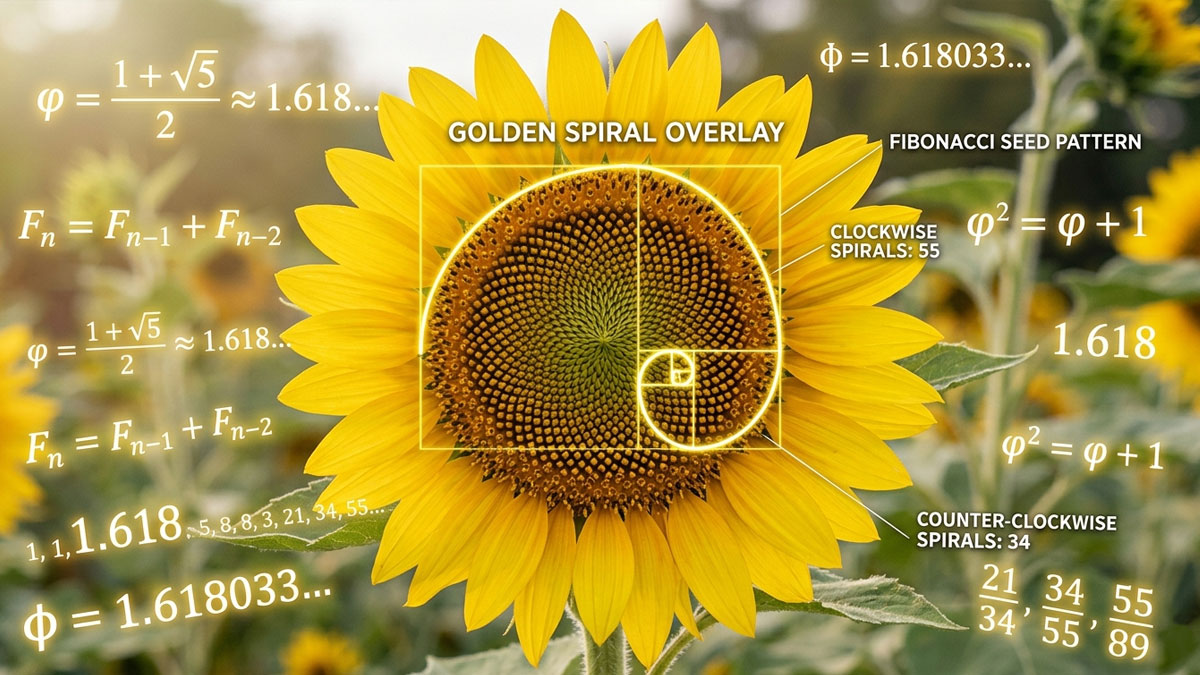
Is there a secret code written in the petals of a flower? From the spiral of a nautilus shell to the arrangement of seeds in a sunflower, nature appears to follow a precise mathematical ratio known as Phi (Φ). This project explores how the Fibonacci sequence and the Golden Ratio dictate the growth and beauty of the natural world.
Defining the Golden Ratio (Φ)
Two quantities are in the Golden Ratio if their ratio is the same as the ratio of their sum to the larger of the two quantities. Mathematically, it is expressed as:
Closely related is the Fibonacci Sequence (0, 1, 1, 2, 3, 5, 8, 13...). As you divide any number in the sequence by the one before it, the result gets closer and closer to 1.618.
Field Observation: Where to Find It
For your project, collect or photograph the following items to measure their ratios:
- Phyllotaxis (Leaf Arrangement): Many plants grow leaves in a spiral pattern to ensure each leaf gets maximum sunlight. Measure the angle between successive leaves.
- The Pinecone Spiral: Count the number of spirals going clockwise versus counter-clockwise. These are almost always two consecutive Fibonacci numbers (e.g., 8 and 13).
- The Nautilus Shell: Measure the width of the chambers. Each chamber is roughly 1.618 times the size of the previous one.
Example Data Table for Your Project
| Object | Measurement A (Long) | Measurement B (Short) | Ratio (A/B) |
|---|---|---|---|
| Sunflower Seed Spiral | 34 spirals | 21 spirals | 1.619 |
| Rose Petal Arrangement | 8 petals | 5 petals | 1.600 |
| Human Forearm to Hand | 25.4 cm | 15.7 cm | 1.617 |
2 Real-World Applications of the Golden Ratio
- Financial Market Analysis: Traders use "Fibonacci Retracements" (based on ratios derived from Phi) to predict support and resistance levels in the stock market. This assumes human trading behavior follows natural patterns.
- Aesthetic Surgery & Design: The Golden Ratio is used in facial reconstructive surgery to determine balanced proportions. Similarly, UI/UX designers use the ratio to create pleasing layouts for websites and mobile apps.
- Solar Energy: Engineers design "Fibonacci Solar Trees" where solar panels are arranged like leaves to minimize shading and maximize energy capture.
Frequently Asked Questions
Q: Does every plant follow the Golden Ratio?
A: No. While it is incredibly common, some plants follow different patterns based on environmental stressors. Finding "exceptions" makes for an excellent section in your project report!
Q: Why does nature prefer this specific number?
A: Efficiency. The Golden Ratio allows for the tightest possible packing of seeds or leaves without overlapping, ensuring the best use of space and resources.
 Durga Puja
 CLAT Aspirants
 Craft Ideas for Kids
 Benefits of Yoga for Kids
 School Projects & Homework Help
 Hobbies: Philately, Fishing, Camping
 Fun and Jokes