
School Project · Mathematics & Probability
The Monty Hall Problem
Should you switch doors — or does it not matter? The answer will surprise you.


Three doors. One car. Two goats. The host opens a door — and now asks: do you switch? Most people say it doesn't matter. They are wrong.
The Setup
Picture the following scenario: you are at the final stage of a game show. In front of you stand three doors, labelled A, B, and C from left to right. Behind one door lies the prize you have been competing for — a brand-new car, for example. The other two doors hold goats. Pick the wrong door, and you get nothing.
The game show host requests that you choose a door. Let us say the chosen door is B. Then the host — who knows what is behind each door — goes over and opens door C. Revealed behind it is a goat. Now, the host asks you: would you like to switch your choice to door A?
At this point, most assume the probability of winning to be 50%. It is natural to do so, since we appear to be considering only two options — A and B. However, the solution to the Monty Hall Problem says that there is a significantly higher probability of winning if you switch.
If You Stay With Door B
Let us consider the case where you picked door B and refused to switch. There are three equally likely scenarios for where the car could be:
Staying with your choice No switch
Result: staying gives you a 1 in 3 chance of winning — a 66.6% chance of losing.
If You Switch to Door A
Now, say you chose B and decided to switch every time the host offers you the chance:
Switching your choice Always switch
Result: switching gives you a 2 in 3 chance of winning — from 33.3% all the way up to 66.6%.
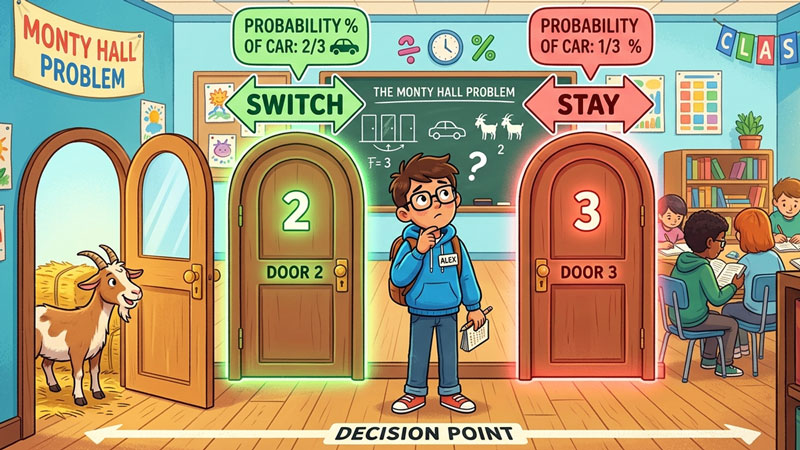
The key insight is this: when you first picked door B, you had a 1/3 chance of being right. That means the other two doors together held a 2/3 chance of concealing the car. When the host eliminates one of those doors by showing a goat, the entire 2/3 probability concentrates on the remaining door — door A. Switching is therefore always the rational choice.
A Brief History of the Problem
The Monty Hall Problem originated from a 1975 letter written by Steve Selvin to The American Statistician, titled "A Problem in Probability." It was named after Monty Hall, the charismatic host of the American television game show Let's Make a Deal, whose three-door format inspired the scenario.
The problem rose to widespread fame in 1990, when Marilyn vos Savant — holder of the Guinness World Record for highest recorded IQ at the time — described and solved it in her "Ask Marilyn" column in Parade magazine. Her correct answer (switch!) triggered an avalanche of outraged letters from readers, including mathematics professors, who insisted she was wrong. She was right.
 Durga Puja
 CLAT Aspirants
 Craft Ideas for Kids
 Benefits of Yoga for Kids
 School Projects & Homework Help
 Hobbies: Philately, Fishing, Camping
 Fun and Jokes