
Optimization of Resources: The Math of Efficiency
A smart school project on resource management


In a world of limited resources, how do we make the best possible choice? Linear Programming (LPP) is the mathematical answer to that question. Whether it’s a factory maximizing production or a nutritionist minimizing cost, LPP provides the framework for perfect decision-making.
1. The Three Components of an LPP
Every optimization problem must be translated into three distinct mathematical parts for your project:
- Decision Variables ($x, y$): The quantities you are deciding upon (e.g., number of tables and chairs to manufacture).
- Objective Function ($Z$): The goal. Usually expressed as:
$Z = ax + by$
- Constraints: The limitations (labor hours, raw materials, budget) expressed as linear inequalities:
$a_1x + b_1y \leq c_1$
2. Solving via the Graphical Method
For Standard XII, we focus on problems with two variables, solved using the coordinate plane:
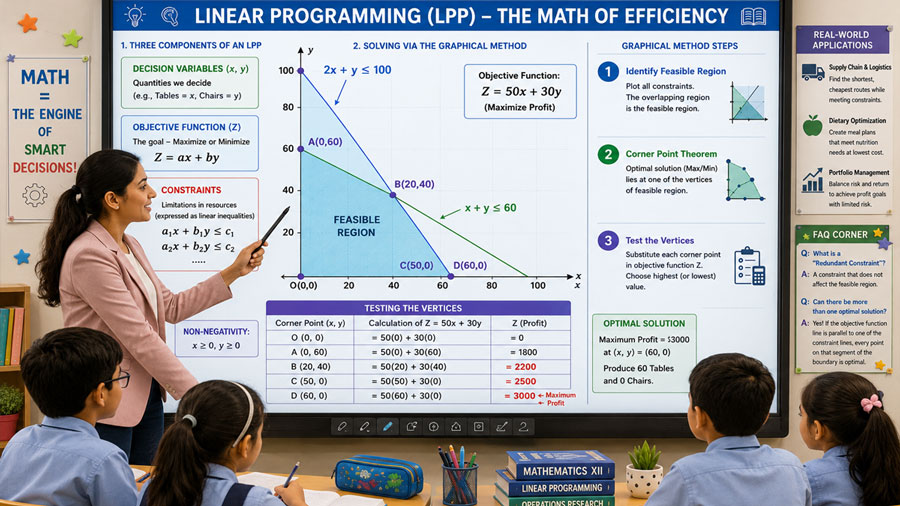
- Identify the Feasible Region: Plot all constraint inequalities on a graph. The area where all shaded regions overlap is your "Feasible Region."
- Corner Point Theorem: The fundamental theorem of LPP states that the optimal solution (Maximum or Minimum) *must* lie at one of the vertices (corners) of the feasible region.
- Test the Vertices: Plug the $(x, y)$ coordinates of each corner into your Objective Function ($Z$). The highest (or lowest) value is your answer.
3. Case Study: The Manufacturing Dilemma
Imagine a furniture maker who makes Tables ($x$) and Chairs ($y$).
- Wood Constraint: $2x + 1y \leq 100$ board-feet
- Labor Constraint: $1x + 1y \leq 60$ hours
- Non-negativity: $x, y \geq 0$
By plotting these, students learn how "bottlenecks" (like wood or labor) limit potential profit and how to find the "Sweet Spot" of production.
Real-World Industry Applications
- Supply Chain & Logistics: Companies like FedEx and DHL use LPP to find the shortest, cheapest routes for thousands of delivery trucks while adhering to fuel and time constraints.
- Dietary Optimization: Hospitals use LPP to create meal plans that meet all nutritional requirements (vitamins, minerals, protein) at the lowest possible cost.
- Portfolio Management: Financial advisors use optimization to balance risk and return, ensuring a client's investment meets a specific profit goal without exceeding a set risk level.
Frequently Asked Questions
Q: What is a "Redundant Constraint"?
A: It is a constraint that does not affect the feasible region. It’s like having a limit on wood that is so high you’d run out of labor long before you ever ran out of wood.
Q: Can there be more than one optimal solution?
A: Yes! If the objective function line is parallel to one of the constraint lines, every point on that segment of the boundary is an optimal solution.
 Durga Puja
 CLAT Aspirants
 Craft Ideas for Kids
 Benefits of Yoga for Kids
 School Projects & Homework Help
 Hobbies: Philately, Fishing, Camping
 Fun and Jokes