
Pascal's Triangle: The Infinite Map of Algebra
Explore Algebra and Probability in This School Project


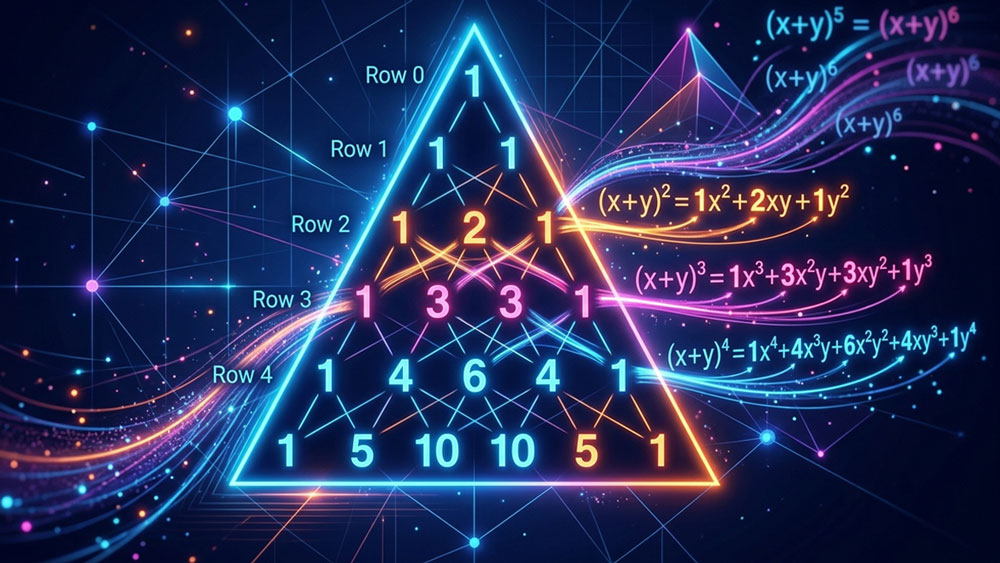
A simple addition, an infinite result. Pascal's Triangle is formed by starting with a 1 at the top and adding the two numbers above to find the one below. While it looks like simple arithmetic, it is actually a powerhouse of advanced mathematics, containing within it the secrets of **Probability, Algebra, and Fractals**. This Standard XI project explores the triangle's deep connection to the Binomial Theorem and beyond.
1. The Binomial Connection
In Standard XI, you learn the **Binomial Theorem** for expanding $(x + y)^n$. Pascal's Triangle is the visual representation of the coefficients ($^nC_r$) for these expansions.
Row 1: $(x+y)^1 = \mathbf{1}x + \mathbf{1}y$
Row 2: $(x+y)^2 = \mathbf{1}x^2 + \mathbf{2}xy + \mathbf{1}y^2$
Row 3: $(x+y)^3 = \mathbf{1}x^3 + \mathbf{3}x^2y + \mathbf{3}xy^2 + \mathbf{1}y^3$
This allows us to expand complex binomials without performing long-hand multiplication, a fundamental skill for calculus and probability.
3. The Sierpinski Gasket (Fractal Art)
If you take a large version of Pascal's Triangle and color all the **odd numbers** one color and the **even numbers** another, you will see a famous fractal known as the **Sierpinski Gasket**.
This reveals that self-similarity (a core concept of Chaos Theory) is baked into basic algebraic structures. As you add more rows, the pattern becomes more intricate, showing that order can arise from simple, repetitive rules.
Real-World Applications
- Probability Theory: Gamblers and actuaries use the triangle to find the probability of outcomes (like coin tosses). The $n^{th}$ row tells you the total combinations for $n$ events.
- Computer Science: The triangle is used in **Bezier Curves**, the mathematical curves used in computer-aided design (CAD) and vector graphics like Adobe Illustrator.
- Genetics: Scientists use binomial expansion (and thus Pascal's Triangle) to predict the probability of specific traits being passed down to offspring based on dominant and recessive genes.
Frequently Asked Questions
Q: Can the triangle be used for negative powers?
A: While the standard triangle is for positive integers, the concept can be extended into the "Binomial Series" for negative and fractional powers, which is a key part of Standard XI/XII Calculus.
Q: Who actually discovered it?
A: While named after Blaise Pascal (1653), the triangle was known to mathematicians in China (Yang Hui), India (Pingala), and Iran (Omar Khayyam) centuries earlier!
Optimized for Standard XI Advanced Mathematics.
 Durga Puja
 CLAT Aspirants
 Craft Ideas for Kids
 Benefits of Yoga for Kids
 School Projects & Homework Help
 Hobbies: Philately, Fishing, Camping
 Fun and Jokes