
Survey on Pocket Money: A Descriptive Statistics Project
Analyzing Student Spending Habits – A School Project


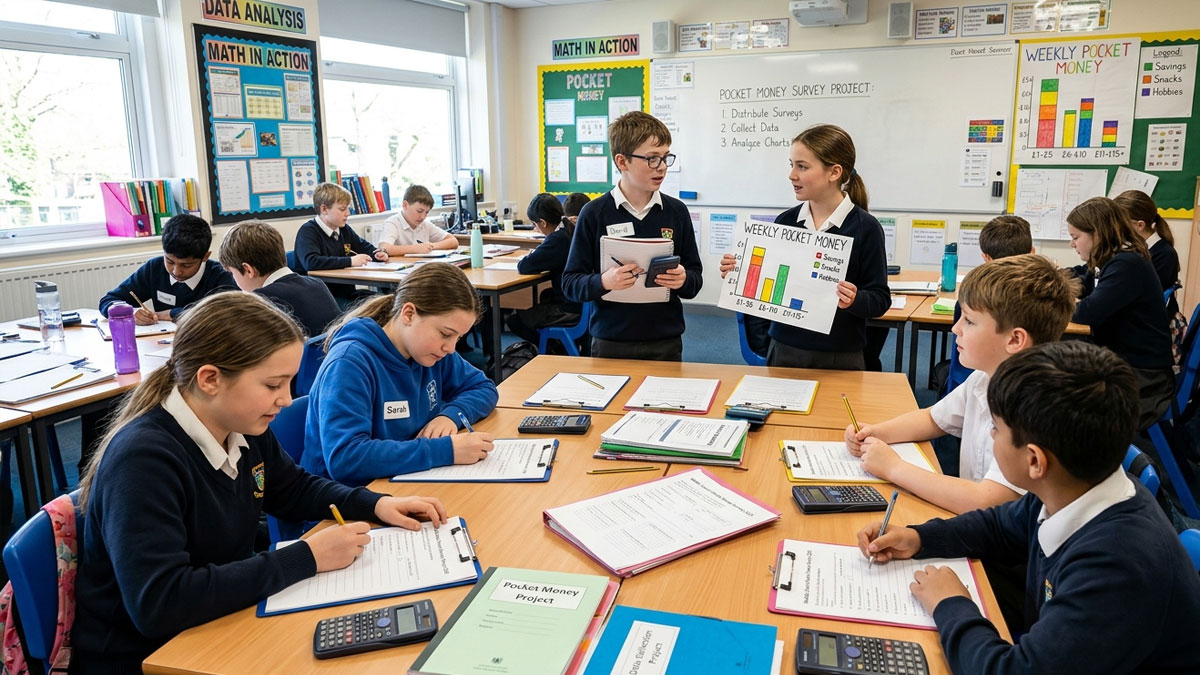
Where does the money go? In this investigative project, we move beyond textbook problems and into real-world data collection. By surveying your peers on their monthly spending habits, you will learn to organize raw data into frequency distributions and calculate the three pillars of central tendency: Mean, Median, and Mode.
Phase 1: Data Collection & Methodology
To ensure a statistically significant result, you must gather data from at least 30 to 50 students. Use a simple questionnaire to record their monthly pocket money or weekly spending.
- Primary Data: Data collected directly by you through the survey.
- Class Intervals: Group the raw data into intervals (e.g., $0-100, 100-200, 200-300$) for easier analysis.
Phase 2: Measures of Central Tendency
Once your data is grouped, apply the following formulas to find the "average" student spender:
Median: The middle value when data is arranged in order. In grouped data, it is found using the formula: $l + \left(\frac{\frac{n}{2} - cf}{f}\right)h$.
Mode: The value that appears most frequently. For grouped data: $l + \left(\frac{f_1 - f_0}{2f_1 - f_0 - f_2}\right)h$.
Phase 3: Graphical Representation
A statistics project is incomplete without visual data analysis. You are required to construct:
- Histogram: To show the frequency distribution of spending.
- Less-than Ogive: A cumulative frequency curve used to estimate the median graphically.
- More-than Ogive: Used to find the point where both curves intersect—this intersection point on the x-axis is your Median.
Real-World Applications
- Market Research: Companies like Amazon or Netflix use similar surveys to determine "Average Revenue Per User" (ARPU), allowing them to price subscriptions effectively for different age groups.
- Economic Policy: Governments conduct "Consumer Expenditure Surveys" to calculate the Consumer Price Index (CPI), which measures inflation based on what an average family spends.
- Banking: Credit card companies analyze spending patterns to detect fraud. If your spending deviates significantly from your calculated "Mean" or "Mode," their algorithms flag it as a risk.
Frequently Asked Questions
Q: What is the difference between Mean and Median in spending data?
A: If one student in your survey gets $10,000 while others get $100, the **Mean** will be very high (skewed), but the **Median** will stay near $100. This is why the Median is often a better measure for "typical" spending.
Q: Why do we use grouped data instead of raw data?
A: Raw data is messy. Grouping data into class intervals makes it easier to spot patterns and create professional graphs like Histograms.
Aligned with Standard X Statistics Syllabus.
 Durga Puja
 CLAT Aspirants
 Craft Ideas for Kids
 Benefits of Yoga for Kids
 School Projects & Homework Help
 Hobbies: Philately, Fishing, Camping
 Fun and Jokes