
Modeling Traffic: The Poisson Distribution
A Real-World Probability School Project on Traffic Flow


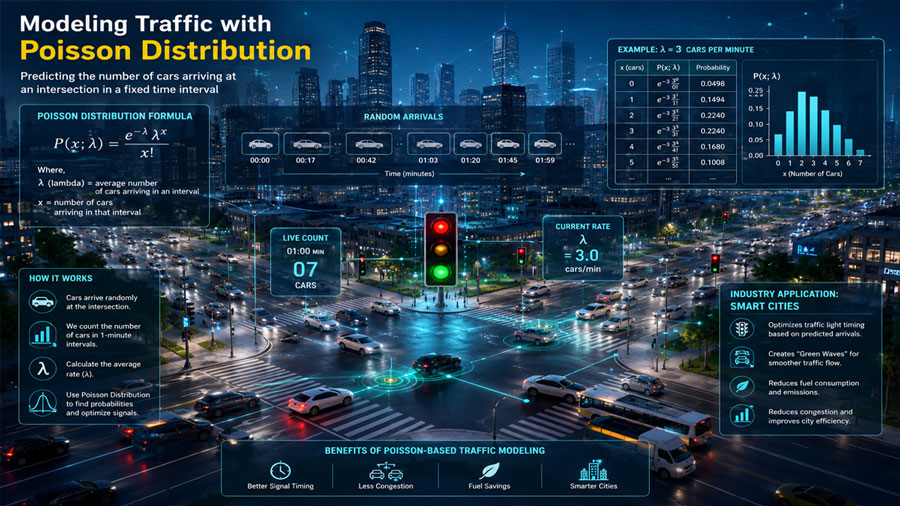
How do urban planners decide the timing of a traffic light? They use the **Poisson Distribution** to model the probability of a certain number of cars arriving at an intersection within a specific timeframe.
The Formula for Random Arrivals
Where $\lambda$ (lambda) is the average number of events per interval. This project involves students counting car arrivals in 1-minute intervals to find the "rate" of the intersection.
Industry Application: Smart Cities
Engineers use this to optimize "Green Waves" in cities, ensuring that traffic lights stay green for the expected arrival of car clusters, reducing fuel consumption and city-wide congestion.
Frequently Asked Questions
Q: What is the Poisson Distribution?
A: The Poisson Distribution is a probability model used to predict how many times an event may occur within a fixed interval of time or space.
Q: How is the Poisson Distribution used in traffic modeling?
A: Traffic engineers use the Poisson Distribution to estimate the probability of cars arriving at an intersection during a certain time period.
Q: What does lambda represent in the Poisson formula?
A: Lambda represents the average number of events occurring within a specific interval, such as the average number of cars arriving per minute.
Q: Why is the Poisson Distribution important for smart cities?
A: It helps optimize traffic signal timing, reduce congestion, improve fuel efficiency, and support intelligent transportation systems in smart cities.
Q: How can students perform a Poisson Distribution school project?
A: Students can count the number of cars arriving at an intersection during equal time intervals and use the data to calculate average arrival rates and probabilities.
 Durga Puja
 CLAT Aspirants
 Craft Ideas for Kids
 Benefits of Yoga for Kids
 School Projects & Homework Help
 Hobbies: Philately, Fishing, Camping
 Fun and Jokes