
Probability in Games: The Science of Winning
A Fun Probability School Project on Games & Chance


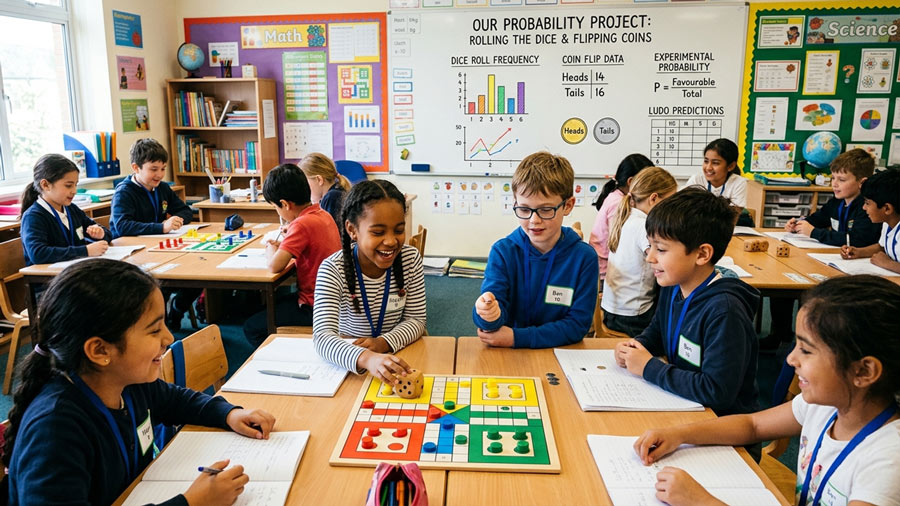
Is it luck, or is it math? From the roll of a die in Ludo to the draw of a card in Poker, every game is governed by the Laws of Probability. This project helps you transition from simple coin tosses to complex game simulations, comparing what *should* happen (Theoretical) with what *actually* happens (Experimental).
Phase 1: Defining the Sample Space
The first step in any probability project is identifying the **Sample Space ($S$)**—the set of all possible outcomes. For a standard 6-sided die, $S = \{1, 2, 3, 4, 5, 6\}$.
Phase 2: The Dice Simulation
Conduct an experiment by rolling a single die 100 times. Record each outcome in a tally mark table. You will often notice that while each number has a 1/6 (16.6%) chance, your experimental results will vary slightly.
| Outcome | Theoretical Prob. | Experimental (100 Rolls) | Difference |
|---|---|---|---|
| Rolling a '6' | 16.6% | 18.0% (Example) | +1.4% |
The Law of Large Numbers: As you increase your trials from 10 to 1,000, your experimental probability will get closer and closer to the theoretical 16.6%.
Phase 3: Real-World Game Analysis
- Monopoly: Calculate the probability of landing on "Go to Jail" versus a high-rent property like "Boardwalk."
- Card Games: Determine the probability of drawing an Ace from a well-shuffled deck of 52 cards ($4/52$ or $1/13$).
- Ludo: Analyze the probability of rolling a "6" to start the game.
Real-World Applications
- Insurance Actuaries: Insurance companies are built on probability. They calculate the "probability of an accident" based on age and history to determine your premium.
- Game Design: Developers for games like *Genshin Impact* or *Candy Crush* use "Drop Rates" (probability) to ensure the game is challenging yet rewarding enough to keep players engaged.
- Artificial Intelligence: Self-driving cars use "Probabilistic Robotics" to decide if an object in the road is a plastic bag or a rock, choosing the safest action based on the highest probability.
Frequently Asked Questions
Q: Why did I roll a '6' five times in a row if the probability is low?
A: Probability describes long-term trends, not short-term streaks. Each roll is an **Independent Event**, meaning the die has no "memory" of previous rolls.
Q: How do I represent this in my project?
A: Use a **Bar Graph** to compare the frequency of each outcome and a **Pie Chart** to show the distribution of your 100 trials.
Verified for Standard X Math Projects.
 Durga Puja
 CLAT Aspirants
 Craft Ideas for Kids
 Benefits of Yoga for Kids
 School Projects & Homework Help
 Hobbies: Philately, Fishing, Camping
 Fun and Jokes