
Pythagorean Theorem in Art: Creating Geometric Proofs
Creative Geometry School Project: Visual Proofs with Art & Fractals.


Proof through Beauty. Can you prove a mathematical law without using a single number? By using "Geometric Tiling" and the fractal patterns of the "Pythagoras Tree," we can visualize the fundamental law of right-angled triangles through art. This project is a perfect fusion of rigorous geometry and creative design.
The Concept: Area-Based Proof
The Pythagorean Theorem states that for any right-angled triangle, the area of the square built on the hypotenuse ($c$) is equal to the sum of the areas of the squares built on the other two sides ($a$ and $b$).
In Artistic Terms: Area(Square A) + Area(Square B) = Area(Square C)
Method 1: Geometric Tiling Mural
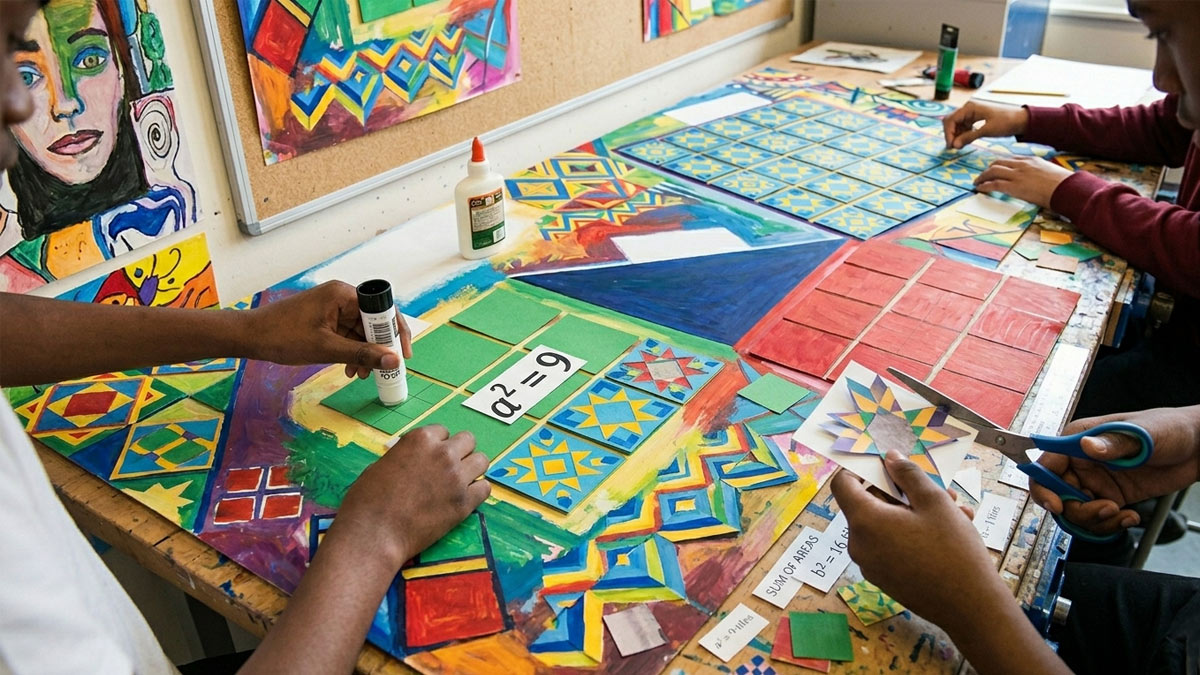
This method uses a specific type of tiling (tessellation) to prove the theorem. By using two different colors of square tiles, you can fill the larger square in a way that visually represents the two smaller squares.
- The Perigal's Dissection: Cut the middle-sized square ($b^2$) into four specific parts and rearrange them around the smallest square ($a^2$) to perfectly fill the largest square ($c^2$).
- Mural Application: Paint these sections in contrasting colors on a canvas to create a "Mathematical Mural."
Method 2: The Pythagoras Tree (Fractal Art)
The Pythagoras Tree is a plane fractal constructed of squares. It shows the theorem repeated infinitely, creating a canopy-like structure.
- Start with a single square as the base (trunk).
- Construct a right-angled triangle on its top side.
- Construct two smaller squares on the other two sides of that triangle.
- Repeat the process for each new square to grow the "branches."
Real-World Applications of Geometric Art
- Architecture & Tiling: Islamic geometric patterns often utilize Pythagorean ratios to create perfect star-shaped tilings (Girih tiles) in mosques.
- Computer Graphics: Fractals like the Pythagoras Tree are used in procedural generation to create realistic-looking foliage in video games.
- Modern Branding: Logos for companies often use "Geometric Construction," where every curve is derived from Pythagorean circles and triangles for visual harmony.
Frequently Asked Questions
Q: Can I use non-square shapes for this proof?
A: Yes! As long as the shapes are "similar" (e.g., semicircles or equilateral triangles), the sum of the areas on the two smaller sides will always equal the area on the hypotenuse.
Q: What is the best medium for a math mural?
A: For school projects, acrylic paint on canvas or colored cardstock paper for "cut-and-paste" tiling works best to ensure sharp, geometric edges.
 Durga Puja
 CLAT Aspirants
 Craft Ideas for Kids
 Benefits of Yoga for Kids
 School Projects & Homework Help
 Hobbies: Philately, Fishing, Camping
 Fun and Jokes