
Regression Analysis: The Math of Trend Prediction
Linear Regression Explained for School Project


Can math predict the future? While we cannot see the future perfectly, we can use **Linear Regression** to find patterns in past data. By calculating the "Line of Best Fit," we can determine how one variable (like study hours) directly influences another (like exam scores), allowing us to make calculated predictions about unknown outcomes.
1. Correlation: Measuring the Connection
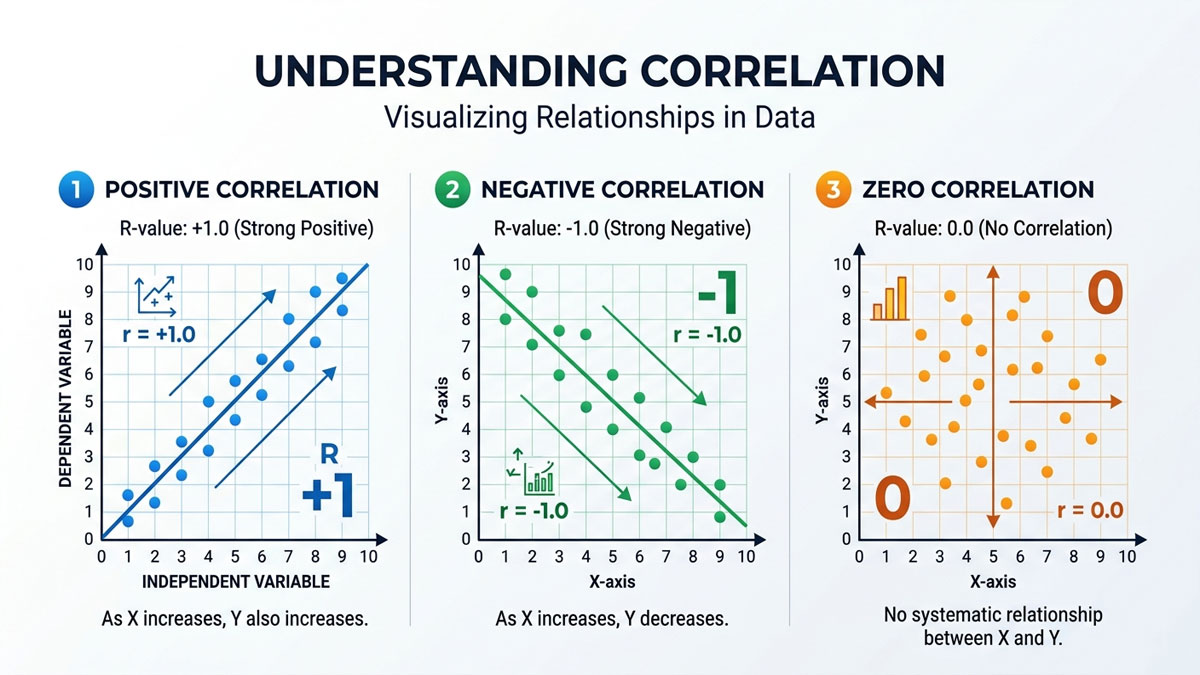
Before predicting, we must measure the strength of the relationship using **Pearson’s Correlation Coefficient ($r$)**. The value of $r$ always ranges from -1 to +1.
- +1: Perfect Positive Correlation (As $X$ goes up, $Y$ goes up).
- -1: Perfect Negative Correlation (As $X$ goes up, $Y$ goes down).
- 0: No Correlation (The variables have no linear relationship).
2. The Least Squares Method
The "Line of Best Fit" is the line that minimizes the sum of the squares of the vertical distances (residuals) between the data points and the line itself. The equation of this line is:
- $Y$ is the dependent variable (to be predicted).
- $X$ is the independent variable.
- $b$ is the slope (Regression Coefficient).
- $a$ is the Y-intercept.
3. Project Methodology
To perform an advanced regression analysis for your school project, follow these steps:
- Data Collection: Gather bivariate data (e.g., Height vs. Weight of 30 students, or Daily Temperature vs. Ice Cream Sales).
- Scatter Plot: Draw a scatter plot of your data points to visually check for a linear trend.
- Calculate Means: Find $\bar{X}$ and $\bar{Y}$.
- Compute $b$: Use the formula $b = \frac{n(\sum XY) - (\sum X)(\sum Y)}{n(\sum X^2) - (\sum X)^2}$.
- Prediction: Use your final equation to predict $Y$ for a new value of $X$ that wasn't in your original survey.
Real-World Industry Applications
- E-commerce (Amazon/Netflix): Regression models analyze your browsing history to predict what you are likely to buy next, allowing for highly targeted "Recommended for You" sections.
- Climate Science: Scientists use regression to correlate atmospheric $CO_2$ levels with global temperature rises, helping them predict future climate scenarios.
- Sports Analytics: Teams (like those in the movie *Moneyball*) use regression to predict a player's future performance based on past statistics, determining their value in the transfer market.
Frequently Asked Questions
Q: Does Correlation imply Causation?
A: Absolutely not! Just because two things move together (like shark attacks and ice cream sales both rising in summer) doesn't mean one causes the other. Both are usually caused by a third factor—in this case, hot weather.
Q: What is an Outlier?
A: An outlier is a data point that is far away from the line of best fit. Outliers can significantly pull the regression line away from the true trend and should be investigated carefully.
 Durga Puja
 CLAT Aspirants
 Craft Ideas for Kids
 Benefits of Yoga for Kids
 School Projects & Homework Help
 Hobbies: Philately, Fishing, Camping
 Fun and Jokes