
Surface Area & Volume House
Build a 3D house model and calculate surface area, volume, and material use.


Architects don't just "draw" houses; they calculate them. This project applies the laws of Mensuration to a 3D architectural model. You will build a composite solid—a house—and calculate how much paint is needed (Surface Area) and how much space is available inside (Volume).
1. Working with Composite Solids
A house is rarely a single shape. To find its total metrics, we must "decompose" the structure into its basic geometric components:
Rectangular Prism (Rooms)
$V = l \times w \times h$$SA = 2(lw + wh + hl)$
Cylinder (Pillars)
$V = \pi r^2 h$$CSA = 2\pi rh$
Triangular Prism (Roof)
$V = (\text{Area of Base}) \times L$$SA = \text{Sum of all faces}$
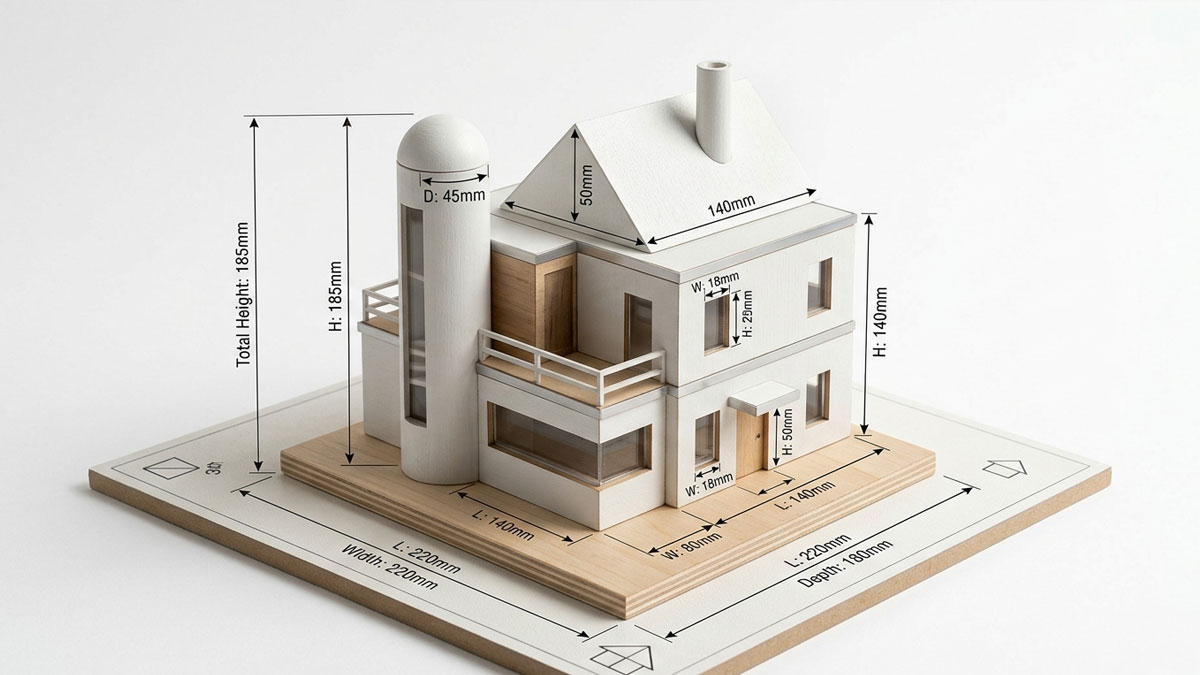
2. The Project Challenge
Scenario: You are an interior designer tasked with renovating a house. You must calculate:
- Lateral Surface Area: To determine the exact amount of paint required for the walls (excluding floors and ceilings).
- Total Volume: To determine the size of the HVAC (Air Conditioning) system needed to cool the house.
- Material Costing: If 1 liter of paint covers 10 $m^2$, how many buckets are required for your model?
Industrial Application
In modern BIM (Building Information Modeling) software like Revit or AutoCAD, these formulas are the "engine." When a designer draws a wall, the software uses these exact geometric principles to instantly generate a Bill of Materials (BOM), saving construction companies millions in waste material.
 Durga Puja
 CLAT Aspirants
 Craft Ideas for Kids
 Benefits of Yoga for Kids
 School Projects & Homework Help
 Hobbies: Philately, Fishing, Camping
 Fun and Jokes