
Trigonometric Clinometer: A Comprehensive Guide for School Projects
Measure the World with a Simple Protractor


Discover how to turn a simple protractor into a powerful surveying tool. In this project, we explore the practical side of trigonometry to measure the heights of towers, trees, and buildings using the "Angle of Elevation."
Introduction to the Clinometer
A clinometer (or inclinometer) is an instrument used for measuring angles of slope, elevation, or depression of an object with respect to gravity. In the Standard X curriculum, this serves as the perfect application for Trigonometric Ratios—specifically the Tangent function.
Materials Required
- A large protractor (180 degrees)
- A stiff piece of cardboard or a plastic tube (to act as a straw/viewing sight)
- Heavy thread or string (approx. 20cm)
- A small weight (a nut, washer, or eraser)
- Adhesive tape or glue
Construction Procedure
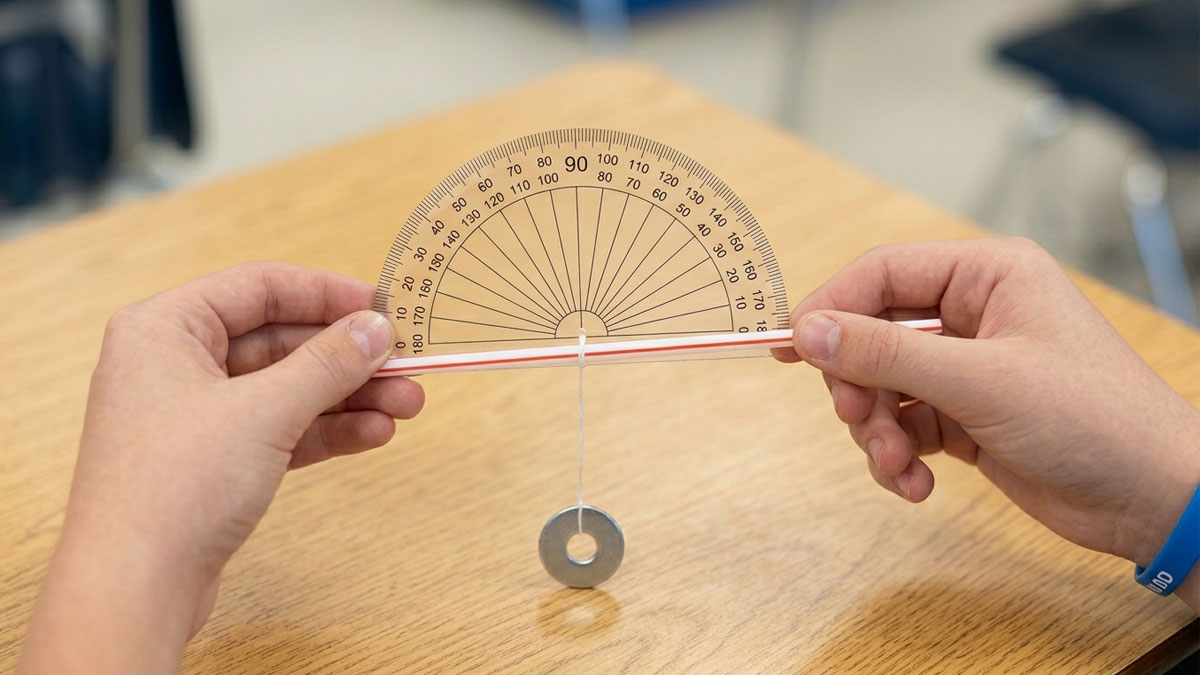
- Attach the Sight: Tape the drinking straw or plastic tube along the straight edge (the 0-180 line) of the protractor.
- Fix the Plumb Line: Punch a small hole at the center point (the origin) of the protractor. Thread the string through and tie it.
- Add the Weight: Tie the weight to the other end of the string. The string should hang freely across the curved edge of the protractor.
The Mathematical Principle
When you look through the straw at the top of a building, the weighted string moves away from the 90° mark. The angle between the string and the 90° mark is exactly equal to the Angle of Elevation ($\theta$) of the object.
Where:
$d$ = Distance from the observer to the object
$\theta$ = Angle of elevation measured by the clinometer
$h$ = Height of the observer's eye from the ground
Real-World Examples
- Civil Engineering: Surveyors use advanced clinometers to check the grade of roads and the height of utility poles.
- Forestry: Park rangers use this method to estimate the height of trees to monitor growth or plan for logging.
- Astronomy: Early astronomers used versions of the clinometer (quadrants) to measure the altitude of stars above the horizon.
Frequently Asked Questions (FAQ)
Q: Why do we add the observer's height ($h$) at the end?
A: The trigonometry calculation only gives the height of the object *above your eye level*. To get the total height from the ground, you must add the distance from your eyes to the floor.
Q: Can I use this for the Angle of Depression?
A: Yes! By looking down from a height, the clinometer measures the angle below the horizontal, which can be used to find the distance of an object on the ground.
 Durga Puja
 CLAT Aspirants
 Craft Ideas for Kids
 Benefits of Yoga for Kids
 School Projects & Homework Help
 Hobbies: Philately, Fishing, Camping
 Fun and Jokes