

Mythological Story: The Sack of Troy
For ten long years, the armies of Greece camped outside the great walled city of Troy, unable to break through its towering defenses. Many heroes had fallen on both sides, and though the gods themselves took sides in the fighting — some favouring the Trojans, others the Greeks — neither army could claim victory. The Greeks began to wonder whether Troy could ever be taken by force at all.
It was the goddess Athena who is said to have planted the seed of a new idea, one built on cleverness rather than strength. She inspired a craftsman named Epeius to construct an enormous wooden horse, hollow inside and large enough to hide a company of armed soldiers. The plan, devised with the sharp mind of the hero Odysseus, was as bold as it was simple: the Greeks would pretend to give up the siege and sail away, leaving the horse behind as what appeared to be an offering to the gods.
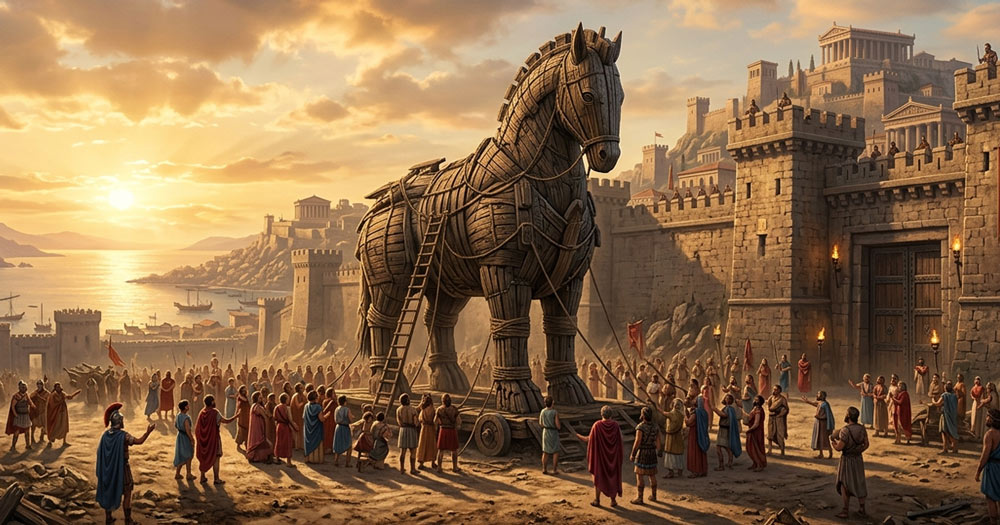
Odysseus and his bravest men climbed inside the hollow belly of the horse while the rest of the Greek fleet sailed just out of sight beyond the horizon, waiting. When the Trojans woke the next morning to find the Greek camp empty and the strange wooden horse standing alone on the shore, they could scarcely believe the long war was finally over.
Some among the Trojans were suspicious. The priest Laocoon warned his people not to trust the gift, famously declaring that he feared Greeks even when they came bearing presents — but his warnings went unheeded, and the people of Troy, weary after a decade of war, wheeled the great horse through their own gates as a trophy of peace. That night, the city celebrated with feasting and wine, certain that their long ordeal had ended at last.
As Troy slept, the hidden Greek soldiers climbed down from inside the horse and quietly opened the city gates. The Greek fleet, which had only sailed a short distance and doubled back under cover of darkness, poured back onto the shore and marched straight into the unguarded city. Troy, which had withstood ten years of open warfare, fell within a single night to a trick.
The fall of Troy marked the end of the Trojan War, but it was only the beginning of new journeys for many of its survivors. Odysseus himself would spend another ten years finding his way home, while other Trojan survivors, according to legend, sailed west to found new nations of their own.
Who's Who in This Story
- Odysseus — the clever Greek hero who devised the plan for the Trojan Horse
- Epeius — the craftsman who built the wooden horse
- Athena — the goddess of wisdom and strategy who inspired the plan
- Laocoon — a Trojan priest who tried and failed to warn his people against the horse
Did You Know?
- The phrase "Trojan Horse" is still used today to describe any trick that hides danger inside something that looks harmless — including a type of computer virus.
- No historical proof of an actual wooden horse has ever been found, but archaeologists have confirmed that a real city of Troy did exist and was indeed destroyed by fire around this period.
- The full story of the war is told across several ancient works, most famously Homer's Iliad and the later Roman poem the Aeneid.
The fall of Troy is one of the oldest reminders in Greek mythology that patience and cleverness can succeed where brute force alone cannot.