CA Foundation Paper 1 Accounts: Ten mock accounts papers that test your grit, and prepares you for flying colours
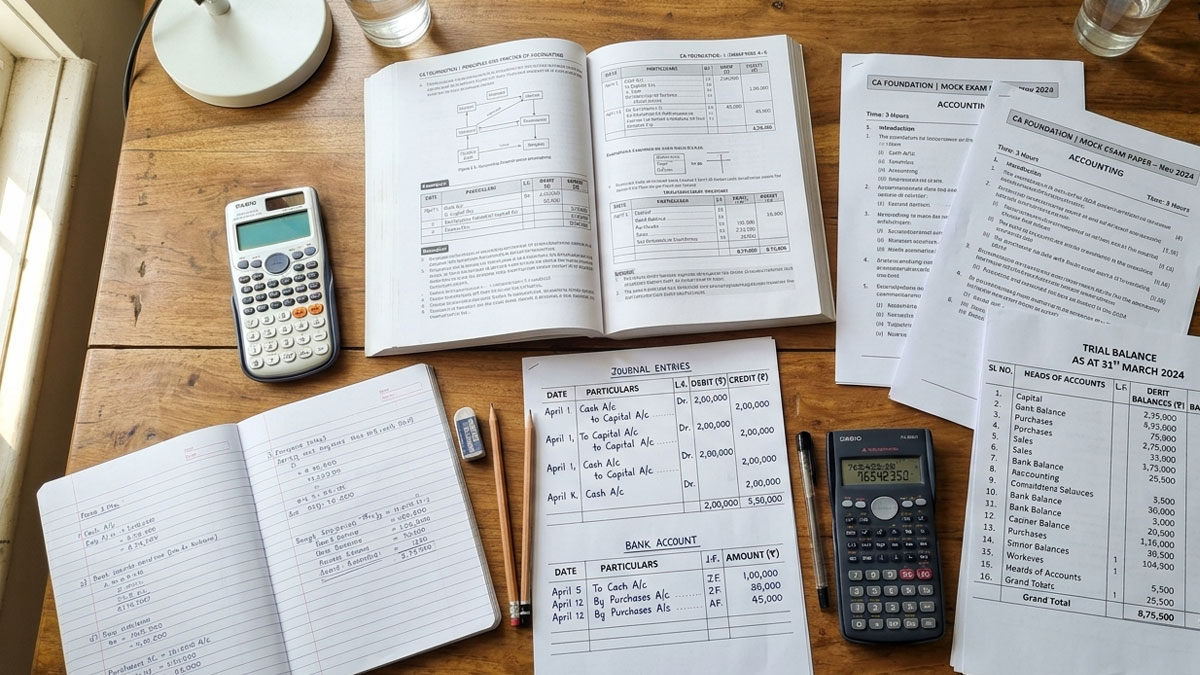
Accounting is the one Foundation paper that is written out rather than ticked, and the one where a candidate can lose twenty marks to a single habit repeated across four questions. These ten sittings are built to find that habit and tell you its name.
Click here for free Sign up and the free mock paperThe paper you will actually sit
One hundred marks, three hours, and nothing to tick. The instructions at the head of the paper are short: Question 1 must be answered, and four of the remaining five after it. That choice is worth understanding early, because it means a candidate who is genuinely weak in one chapter can walk past it — and a candidate who is weak in three cannot.
Question 1 is the odd one out, and the one most candidates prepare for last. Its twenty marks divide into six statements to be marked true or false with the reason at two marks each, a four-mark question answered in prose, and a four-mark practical drawn from the accounting process. Sixteen of those twenty marks are theory, and the reason is what is being bought, not the verdict.
What one of these ten papers looks like
The same hundred marks in the same three hours, laid out the way the real paper lays them out.
| Question | What it asks for | Marks |
|---|---|---|
| Question 1 | ||
| 1 (i)–(viii) | Statements to be marked true or false, with the reason — 8 of them, 2 marks each | 16 |
| 1 (ix) | A subsidiary book, or the entries behind one | 4 |
| Questions 2 to 5 | ||
| 2 | Final accounts of a sole proprietor | 20 |
| 3 (i) | Partnership | 12 |
| 3 (ii) | Partnership | 8 |
| 4 (i) | Company accounts | 12 |
| 4 (ii) | Company accounts | 8 |
| 5 (i) | One of not-for-profit organisation, accounts from incomplete records, bank reconciliation, inventories, depreciation, bills of exchange, cash book, rectification of errors or trial balance | 8 |
| 5 (ii) | One of inventories, bills of exchange, not-for-profit organisation, depreciation, bank reconciliation, rectification of errors or accounts from incomplete records | 6 |
| 5 (iii) | One of bills of exchange, inventories, depreciation, not-for-profit organisation, bank reconciliation, rectification of errors or accounts from incomplete records | 6 |
| Total | 100 | |
Three places this departs from the real paper
Stated here rather than discovered on the day.
- Everything is to be attempted. The real paper lets you leave one of the last five alone. These do not, because a question you skip cannot be diagnosed, and skipping is how a weak chapter stays weak until the week before.
- The prose answer becomes two more statements. Question 1 here is eight statements and the practical rather than six, the prose and the practical. An answer written in sentences cannot be marked in a browser, and pretending otherwise would be worse than the substitution.
- Written answers are not marked anywhere. What is read here is the figure and its classification. Everything a Foundation examiner would give for the explanation beside it is outside what this can see.
Every chapter, somewhere in the set
Four chapters carry a question of their own in all ten papers, because the real paper gives them that weight. The rest rotate through Question 5, and they rotate rather than shuffle, so the ten papers between them reach the whole syllabus instead of reaching most of it on average.
| Ch. | Chapter | Where the set examines it |
|---|---|---|
| 1 | Theoretical framework | Question 1, in every paper |
| 2 | Accounting process | Questions 1 (ix) and 5, in every paper |
| 3 | Bank reconciliation statement | Question 5, in three of the ten |
| 4 | Inventories | Question 5, in five of the ten |
| 5 | Depreciation and amortisation | Question 5, in four of the ten |
| 6 | Bills of exchange and promissory notes | Question 5, in six of the ten |
| 7 | Final accounts of sole proprietors | Question 2, in every paper |
| 8 | Not-for-profit organisations | Question 5, in four of the ten |
| 9 | Accounts from incomplete records | Question 5, in three of the ten |
| 10 | Partnership and LLP accounts | Question 3, in every paper |
| 11 | Company accounts | Question 4, in every paper |
The theory marks have a page of their own
Marking a statement true is not the same skill as earning two marks for saying why, and the gap between them is where that twelve-mark block is usually lost. The theory questions of Paper 1 sets out where the marks sit, ten statements to try, and a three-step way of turning a verdict you are sure of into a sentence that pays.
Alongside the ten papers there is an untimed set of 66 statements covering the whole syllabus, grouped by the eight ways a concept is usually misremembered. It is not a paper and carries no clock: it exists to be worked through slowly, with the reason read after each one.
Getting in
The subscription is sold by route, not by examination, because nobody sits CA Foundation on its own at this stage — it arrives on top of a board year. Pick the board you are entered for; the account that opens covers that board, this paper and the CSEET together, and the first paper of all three is free.
Questions
Are these ICAI’s papers with the numbers changed?
No. Every sum is generated from scratch and then checked by machine against the full text of ICAI’s study material — three hundred thousand words of it — for any run of twelve words in common. Nothing in the set shares a sum or a turn of phrase with it. The intention is not to dress up a past paper but to set a fresh one that behaves the same way.
Why ten papers rather than six?
Because a diagnosis is a rate, and a rate needs occasions. Ten sittings give the same slip enough chances to show that it is a habit rather than an accident, and this is the paper where that matters most: the syllabus is wide, the paper is long, and a single bad afternoon tells a candidate nothing.
Do these replace reading the study material?
They do the opposite. The set is built to send you back to a particular page rather than to all of them, by naming which decision you got wrong and how often. Reading comes first; this is what tells you which reading did not take.
Is the paper really written out by hand?
Yes. Paper 1 carries no multiple-choice section at all: the answers are accounts, statements and working notes, written out. That is why the boxes here ask for figures and for which way they go, and why what comes back is a reading of your working rather than a tick.