

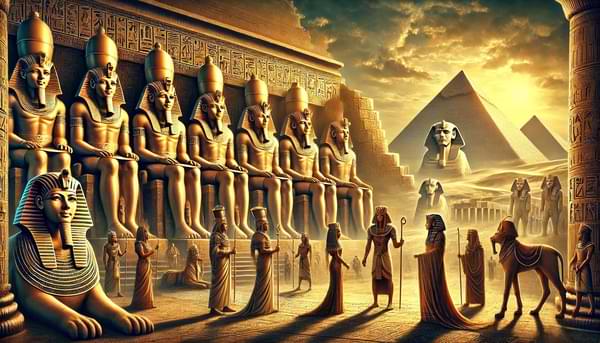
For more than three thousand years, ancient Egypt was ruled by pharaohs — god-kings whose names still echo through the modern imagination. Some are famous for the monuments they raised, others for the empires they built, and a few for stories so dramatic they passed straight into legend. This guide introduces eleven of the most famous pharaohs of ancient Egypt, the rulers whose reigns shaped the civilisation of the Nile and whose tombs, temples and treasures we still study today.
A pharaoh was not simply a king. Egyptians believed the pharaoh was a god in human form, the link between the divine and the people, responsible for keeping order in the universe itself. Most pharaohs inherited the throne through royal birth, though a few rose to it through other paths — military commanders such as Horemheb, foreign rulers such as the Ptolemies, and a handful of remarkable women including Hatshepsut and Cleopatra VII.
Long before the pyramids, Egypt was two lands — Upper Egypt in the south and Lower Egypt in the north. Narmer is the king credited with bringing them together around 3100 BC, founding the First Dynasty and beginning what we now call ancient Egyptian civilisation. The famous Narmer Palette, a carved stone tablet preserved in the Egyptian Museum, shows him wearing the white crown of Upper Egypt on one side and the red crown of Lower Egypt on the other — a clear visual statement that he ruled them both. Some traditions link Narmer with the legendary king Menes; many historians believe they are the same person.
About four hundred years after Narmer, the Third Dynasty pharaoh Djoser changed Egyptian architecture forever. Working with his brilliant vizier and architect Imhotep, Djoser commissioned the Step Pyramid at Saqqara — the first pyramid in history, and the world's earliest large-scale monumental stone structure. Built as six stacked stone mastabas rising about 60 metres high, it set the template that later pharaohs would refine into the famous smooth-sided pyramids at Giza. Imhotep, the man who designed it, was so admired that he was later worshipped as a god of wisdom and medicine.
Khufu, known to the Greeks as Cheops, was the second pharaoh of the Fourth Dynasty — and the man behind the most famous building of the ancient world. The Great Pyramid of Giza, built as his tomb, originally stood about 147 metres high and was the tallest human-made structure on Earth for nearly four thousand years. It is the only one of the Seven Wonders of the Ancient World still standing. How exactly its 2.3 million limestone blocks were quarried, moved and raised is still debated, and the precision of its alignment to the cardinal points remains astonishing. The pyramid is essentially all we have of Khufu — ironically, the only confirmed statue of him is a tiny ivory figurine just 7.5 centimetres tall.
Khufu's son Khafre built the second great pyramid at Giza, slightly smaller than his father's but on higher ground, so that it appears taller from a distance. He is also widely credited with the Great Sphinx, the colossal limestone statue of a reclining lion with a human face that guards the Giza plateau. Many Egyptologists believe the Sphinx's face is a portrait of Khafre himself. Carved from a single outcrop of bedrock, the Sphinx is around 73 metres long and 20 metres high, making it one of the largest single-stone statues in the world.
Hatshepsut became one of ancient Egypt's most successful pharaohs — and she did so as a woman in a role expected to be male. She began as regent for her young stepson Thutmose III, but within a few years she took the full titles of pharaoh and ruled in her own right. Her reign was a time of peace, building and trade. She launched a famous expedition to the distant land of Punt, returning with incense, gold and exotic animals, and she built the magnificent mortuary temple at Deir el-Bahri, its colonnaded terraces cut into the cliffs across the Nile from Thebes. In statues and reliefs she is often shown in the traditional male pharaoh's regalia, including the false beard — a powerful claim to her authority. After her death, Thutmose III tried to erase her image from many monuments, but enough survives that her legacy is now firmly restored.
Once Thutmose III ruled in his own name, he proved to be the greatest military commander in Egyptian history. In a series of seventeen campaigns over twenty years, he expanded Egypt's empire to its largest extent, reaching deep into the Levant and Nubia. His decisive victory at the Battle of Megiddo, fought around 1457 BC against a coalition of Canaanite city-states, is the first battle in history recorded in such detail that we can still follow its tactics. The careful records preserved on the walls of the temple at Karnak have earned Thutmose III the nickname "the Napoleon of Egypt".
By the time Amenhotep III came to the throne, the Egyptian empire was at its height — rich, secure and respected abroad. His long reign of nearly forty years is often called Egypt's golden age. Where earlier pharaohs had fought to expand, he ruled by diplomacy, exchanging letters and gifts with the kings of Babylon, Assyria and Mitanni. His name is on the colossal statues we now call the Colossi of Memnon and on a vast palace complex at Malkata. The art of his court is unusually refined and human, a quality that would soon take an even more radical turn under his son.
Few pharaohs are as controversial as Akhenaten. Born Amenhotep IV, he changed his name and broke with more than a thousand years of Egyptian religion by closing the temples of the traditional gods and declaring that there was only one true god — Aten, the disc of the sun. He moved the capital to a brand-new city, Akhetaten (modern Amarna), and encouraged a strikingly different style of art, in which the royal family is shown with elongated heads, soft bellies and intimate scenes of family life. His chief queen was the famously beautiful Nefertiti, whose painted limestone bust is one of the most recognised faces from the ancient world. After Akhenaten's death, Egypt swiftly returned to its old gods and tried to erase his name from history — which is part of why his short-lived revolution still fascinates us today.
Tutankhamun became pharaoh at about nine years old and died around nineteen — a short reign by any measure. During his rule the old gods were restored and the country quietly recovered from the Amarna upheaval. He would probably be a footnote in Egyptian history except for one thing: in 1922, the British archaeologist Howard Carter discovered his nearly intact tomb in the Valley of the Kings. The treasures inside — the golden death mask, the nested coffins, the chariots, the jewellery, more than five thousand objects — gave the world its most vivid glimpse of royal Egypt and turned "King Tut" into the most famous pharaoh of all time.
Ramses II is the pharaoh whose name appears on more monuments than any other — partly because he reigned for an astonishing 66 years, partly because he was a tireless self-promoter. The third pharaoh of the Nineteenth Dynasty, he led Egypt through one of its most prosperous periods, fought the famous Battle of Kadesh against the Hittites around 1274 BC, and afterwards signed what is generally considered the world's earliest surviving peace treaty. As a builder he was extraordinary: the rock-cut temples of Abu Simbel, the massive Ramesseum, additions to Karnak and Luxor. Many statues of earlier pharaohs were re-inscribed with his name. Later kings called him "the Great Ancestor", and his mummy, now in Cairo, still bears the strong nose his statues are known for.
Cleopatra VII was the final pharaoh of ancient Egypt, ruling at a time when the kingdom was caught between its own ancient traditions and the rising power of Rome. A member of the Greek Ptolemaic dynasty founded after Alexander the Great's conquest, she was famously well-educated and is said to have spoken nine languages, including Egyptian — the only Ptolemy to do so. She allied herself politically and personally with two of Rome's most powerful men, Julius Caesar and later Mark Antony, in a long effort to keep Egypt independent. When she and Antony were defeated by Octavian at the Battle of Actium in 31 BC, the end was near; Cleopatra died in 30 BC, traditionally by the bite of an asp. Egypt became a Roman province, and the more than three-thousand-year line of pharaohs ended with her.
These eleven pharaohs together span nearly the entire history of ancient Egypt — from its unification under Narmer to its absorption into Rome under Cleopatra. They were not just rulers but builders, generals, diplomats and reformers, and they left behind the pyramids, temples, tombs and treasures that draw us to ancient Egypt to this day. Studying their reigns is one of the best ways to understand a civilisation that lasted longer than almost any other in history, and whose ideas about kingship, religion and the afterlife still shape how we imagine the ancient world.
Tutankhamun is widely considered the most famous pharaoh of ancient Egypt, thanks to the 1922 discovery of his intact tomb in the Valley of the Kings by Howard Carter. Other strong contenders include Ramses II, Cleopatra VII, Khufu and Hatshepsut.
Narmer is generally considered the first pharaoh of ancient Egypt. Around 3100 BC he unified Upper and Lower Egypt under one ruler, founding the First Dynasty. He is sometimes identified with the legendary king Menes.
Cleopatra VII, who ruled from 51 BC to 30 BC, is regarded as the last pharaoh of ancient Egypt. After her death, Egypt was annexed by Rome and the more than 3,000-year-old line of native Egyptian rulers came to an end.
Only a handful of women are confirmed to have ruled ancient Egypt as pharaoh in their own right. The most famous are Hatshepsut, who reigned in the 15th century BC, and Cleopatra VII, the last pharaoh of Egypt. Others include Sobekneferu and Twosret.
A pharaoh was the supreme ruler of ancient Egypt. Pharaohs were both political and religious leaders, regarded as gods in human form and as the link between the gods and the Egyptian people. They led armies, oversaw the building of temples and pyramids, and were buried with great treasures for the afterlife.
Explore more in our Ancient Egypt section for guides to pyramids, gods, mummies and daily life along the Nile.
Try out the other sections
 Father's Day
 Craft Ideas for Kids
 Benefits of Yoga for Kids
 Stories for Kids
 School Projects & Homework Help
 Hobbies
