A KidsGen field guide to the unexplained

Twelve mysteries the world still can't explain

From a lake in Scotland to a shipwreck off Greece, these are true stories, strange objects, and open questions that have puzzled scientists, explorers, and curious kids for centuries. Every case below comes with a location, a time period, and its current status β€” because a good mystery deserves real facts, not just spooky rumors.

Tell Me Why β€” fun facts and curious answers for kids on KidsGen
12Case files to explore
6Continents involved
3.1BYears old β€” the oldest object here
1872Year the Mary Celeste was found empty

The Unsolved Mysteries

Humans have always been drawn to things we can't quite explain. A shape in dark water, a monument nobody claimed, a pattern carved into a desert floor β€” each one invites the same question: what really happened here? Some of the mysteries below have since been solved by patient scientists; others remain as puzzling today as the day they were discovered.

Read them in any order, share your favorite with a friend, and see how many you can spot the next time they come up in a book, a documentary, or a quiz night.

Where
Loch Ness, Scottish Highlands
When
Stories since the 6th century; modern craze since 1933
Status
Unproven

The Loch Ness Monster

Loch Ness is a long, glacier-carved lake in the Scottish Highlands, so deep that its floor wasn't fully mapped until sonar surveys in the 2000s. Tales of something living in its waters go back over a thousand years, but the modern legend of "Nessie" took off in 1933, when a new road along the shoreline brought thousands of visitors past the lake for the first time.

Since then, people have reported a long neck breaking the surface, a hump rolling through the waves, or a shadow gliding beneath their boat. Investigators have used sonar, submarines, and even DNA sampling of the water to search for a hidden animal β€” and every serious study has come back empty. Most scientists think sightings are floating logs, swimming deer, boat wakes, or tricks of the light on very dark water. Even so, nobody has ever fully proven there isn't something down there, which is exactly why Nessie remains one of the world's favorite mysteries.
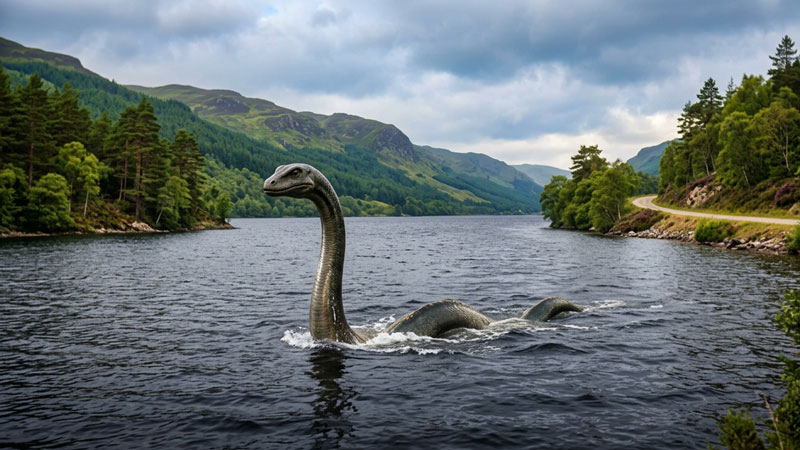
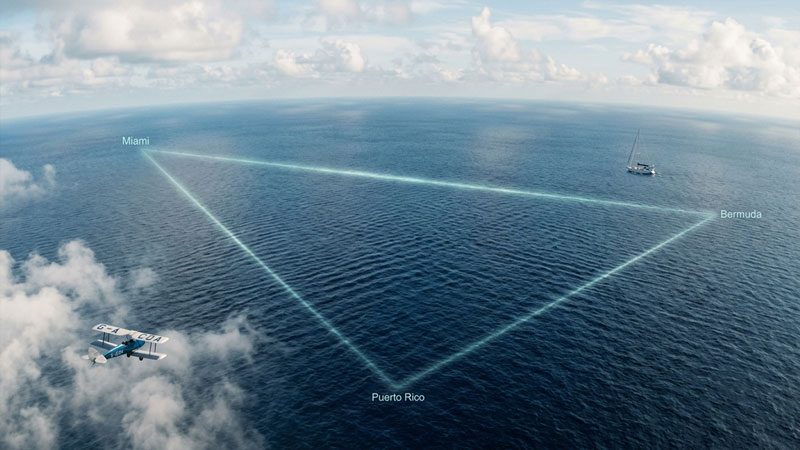
Illustration of the Loch Ness Monster legend in a misty Scottish lake
Where
Atlantic Ocean, Miami–Bermuda–Puerto Rico
When
Most reports cluster in the 1940s–1970s
Status
Statistically ordinary

The Bermuda Triangle

Draw a line from Miami, Florida, to the island of Bermuda, down to Puerto Rico, and back β€” and you've traced the roughly 500,000-square-mile stretch of ocean known as the Bermuda Triangle. For decades, stories have circulated about ships and planes that entered this area and were never seen again, with no wreckage and no final radio call.

The most famous case is Flight 19, a squadron of five Navy planes that vanished in 1945 during a training flight. Investigators later suggested the lead pilot became disoriented and the planes ran out of fuel over open water β€” a tragic but explainable accident. When insurance companies and the U.S. Coast Guard compared the Triangle to other heavily traveled stretches of ocean, they found the loss rate wasn't unusually high; the area simply sees sudden storms, strong currents, and dense shipping traffic. Still, sailors have swapped stories about the "Devil's Triangle" for generations, and plenty of people still give it a wide berth.

Aerial illustration of the Bermuda Triangle with a plane and ship over open ocean
Where
Elbert County, Georgia, USA
When
Built 1980; destroyed by explosion in 2022
Status
Two mysteries, no suspects

The Georgia Guidestones

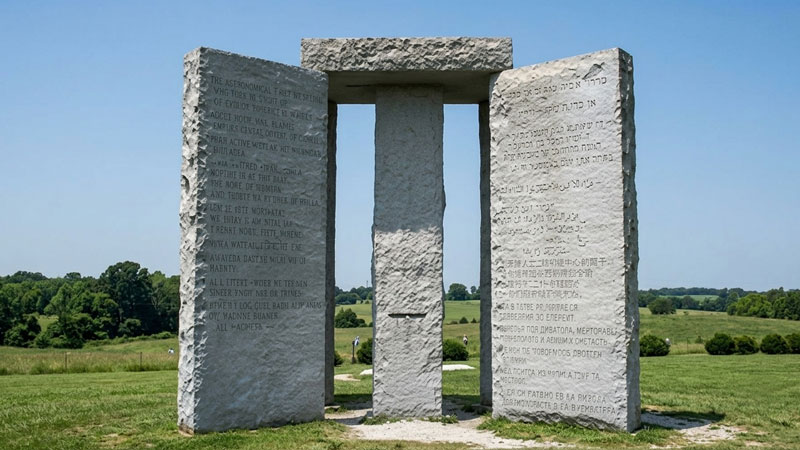
On one of the highest hilltops in Elbert County, Georgia stands a giant granite monument. Engraved in eight different languages on the four giant stones that support the common capstone are 10 Guides, or commandments. The monument is alternately referred to as The Georgia Guidestones, or the American Stonehenge.

The origin of this strange monument is covered in mystery because no one knows the true identity of the man, or men, who commissioned its construction. All that is known for certain is that in June 1979, a well-dressed, articulate stranger visited the office of the Elberton Granite Finishing Company and announced that he wanted to build an edifice to transmit a message to mankind. He identified himself as R. C. Christian, but it soon became apparent that was not his real name. He said that he represented a group of men who wanted to offer direction to humanity, but to date, almost two decades later, no one knows who R. C. Christian really was, or the names of those he represented.

The messages engraved on the Georgia Guidestones deal with four major fields:

  1. Governance and the establishment of a world government,
  2. Population and reproduction control,
  3. The environment and man's relationship to nature, and
  4. Spirituality.

The Message of the Georgia Guidestones

  1. Maintain humanity under 500,000,000 in perpetual balance with nature.
  2. Guide reproduction wisely - improving fitness and diversity.
  3. Unite humanity with a living new language.
  4. Rule passion - faith - tradition - and all things with tempered reason.
  5. Protect people and nations with fair laws and just courts.
  6. Let all nations rule internally resolving external disputes in a world court.
  7. Avoid petty laws and useless officials.
  8. Balance personal rights with social duties.
  9. Prize truth - beauty - love - seeking harmony with the infinite.
  10. Be not a cancer on the earth - Leave room for nature - Leave room for nature.

Certainly the group that commissioned the Georgia Guidestones is one of many similar groups working together toward a New World Order, a new world economic system, and a new world spirituality.

The hole that you see in the stone was drilled in the Center Stone so that the North Star could be visualized through it at any moment. This was one of several requirements stipulated by R.C.Christian for the building of the American Stonehenge and reflects his obsession with the alignment of the stars, the sun, and the moon.

The Georgia Guidestones granite monument standing on a hilltop before its 2022 destruction
Where
Ottosdal, South Africa
When
Formed 2.8–3.1 billion years ago
Status
Solved by geologists

The Klerksdorp Spheres

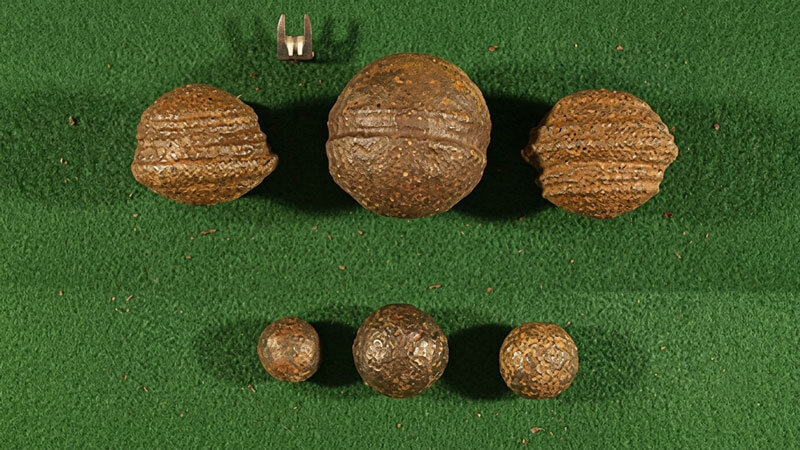
Deep in a South African mine, workers have pulled out hundreds of small, strangely smooth spheres β€” some etched with parallel grooves running around their middle, like a tiny etched planet. Because the rock layer holding them is roughly 3 billion years old, and because they looked almost machine-made, the spheres spent decades as a favorite claim of "ancient astronaut" enthusiasts, who insisted no natural process could carve such a precise groove.

Geologists who have actually cut the spheres open tell a calmer story. Inside, each one shows a radial crystal pattern growing outward from the center β€” the signature of a concretion, a mineral lump that slowly hardens around a tiny seed inside layered sediment. The grooves line up with thin bands in the surrounding rock, meaning they formed naturally as each sphere grew through different layers of ancient lakebed mud. Similar grooved, spherical concretions β€” nicknamed "Moqui marbles" β€” turn up in Utah and elsewhere, so scientists consider the Klerksdorp spheres a closed case, even though the myth still circulates online.

Close-up of grooved Klerksdorp spheres found in a South African mine
Where
Nazca Desert, southern Peru
When
Made roughly 400–650 CE
Status
Purpose debated

The Nazca Lines

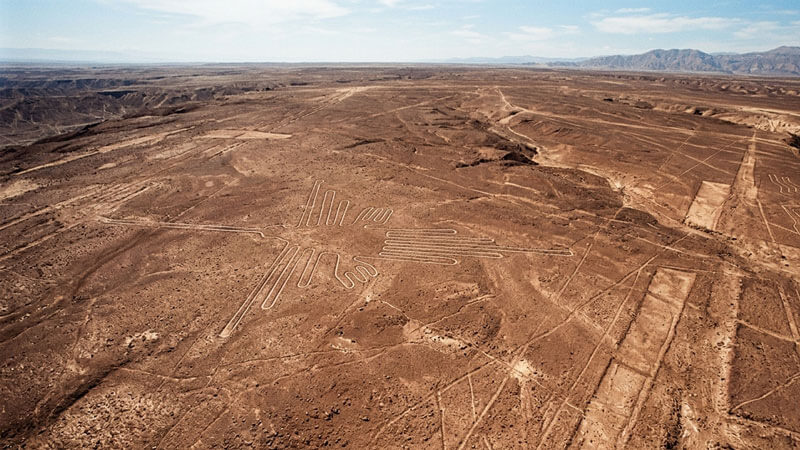
Nazca lines, located in the Nazca desert of South Peru, covering a sprawling area of 80 km between the towns Nazca and Palpas de Jumana, are a series of primeval geoglyphs. Nazca lines are in the list of the UNESCO world heritage sites since 1994. Scholars believe that these lines depict the artistic and cultural excellences of Nazca and were created between 400 and 650 AD. Innumerable complex figures really fascinate everyone. Starting from Simple lines to stylish figures, everything is there. Figures like Hummingbirds, Spiders, Monkeys, Fishes, Sharks, Orcas, Llamas and Lizards are prominently visible in the territory of Nazca lines.

The pretty but thinly designed figures are formed by removing reddish pebbles. The removal of these pebbles reveals the existence of whitish ground underneath. Hundreds of figures are simple lines where as more than 70 zoomorphic designs portray birds, fish, llamas, jaguar, monkey and even human figures. Shapes of trees and flowers are also not uncommon. The largest figures, spread across 660 feet, are the epitomes of marvelous arts. Even though the exact purposes of these creations are unidentified but religious significance of these figures are prominent. The geometric figures could indicate the flow of water. Due to the dryness and stability of climate most of the artistic designs are preserved. But the weather conditions may provisionally alter the general designs.

Aerial view of the Nazca Lines hummingbird geoglyph in the Peruvian desert
Where
Rapa Nui (Easter Island), Pacific Ocean
When
Statues carved c. 1250–1500 CE
Status
Mostly explained

Easter Island's Moai

Rapa Nui is one of the most isolated inhabited islands on Earth, over 2,000 miles from the nearest continent β€” yet its Polynesian settlers carved nearly 900 giant stone statues, called moai, from volcanic rock. The tallest stands over 30 feet high, and many were moved several miles from the quarry to platforms along the coast, all without wheels, cranes, or draft animals.

For years the move itself was treated as an unsolved puzzle. Recent experiments by archaeologists, guided by islanders' own oral traditions, suggest the statues were "walked" upright, rocked side to side with ropes by teams of people β€” a method that's since been tested successfully with full-size replicas. What still fascinates researchers is why the islanders' descendants stopped carving and toppled many of the standing moai centuries later, and how a once heavily forested island became the treeless landscape European explorers found when they arrived on Easter Sunday, 1722, giving the island its name.

Row of giant moai stone statues on the coast of Easter Island
Where
Claimed origin: Mexico and Central America
When
Appeared in collections in the late 1800s
Status
Debunked as 19th-century fakes

Crystal Skulls

Carved from single blocks of clear or smoky quartz, crystal skulls became famous after several turned up in museum collections in the late 1800s, supposedly dug from ancient Maya or Aztec sites. Collectors and mystics claimed the skulls were thousands of years old and held healing or psychic powers, able to store information the way a modern computer chip does.

Modern science tells a very different story. Electron-microscope studies of the most famous skulls, including ones held by the British Museum and the Smithsonian, revealed tool marks from rotary cutting wheels and abrasives β€” technology that didn't exist in the ancient Americas but was common among European gem-cutters in the 1800s. Museums have since relabeled their skulls as 19th-century curiosities rather than pre-Columbian artifacts. The mystery today isn't really about ancient magic; it's about exactly who carved the skulls and sold them as antiquities, and why the legend still captures so many imaginations.

Faceted crystal skull artifact linked to 19th-century mystery collections
Where
BΓ©lmez de la Moraleda, Spain
When
First reported 1971
Status
Disputed

The BΓ©lmez Faces

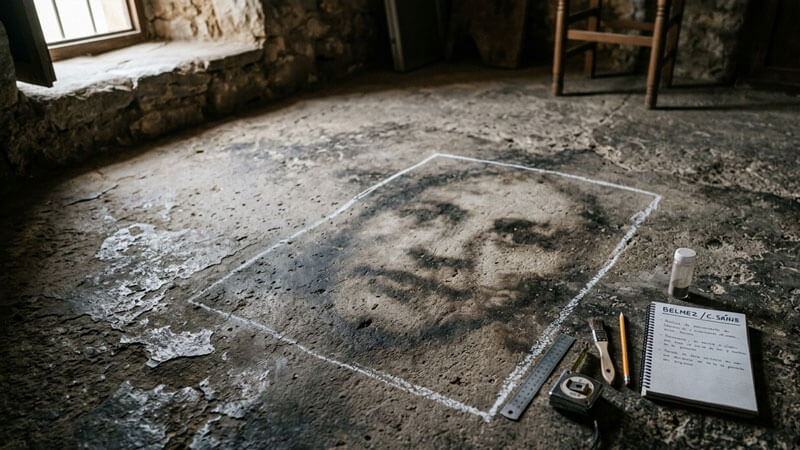
In a small house in southern Spain, the homeowner reported something eerie in 1971: faces appearing to form on her concrete kitchen floor. Local investigators covered the images and even dug up and replaced sections of the floor, yet new faces reportedly kept appearing, drawing curious visitors and journalists from around the world for years.

Parapsychologists who studied the case suggested it might be a rare case of "thoughtography" β€” images unconsciously produced by the mind. Skeptical researchers took a more grounded approach, pointing out that the images stayed fixed in place rather than shifting like a natural stain, and that chemical tests on some samples detected pigments consistent with paint rather than natural discoloration. Because the house was later demolished and much of the original floor lost, a final, conclusive answer may never be possible β€” which is part of why the BΓ©lmez Faces are still argued about by mystery fans today, even as most researchers lean toward a human explanation.

Faint face-like stain on a concrete floor in BΓ©lmez de la Moraleda, Spain
Where
Found worldwide, from Egypt to Italy
When
Oldest known carving is thousands of years old
Status
Symbolic, not physical

The Flower of Life

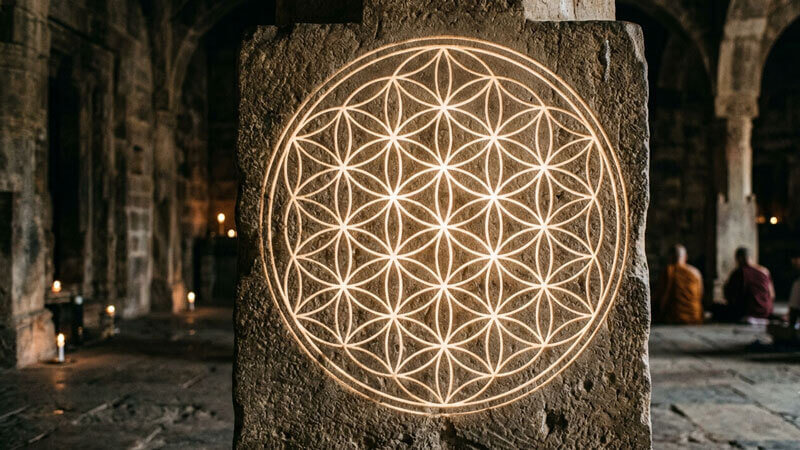
The Flower of Life is a pattern made from evenly overlapping circles, arranged so the center of each circle sits on the edge of six circles around it β€” a design so precise it can be built with nothing more than a compass and a steady hand. One of the oldest known examples is carved into a granite column at the Temple of Osiris in Abydos, Egypt, and similar patterns turn up in cultures across the world, from China to Renaissance Italy.

Because it's built on such exact geometry, the design has long attracted spiritual and philosophical meaning β€” some see it as a symbol of creation, connected to shapes called the Platonic solids, the five three-dimensional forms that fit perfectly inside a sphere. Historians mostly agree the pattern spread because compass-and-straightedge geometry was a popular art and mathematical exercise across many ancient cultures. Whether it holds a deeper hidden meaning is more a matter of belief than evidence β€” which is exactly what keeps people fascinated by it.

Flower of Life sacred geometry pattern of seven overlapping circles
Where
Beinecke Library, Yale University
When
Parchment dated to the early 1400s
Status
Never translated

The Voynich Manuscript

Named after the book dealer who rediscovered it in 1912, the Voynich Manuscript is a roughly 240-page handwritten book filled with flowing, looping text in an alphabet nobody recognizes, alongside detailed illustrations of unidentifiable plants, astronomical diagrams, and small figures bathing in green liquid. Carbon dating places the parchment squarely in the early 1400s, ruling out the idea that it's a modern hoax.

Codebreakers, linguists, and even military cryptographers who cracked real wartime codes have spent over a century trying to decode it, and computer scientists have run the text through modern language-pattern software. Some patterns in the writing look statistically similar to real languages, which argues against it being random gibberish, yet no proposed translation has ever held up to scrutiny. Without knowing what language, code, or invented system its author used, the Voynich Manuscript remains one of the most stubborn puzzles in the history of writing.

Open page of the Voynich Manuscript showing unknown script and plant drawings
Where
Shipwreck off Antikythera, Greece
When
Built c. 100–150 BCE; found in 1901
Status
Mostly decoded

The Antikythera Mechanism

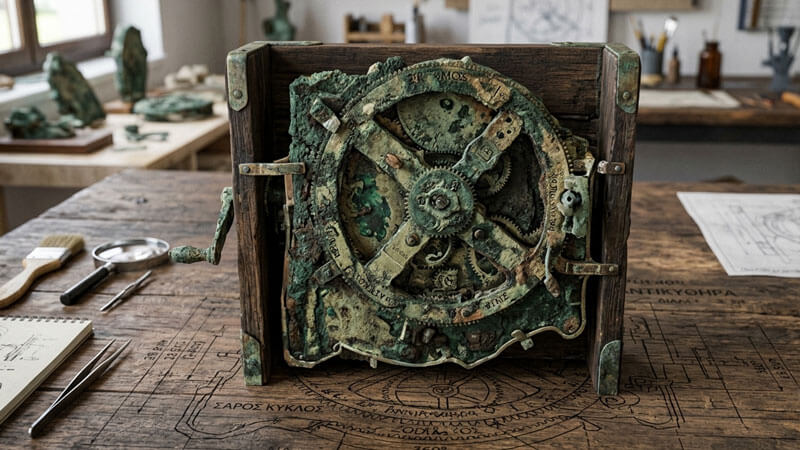
In 1901, sponge divers exploring an ancient shipwreck off the coast of Greece pulled up a corroded lump of bronze that sat in a museum drawer for decades before anyone realized what it was. Using X-ray and CT scanning, researchers eventually revealed more than 30 intricately cut bronze gears packed inside β€” a mechanical device so advanced that nothing else like it appears in the historical record for over a thousand years.

Scientists now believe the Antikythera Mechanism was a hand-cranked astronomical calculator, able to predict the positions of the sun, moon, and planets, track the four-year cycle of the ancient Olympic Games, and even forecast eclipses. What still puzzles historians is who had the engineering skill to design it, since nothing of comparable complexity survives from the ancient world, and how many similar devices may once have existed without surviving two thousand years underwater or in storage.

Bronze gears of the ancient Antikythera Mechanism astronomical calculator
Where
Atlantic Ocean, near the Azores
When
Found abandoned, December 4, 1872
Status
Best guess only

The Mary Celeste

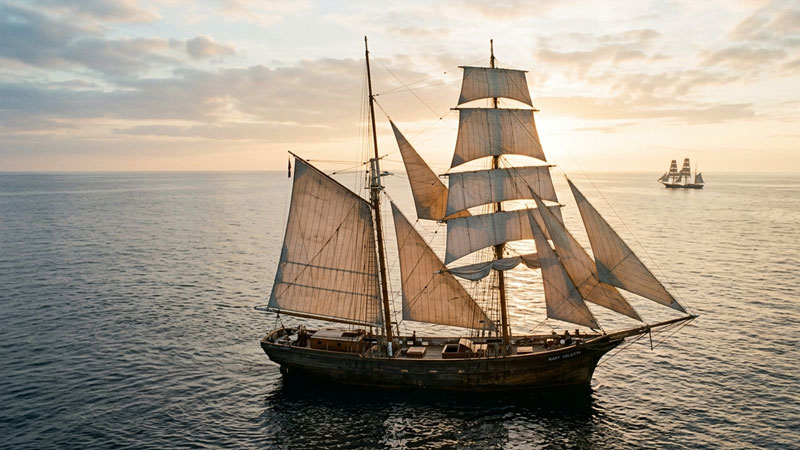
On December 4, 1872, the crew of the ship Dei Gratia spotted another ship drifting strangely in the Atlantic, its sails partly set and no one answering their calls. When they boarded, they found the Mary Celeste completely deserted β€” no captain, no crew, no passengers β€” yet the ship was seaworthy, its cargo mostly intact, and the crew's belongings, including the captain's family's clothing, still in their cabins. The one lifeboat was missing.

Investigators at the time searched for signs of piracy, mutiny, or storm damage and found none of the violence they expected. Over the following century, theories ranged from a leaking cargo of alcohol causing panic to waterspouts to faulty pump readings that convinced the crew they were sinking. The most widely accepted modern theory is that the captain, worried the ship was taking on water, ordered everyone into the lifeboat as a precaution β€” and then lost the ship in a sudden storm or wind shift, stranding them at sea. No trace of the lifeboat or crew was ever found, which is why the Mary Celeste remains one of the most famous "ghost ship" mysteries of all time.

The Mary Celeste ship found drifting empty in the Atlantic Ocean

Mystery fast facts

A few numbers and details worth remembering the next time a mystery comes up in conversation.

  • The Antikythera Mechanism contains more precision gears than many clocks built 1,500 years later.
  • Loch Ness is deeper in places than the height of most city skyscrapers.
  • The Nazca hummingbird geoglyph stretches longer than a full-size football field.
  • Only about 900 moai statues have been counted on Easter Island, and roughly half were never fully finished.
  • The Klerksdorp spheres are older than most rock on Earth's continents today.
  • The Georgia Guidestones' message was carved in eight languages, including Swahili, Hebrew, and Russian.
  • No two Voynich Manuscript "plants" have ever been matched to a real species with full confidence.
  • The Bermuda Triangle covers an area roughly the size of the entire country of Egypt.

Mystery Questions, Qnswered (FAQ)

Is the Loch Ness Monster real?

No confirmed evidence has ever been found. Sonar surveys, DNA sampling, and decades of investigation haven't turned up a hidden animal, and most scientists think sightings are logs, waves, or known animals. Because you can't fully prove a negative, the legend continues.

Is it dangerous to travel through the Bermuda Triangle?

No. Ships and planes cross the Bermuda Triangle safely every single day. Studies comparing it to other busy stretches of ocean found its accident rate isn't unusually high once weather and traffic are taken into account.

Who built the Georgia Guidestones?

Nobody knows. The monument was commissioned in 1979 by a man using the fake name R. C. Christian, who never revealed his real identity or the group he claimed to represent. The Guidestones were destroyed in an explosion in 2022, and the person responsible was never identified either.

Are crystal skulls really ancient artifacts?

No. Microscope testing on the most famous crystal skulls found tool marks from rotary cutting wheels β€” a technology that didn't exist in the ancient Americas. Museums now date the skulls to the 19th century.

Why do some mysteries never get solved?

Evidence can be lost, destroyed, or never recorded in the first place, and eyewitness memories aren't always reliable. Some mysteries also stick around simply because they make a great story, so they keep getting retold long after a scientific explanation has already been found.

Back to KidsGen Home