
The Origin of Kedarnath: Pandavas' Pilgrimage and Shiva's Forgiveness
Introduction:
The war of Kurukshetra may have ended in victory for the Pandavas, but the emotional toll was immense. Seeking spiritual redemption for the bloodshed, the brothers turned to Lord Shiva. Their penance and devotion led to a divine confrontation and the miraculous formation of Kedarnath, one of the most sacred temples in Hinduism. This is the powerful story of faith, forgiveness, and divine grace.
The Price of Victory at Kurukshetra
The victory at Kurukshetra came at a heavy price. The battlefield lay littered with the bodies of loved ones and foes alike. The Pandavas, though victorious, were burdened by the weight of their actions. They had slain countless warriors, a deed that cast a long shadow on their conscience.
A Journey of Atonement to Mount Kailash
Seeking absolution for their sins, the Pandavas embarked on a pilgrimage to Mount Kailash, the abode of Lord Shiva, the destroyer and the redeemer. Their hearts yearned for Shiva's divine touch, a cleansing that could alleviate their guilt.
Upon reaching Mount Kailash, however, the Pandavas encountered a curious situation. Despite their fervent prayers and offerings, Shiva remained elusive. They searched high and low, their yearning for his presence intensifying with each passing moment.
Yudhisthira, the eldest Pandava, known for his wisdom and righteousness, understood the reason behind Shiva's absence. He addressed the mountain, his voice filled with quiet determination, "We know you are hidden, Lord Shiva. We come here burdened by the sins of war. We will not leave until you grant us your darshan (holy sight)."
Shiva's Elusiveness and the Bull EncounterAs they continued their journey, a ferocious bull emerged from nowhere, charging towards the Pandavas. Bhima, the strongest of the brothers, known for his immense physical prowess, stepped forward to protect his kin.
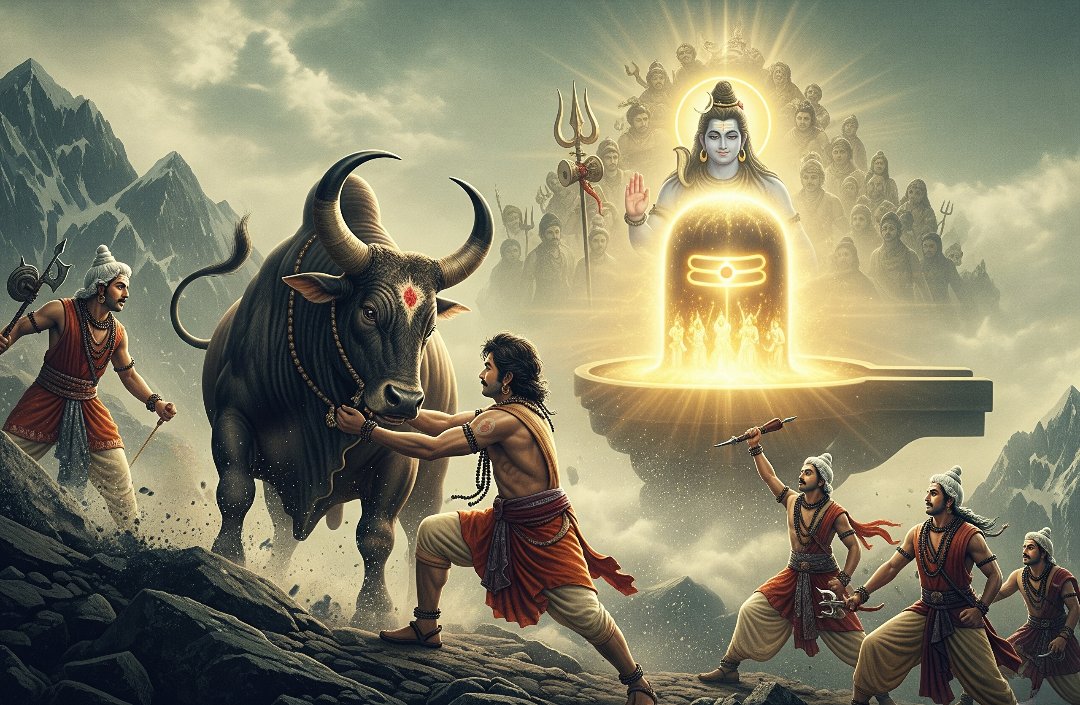
A fierce battle ensued between Bhima and the bull. Bhima, accustomed to overpowering his opponents, was surprised by the bull's unwavering strength and agility. Finally, in a desperate attempt to subdue the beast, Bhima grabbed the bull by its tail and pulled with all his might.
Emergence of the Shivalinga and Shiva's Message
However, instead of the anticipated outcome, the bull's body separated from its head at the point of strain. The headless torso then transformed into a luminous Shivalinga, a representation of Shiva himself.
Standing before them, no longer hidden, was Lord Shiva. He acknowledged the Pandavas' perseverance and their genuine remorse. He recognized the complexity of the Kurukshetra war, a battle fought for dharma (righteousness) but also stained by bloodshed.
With his divine wisdom, Shiva declared, "The weight of war lies not just on the one who wields the weapon, but also on the one who compels it." He acknowledged the difficult choices the Pandavas had faced and the burden they carried.
The Shivalinga formed from the bull's body, now known as Kedarnath, stands as a testament to the Pandavas' journey of atonement. Shiva's forgiveness cleansed their souls, reminding them that even the most righteous battles leave scars, but with genuine remorse and faith, redemption is always a possibility.
 Back to School
 Craft Ideas for Kids
 Benefits of Yoga for Kids
 Fun and Jokes
 Stories for Kids
 School Projects & Homework Help
 Hobbies
