

When Krishna slew the tyrant Shishupal at Yudhishthira's great sacrifice, Shishupal's friend King Salva swore revenge against the Yadu dynasty. Through long penance he won a terrible weapon — a flying fortress called the Saubha — and waited for the moment Krishna was away from Dwarka to strike.
Salva's Vow and the Boon of Shiva
Salva was a close friend of Shishupal. At the wedding of Rukmini, he had fought on Shishupal's side and been defeated by the Yadu warriors, along with Jarasandha and the other kings. When Krishna later killed Shishupal in the assembly of the Rajasuya sacrifice, Salva's grief turned to fury.
Before all the assembled kings he made a vow: "I will rid the earth of the Yadavas. Just watch my power!" To make good on his oath, the foolish king worshipped Lord Shiva with severe penance, eating only a single handful of dust each day.
At the end of a year, Shiva — known as the lord who is quickly pleased — granted Salva a boon. Salva asked for a vehicle that could not be destroyed by gods, demons, humans, Gandharvas or serpents, that could fly wherever he wished, and that would strike terror into the Vrishnis. On Shiva's command, the demon architect Maya Danava built a flying iron city called the Saubha and gave it to Salva.
The Siege of Dwarka
Seizing his chance while Krishna was at Indraprastha for the Rajasuya sacrifice, Salva descended on Dwarka with a great army. From the Saubha he rained down a torrent of weapons — stones, tree trunks, thunderbolts, serpents and hailstones — while a fierce whirlwind blanketed the city in dust. Dwarka was tormented, much as the earth had once been by the three flying cities of the demons.
Pradyumna Defends the City
Seeing his people harassed, Pradyumna — Krishna's heroic son — mounted his chariot and called out, "Do not fear!" The great Yadu commanders rode out with him: Satyaki, Charudeshna, Samba, Akrura, Gada, Hardikya and many other mighty archers. A tumultuous battle began, like the wars of the gods and demons.
With his divine weapons Pradyumna swept away Salva's illusions as the morning sun scatters the darkness of night. Yet the Saubha was no ordinary foe — built by Maya Danava, it would split into many identical shapes and then become one, appearing now on the ground, now in the sky, now on a mountain peak, now upon the water, like a whirling torch that never rested in one place.
A Long and Fearsome War
Salva's minister Dyuman struck Pradyumna with a club of black steel, and his charioteer — the son of Daruka — carried the wounded prince from the field to protect him, as duty required. When Pradyumna recovered, he insisted on returning at once, for no one born in the Yadu line had ever fled a battle. He came back and felled Dyuman. So the war between the Yadus and Salva's forces raged on, tumultuous and terrible, for twenty-seven days and nights.
Krishna Returns to Dwarka
At Indraprastha, once the Rajasuya was complete and Shishupal slain, Krishna began to see inauspicious omens. Fearing for his city, he took leave of the Kuru elders, the sages and the Pandavas, and hurried home. Arriving to find Dwarka under siege, he arranged for its defence and told his charioteer Daruka: "Take my chariot swiftly to Salva. He is a great magician — do not let him bewilder you."
The Battle in the Sky
Salva hurled a roaring spear at Krishna's charioteer, but Krishna shattered it into a hundred pieces in mid-air. He pierced Salva with sixteen arrows and struck the darting Saubha with a deluge more, shining like the sun flooding the heavens with light. In a daring stroke, Salva struck Krishna's left arm, and — to the dismay of all who watched — the bow Sharnga slipped from the Lord's hand.
The Great Illusion
Then the magician worked his cruelest trick. After Krishna's club struck him on the collarbone, Salva vanished. A moment later a messenger came weeping and bowed before Krishna, saying he had been sent by Mother Devaki:
"O Krishna, mighty-armed one, so devoted to your parents — Salva has seized your father Vasudeva and carried him away, as a butcher leads an animal."
Playing the part of a mortal man, Krishna showed sorrow and confusion. Salva then appeared, seeming to lead the captive Vasudeva before him, mocked the Lord, and — before Krishna's eyes — appeared to behead his father with a sword and carry the head into the Saubha.
For a moment, out of love for his family, Krishna remained absorbed in grief like an ordinary person. But he is full in knowledge, and he soon recognised the whole vision for what it was: a demoniac illusion devised by Maya Danava and worked by Salva. Awakening as if from a dream, he saw no messenger and no body on the battlefield — only his enemy circling above in the Saubha.
The Heart of the Story
Salva's strongest weapon was not the Saubha but deception — striking at Krishna's love for his family. The tale teaches that illusion preys on our deepest attachments, and that clarity of mind, not force alone, is what finally cuts through deceit.
The Fall of Salva
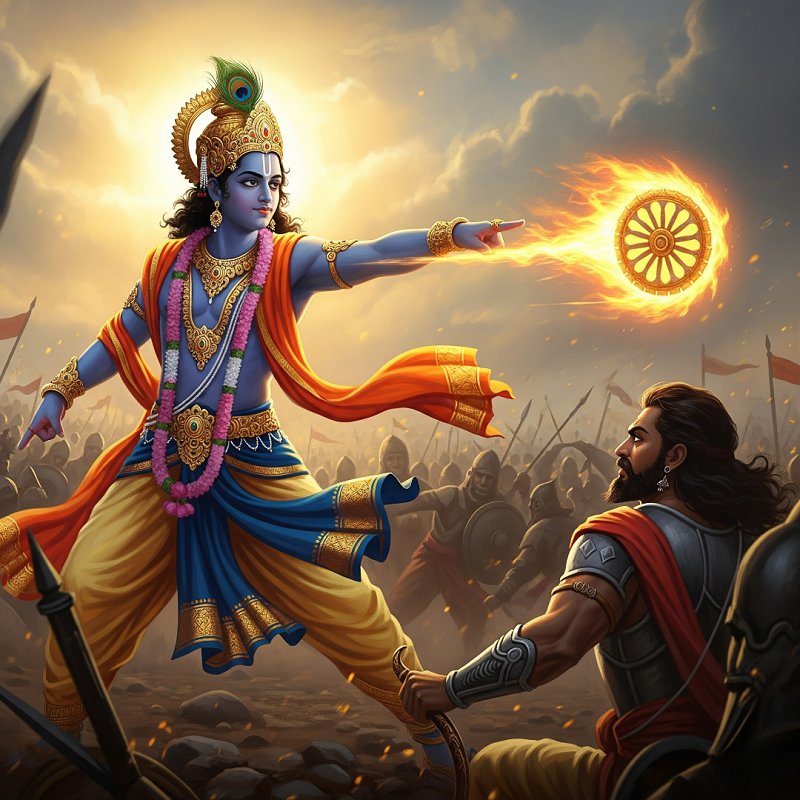
Now fully alert, Krishna met Salva's storm of weapons with his own unfailing arrows, piercing him and shattering his armour, his bow and his crest-jewel. With his club he smashed the Saubha, and the flying city broke into a thousand pieces and crashed into the sea. Salva leapt to the ground and charged with his club, but Krishna severed his weapon-bearing arm with a bhalla dart. Then, raising the Sudarshana Chakra — blazing like the sun at the end of time — the Lord struck off Salva's head, crown and earrings and all.
As the sinful king fell and the Saubha lay destroyed, the demigods sounded their kettledrums in the heavens. The long siege of Dwarka was over at last.
Frequently Asked Questions
Who was Salva in Hindu mythology?
Salva was a king and a friend of Shishupal. After Shishupal was killed by Krishna, Salva vowed to destroy the Yadu dynasty and worshipped Lord Shiva to obtain a magical flying fortress called the Saubha.
What was the Saubha?
The Saubha was a flying iron city built by the demon architect Maya Danava and granted to Salva through a boon from Lord Shiva. It could travel anywhere at will, appear in many forms at once, and could not be destroyed by gods, demons or humans.
How did Krishna defeat Salva?
Krishna saw through Salva's magical illusions, including a false vision of his father Vasudeva being killed. He shattered the Saubha with his club, severed Salva's arm with a bhalla arrow, and finally beheaded him with the Sudarshana Chakra.
Which scripture tells the story of Krishna and Salva?
The story appears in the Bhagavata Purana, in the Tenth Canto, Chapters 76 and 77. It is also referred to in the Mahabharata. In these accounts Salva is also called the master of Saubha.