

The Origin — Sage Durvasa's Curse
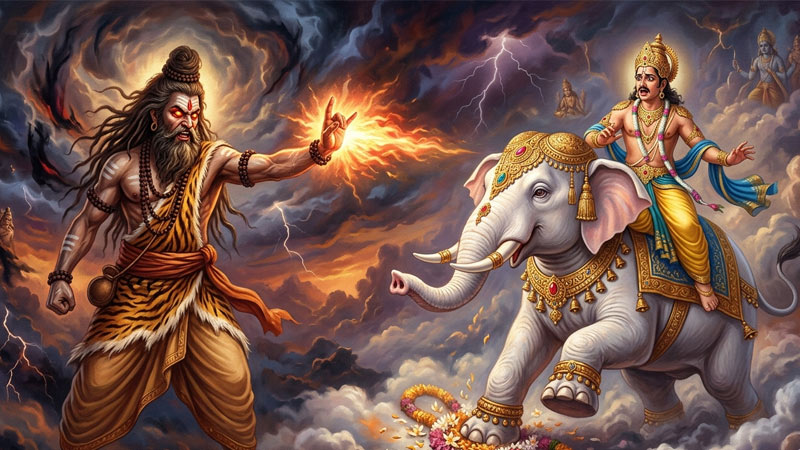
The chain of events that set the stage for Samudra Manthan began with an act of inadvertent disrespect. Indra, the king of the Devas and ruler of the heavens, was riding his celestial elephant Airavata when he encountered the revered sage Durvasa — a figure celebrated in the Puranas for his vast spiritual power and equally formidable temper.
Durvasa offered Indra a sacred garland of Kalpaka flowers, a divine gift from a celestial nymph. Indra accepted the garland and, without particular thought, placed it on the trunk of Airavata. Bees, drawn by the garland's heady fragrance, began to swarm the elephant, irritating it. Airavata tossed the garland to the ground and trampled it underfoot.
To Durvasa, this was not a careless moment but a profound act of disrespect toward a sacred offering. Furious, the sage pronounced a sweeping curse upon Indra and all of the Devas: they would henceforth be stripped of all strength, fortune, and divine power. The curse took swift effect. The Devas grew weak, their radiance faded, their sacrificial fires sputtered, and their armies could no longer hold their ground.
Taking advantage of this sudden vulnerability, the Asuras — led by the mighty demon king Bali — swept across the cosmos and seized control of the three worlds: the heavens, the earth, and the nether regions. The natural order of the universe had been overturned.
Vishnu's Strategy — The Alliance of Gods and Demons
Desperate and powerless, Indra journeyed to Vaikuntha to seek counsel from Lord Vishnu, the preserver of the universe. Vishnu listened with characteristic patience and then revealed his plan: the only way to restore the Devas' strength was to obtain Amrita, the nectar of immortality, which lay hidden deep within the vast ocean of milk (Ksheer Sagar). Consuming Amrita would make the Devas unconquerable.
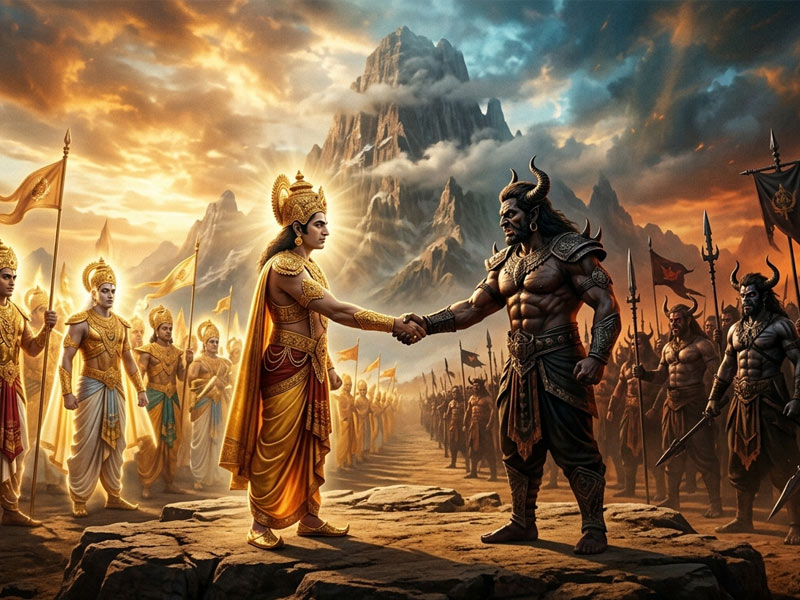
However, the task was of staggering proportions — one the Devas could not accomplish alone in their current state of weakness. Vishnu advised Indra to make a temporary truce with the Asuras and enlist their assistance. He counselled patience and diplomacy, promising that once Amrita was obtained, he himself would ensure that only the Devas drank it.
The Asuras agreed to the alliance, partly through Vishnu's diplomatic guidance and partly because the prospect of immortality was irresistible to them as well. Thus began one of the most extraordinary cooperative ventures in cosmic history — the joint churning of the primordial ocean.
Mount Mandara, Vasuki, and the Kurma Avatar
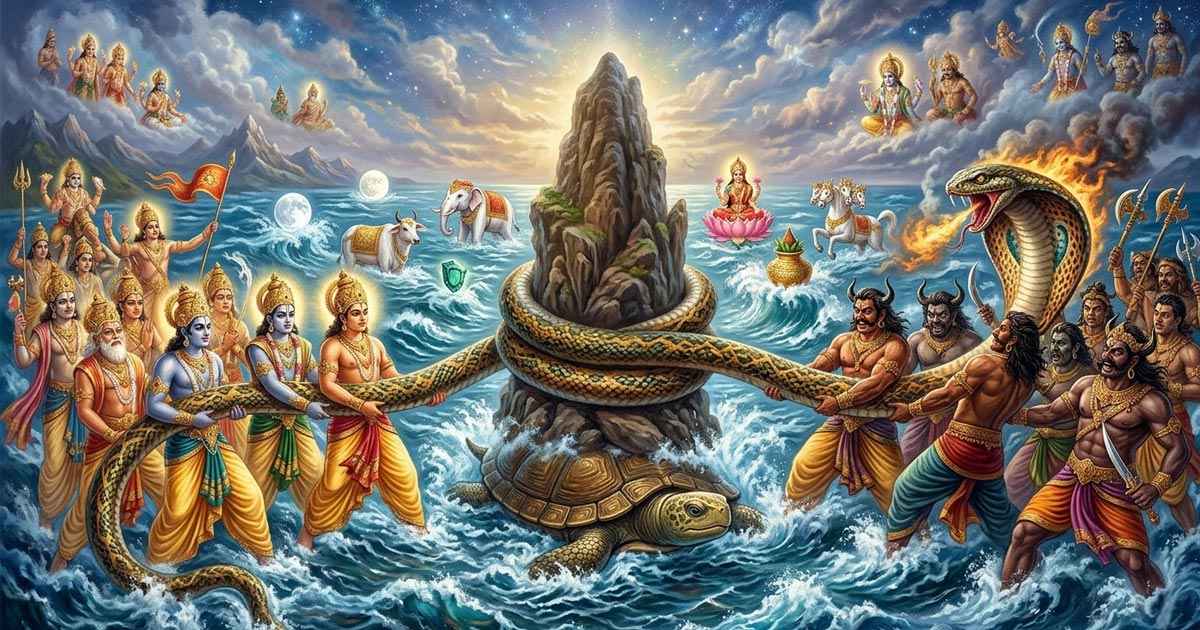
For the churning to begin, two things were needed: a churning rod of immense strength, and a rope capable of withstanding the forces involved. The gods and demons agreed to use the great mountain Mandara as the churning rod, and the king of serpents, Vasuki, as the churning rope.
Uprooting Mount Mandara proved difficult enough. When they finally managed to transport it to the edge of the ocean and lower it into the waters, disaster struck — the mountain, with its colossal weight, began to sink rapidly into the depths of the ocean floor. All seemed lost before it had even begun.
At this critical moment, Vishnu took action. He manifested in his second avatar — the cosmic tortoise, Kurma — and descended into the ocean. The divine tortoise positioned himself beneath Mount Mandara, supporting it upon his vast, indestructible shell. With the mountain now stabilised, the churning could begin in earnest.
Vasuki was coiled around the mountain's mid-section as the rope. By convention and by Vishnu's subtle suggestion, the Asuras took hold of the serpent's head while the Devas gripped the tail. (Some versions note that Vasuki was uncomfortable with this arrangement, preferring the honour of the head-side, but Vishnu's counsel ultimately guided the seating.) Both sides pulled in alternating rhythm, causing the great mountain to rotate and the ocean to churn.
- The Ocean: Ksheer Sagar — the primordial ocean of milk, understood in some traditions as the cosmic ocean of consciousness
- The Churning Rod: Mount Mandara — one of the great sacred mountains of ancient India
- The Rope: Vasuki — the king of serpents and one of the Nagas, who wears Lord Shiva as an ornament around his neck
- The Base / Support: Kurma — Vishnu's second avatar in the form of a giant cosmic tortoise
- Duration: According to various Puranas, the churning continued for a thousand divine years
Halahala — The Poison That Could End Creation
As the churning intensified, the first thing to emerge from the agitated ocean was not a treasure but a catastrophe. A thick, suffocating cloud of dark blue-black vapour billowed out of the ocean — the Halahala, a venom so potent that even a small quantity of it, released into the atmosphere, threatened to destroy every living being in all the three worlds.
Gods and demons alike fled in terror. Even Brahma, the creator, and Vishnu himself could offer no solution — the Halahala was beyond their jurisdiction. In their desperation, all beings — Devas, Asuras, humans, and celestial beings — turned to Lord Shiva, the destroyer and the ascetic who alone had the cosmic power to contain such a force.
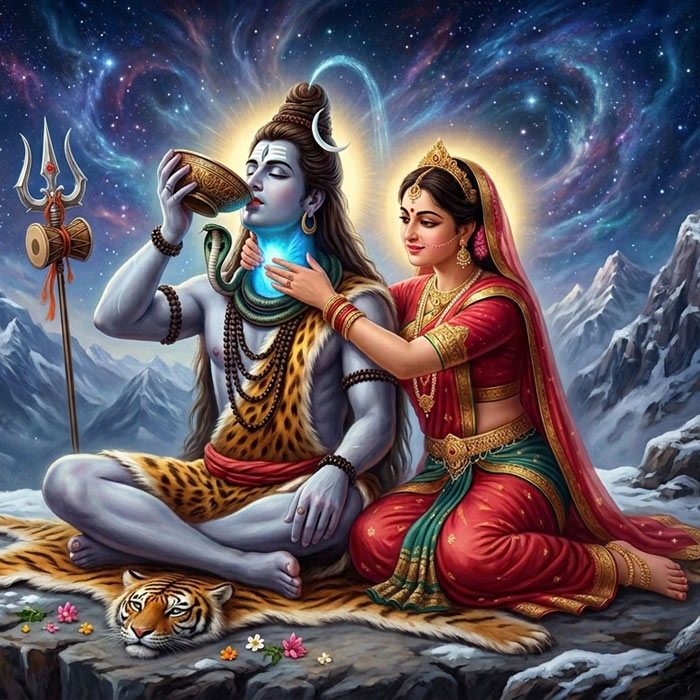
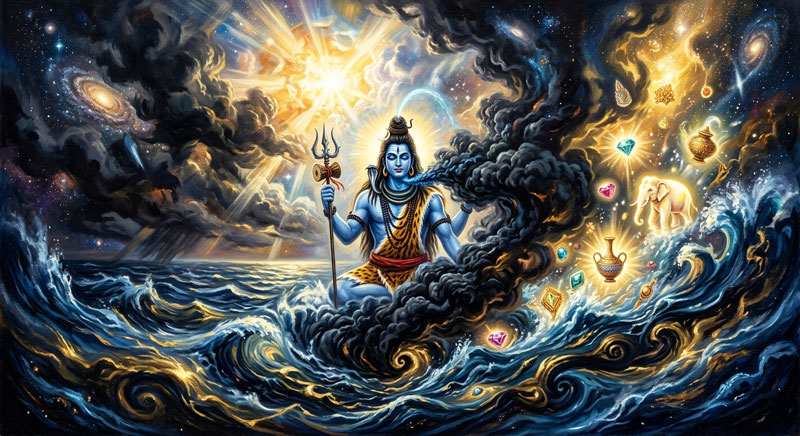
Shiva, ever compassionate, agreed. In an act of supreme sacrifice for the preservation of creation, he gathered the entirety of the Halahala into his cupped palms and drank it. But rather than swallow the poison, he held it in his throat through the power of his yogic mastery. His consort Parvati, alarmed, pressed her hands to his throat to prevent the poison from descending further into his body.
The Halahala discoloured Shiva's throat permanently, turning it a deep, vivid blue. From this moment onward, Shiva became known as Neelkantha — the Blue-Throated One — one of his most celebrated epithets. The Shiva Purana describes Parvati as placing her hand over Shiva's throat out of love, which also contributed to the poison staying contained in that region alone.
By containing the Halahala, Shiva demonstrated that the path of true spiritual power lies not in the accumulation of blessings but in the willingness to absorb suffering for the sake of all beings.
— Theme from the Bhagavata Purana, Book 8With the immediate existential crisis averted, the churning resumed. Now, one by one, the divine treasures of the ocean began to emerge.
The 14 Divine Treasures — Chaturdasa Ratnas
Different versions of the Puranas — the Bhagavata Purana, Vishnu Purana, Padma Purana, and Skanda Purana — enumerate slightly varying lists of the treasures. However, the principal items that appear consistently across the texts are the following fourteen, collectively known as the Chaturdasa Ratnas (fourteen jewels):
The Emergence of Goddess Lakshmi
Among the most celebrated of all the treasures was the emergence of the goddess Lakshmi. According to the Bhagavata Purana, she arose from the churned waters seated upon a fully bloomed lotus, her form luminous with an inner radiance that outshone the brilliance of every jewel and every divine being present. All the Devas, Asuras, sages, and celestial beings fell into a reverent hush at her appearance.
Lakshmi surveyed those assembled before her. The gods and demons alike sought to become her consort, but she turned her gaze upon Vishnu alone and placed a garland of eternal flowers around his neck, choosing him as her eternal companion. This is why Lakshmi is always depicted alongside Vishnu in Hindu iconography — her emergence from Samudra Manthan was also her reunion with her eternal consort.
Dhanvantari, the Battle for Amrita, and Mohini
The culmination of the churning came when Dhanvantari, the divine physician of the gods, rose from the ocean bearing a golden pot filled with Amrita. Dhanvantari is revered in Hindu tradition as the source of all medicinal knowledge; his emergence is said to mark the beginning of the science of Ayurveda. Even today, Dhanteras — the first day of the Diwali festival — is celebrated as Dhanvantari Trayodashi in his honour.
The moment Dhanvantari surfaced, the Asuras snatched the pot and fled. A chaotic battle for possession of Amrita broke out, with the demons quarrelling not only with the gods but among themselves over who would drink first. For a period, the situation appeared hopeless for the Devas.
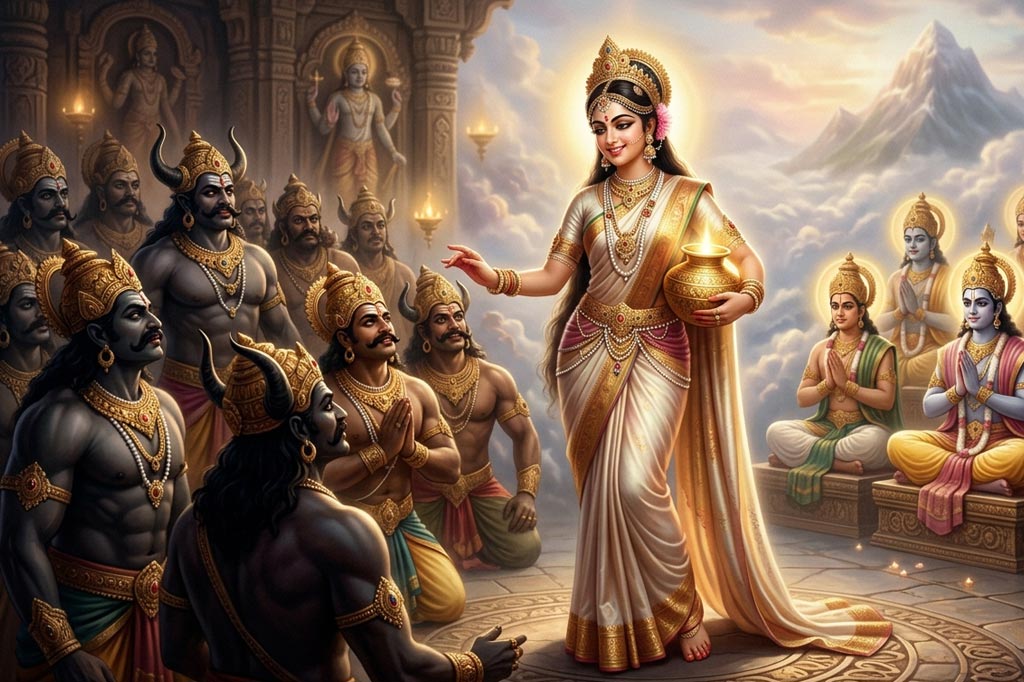
Vishnu, true to his earlier promise, now intervened with ingenuity rather than force. He took the form of Mohini — a supernaturally beautiful woman whose grace and enchantment were irresistible. When Mohini appeared before the assembled gods and demons and offered to distribute the Amrita impartially, the besotted Asuras readily handed the pot to her, abandoning all suspicion.
Mohini arranged the Devas and Asuras in two separate rows and began serving the nectar — but served only the Devas. By the time the Asuras realised the deception, all the Devas had consumed the Amrita and become immortal.
Rahu and Ketu — The Demon Heads of the Sky
Two demons, Svarbhanu and another, suspected the ruse and disguised themselves as gods, slipping into the Devas' row. One of them — Svarbhanu — managed to receive a portion of Amrita and had just begun to swallow it when the sun god Surya and the moon god Chandra noticed the deception and alerted Vishnu.
Vishnu immediately hurled his Sudarshana Chakra (the divine discus) at the demon, severing his head from his body at the precise moment the nectar had reached his throat. Because the Amrita had already reached the neck, neither the head nor the body died — both became immortal. The immortal head became Rahu and the immortal body became Ketu.
Bearing a profound grudge against Surya and Chandra for exposing them, Rahu and Ketu periodically take revenge by swallowing the sun and moon, causing solar and lunar eclipses. In Hindu astronomical tradition, Rahu and Ketu are the ascending and descending lunar nodes — shadow planets of enormous astrological significance.
Kumbh Mela — Where the Nectar Fell
After Vishnu restored the Amrita to the Devas as Mohini, he entrusted the pot to Garuda, the divine eagle and Vishnu's celestial vehicle, to protect it from further Asura attacks. During the subsequent battle — which raged for twelve divine days, equivalent to twelve human years — Garuda flew with the pot of nectar while the Asuras pursued him.
In the course of this flight and the ensuing struggle, drops of Amrita spilled from the pot and fell to earth at four sacred locations: Prayagraj (Allahabad), Haridwar, Ujjain, and Nashik. The earth at these four sites was sanctified by the nectar's touch.
The Kumbh Mela — held at these four cities in a twelve-year rotation — commemorates this event. It is the largest religious gathering in the world, drawing tens of millions of pilgrims who bathe at the confluence of sacred rivers, believing that the waters still carry traces of that immortal nectar and that bathing in them at the appointed time cleanses the soul of accumulated sins.
- Prayagraj (Allahabad), Uttar Pradesh — at the Triveni Sangam, confluence of the Ganga, Yamuna, and the mythical Saraswati
- Haridwar, Uttarakhand — where the Ganga descends from the Himalayas to the plains
- Ujjain, Madhya Pradesh — on the banks of the river Shipra, the site of the ancient Mahakaleshwar temple
- Nashik, Maharashtra — on the banks of the Godavari, one of the seven sacred rivers of India
The Final War and Its Aftermath
Invigorated by Amrita and restored to full divine power, the Devas rose in battle against the Asuras. The demons, though formidable, could not prevail against opponents who were now genuinely immortal. Bali and his armies were driven back; the natural cosmic order — with the Devas presiding over the heavens and the Asuras restrained within their proper sphere — was restored.
A few Asuras, however, had managed to taste small quantities of Amrita during the scramble, acquiring a degree of immortality themselves. This explains why, according to Hindu scripture, the cosmic struggle between the forces of order (Dharma) and disorder (Adharma) never truly ends — it is an eternal cycle that mirrors the fundamental tension within existence itself.
The Deeper Significance of Samudra Manthan
Beyond its narrative splendour, Samudra Manthan carries rich layers of allegorical meaning that scholars and spiritual thinkers across centuries have reflected upon. The churning of the cosmic ocean is understood as a metaphor for the inner life of human consciousness. The ocean represents the mind itself — vast, deep, and containing treasures alongside poisons. The churning is the practice of spiritual discipline: meditation, self-inquiry, and the study of sacred texts.
The poison — Halahala — that emerges first represents the fears, negative impulses, and darkness that arise when one begins genuinely examining one's own inner life. The willingness of Shiva to consume this poison symbolises the courage required to face and transform one's shadow rather than fleeing from it. Only after this confrontation do the gifts and treasures of consciousness emerge.
The fact that gods and demons must cooperate also speaks to the necessity of integrating opposing forces — light and shadow, conscious and unconscious, creation and destruction — in the pursuit of any great spiritual achievement. Amrita, the nectar of immortality, thus becomes a symbol for enlightened awareness, which is the ultimate fruit of this inner churning.
Frequently Asked Questions
Samudra Manthan, also called the Churning of the Cosmic Ocean or Ksheer Sagar Manthan, is one of the most celebrated episodes in Hindu scriptures. It describes how the Devas (gods) and Asuras (demons) jointly churned the primordial ocean of milk to obtain Amrita — the nectar of immortality — as well as numerous other divine treasures known as the Chaturdasa Ratnas.
The story appears in the Bhagavata Purana (Book 8, Chapters 6–12), the Vishnu Purana (Book 1, Chapter 9), the Padma Purana, the Skanda Purana (Book 2, Section 9), and the Mahabharata (Adi Parva). Each text offers slightly different details and varying lists of treasures that emerged.
The fourteen divine treasures (Chaturdasa Ratnas) are: Halahala (deadly poison consumed by Shiva), Kamadhenu (wish-granting cow), Uchhaishravas (divine horse), Airavata (divine elephant), Kaustubha Mani (precious gem), Parijata (wish-granting tree), Apsaras (celestial nymphs), Varuni (goddess of wine), Chandra (the moon), Sharanga (Vishnu's bow), Shankha (sacred conch), Lakshmi (goddess of fortune), Dhanvantari (divine physician) and Amrita (nectar of immortality).
When the deadly Halahala poison emerged during Samudra Manthan and threatened all of creation, Lord Shiva consumed it to protect the cosmos. Holding the poison in his throat through yogic mastery, his throat turned permanently blue. Neelkantha means "the blue-throated one" (Neela = blue, Kantha = throat), and it remains one of Shiva's most revered epithets.
While Garuda transported the pot of Amrita to protect it from the Asuras, a few drops of the nectar fell at four places on earth: Prayagraj, Haridwar, Ujjain, and Nashik. The Kumbh Mela is held at these four cities in a rotating twelve-year cycle. Pilgrims bathe in the sacred rivers there, believing that the waters retain the sanctifying power of the Amrita that once fell there.
When Mount Mandara began sinking into the ocean floor under its own weight, Vishnu manifested as Kurma — the cosmic tortoise — and descended beneath the mountain to support it on his shell. The Kurma avatar is counted as the second of Vishnu's ten principal incarnations (Dashavataras). It represents Vishnu's role as the ultimate foundation and support of the cosmos during times of upheaval.