

The philosophy of the Upanishads explores some of the deepest questions of life-Who am I? What is reality? What is the purpose of existence? These ancient teachings from India continue to influence spirituality, philosophy, and even modern discussions about consciousness.
This guide explains Upanishads philosophy in simple language, covering key ideas like Atman, Brahman, and Tat Tvam Asi, along with real-world examples and deeper insights.
👉 Also explore: Upanishads Stories Collection
The Upanishads are ancient Indian texts focused on understanding ultimate reality and the true nature of the self. Their central teaching is that the inner self (Atman) is not separate from the universal reality (Brahman).

The true self beyond body and mind.
The infinite reality underlying everything.
The unity of the individual and universal reality.
Inquiry into the finite ultimately leads to the threshold of the Infinite. In modern times, quantum physics has approached this boundary through the study of matter. In contrast, the sages of Hindu philosophy-especially the seers of the Upanishads-arrived at the same truth through a transformation of consciousness, moving from individual ego-based awareness to a transcendental, universal state.
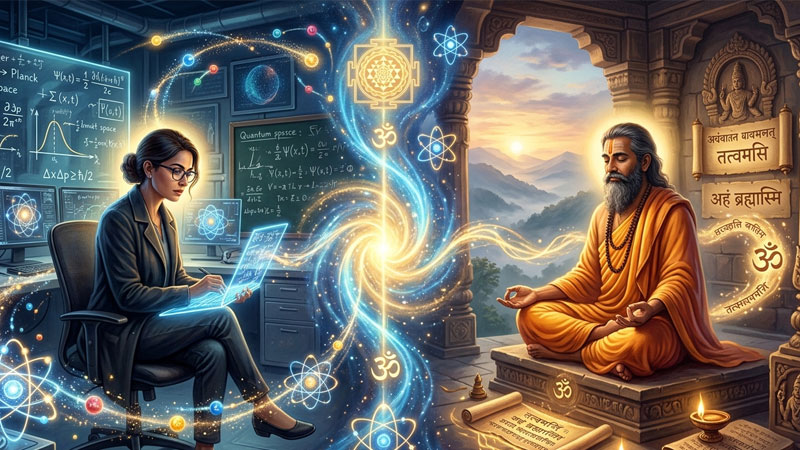
Where physicists often pause before the mystery at this boundary, the Upanishadic seers went further. They declared that ultimate reality cannot be fully expressed through thought or language. It lies beyond the domain of relative knowledge, which depends on the distinction between subject and object. The Infinite belongs to a transcendental state that the finite intellect cannot completely grasp.
From this higher perspective, distinctions such as "I," "you," and even the universe lose their absolute status. What is realized instead is an all-pervading consciousness-the Self (Atman). This realization is captured in the profound Upanishadic statement Tat Tvam Asi ("You are That"), pointing to the essential unity of the individual and the universal.
Even great physicists like Erwin Schrödinger, Werner Heisenberg, and Niels Bohr pushed human intellect to its furthest limits through quantum mechanics. In doing so, they encountered a fundamental insight: reality cannot be completely objectified, and the observer cannot be separated from what is observed. At this frontier, logical reasoning often gives way to paradox, revealing the limitations of purely intellectual and objective methods.
Despite these breakthroughs, the scientific approach remains rooted in observation, measurement, and mathematical modeling. Even when physicists reflect philosophically, they continue to function as observers examining reality as something external. The Upanishadic perspective differs in a crucial way: it asserts that ultimate reality is not an object to be known at all.
Science-including quantum physics-operates within a structure involving subject, observation, and object, even when the "object" becomes subtle, such as a wave function or probability field. Advaita Vedanta, however, takes a radically different stance. It teaches that the ultimate reality (Brahman) is not something separate to be known-it is the very knower itself, and that is your true nature.
The intellect cannot step outside itself to observe its own source. This is where Vedanta introduces a profound shift-not by accumulating more knowledge, but by transforming the way we experience awareness itself.
Science typically begins with statements like "I think" or "I observe the world." Vedanta invites a deeper inquiry: to see thoughts, perceptions, and even the sense of "I" as objects appearing within awareness. According to this view, you are not merely an individual observer-you are the awareness in which even the observer appears.
While intellectual refinement can deepen understanding, it cannot dissolve the fundamental split between subject and object. Science looks outward; Vedanta turns inward through self-inquiry (Atma Vichara).
Physics asks: "What is the universe made of?"
Vedanta asks: "To whom does the universe appear?"
From this standpoint, crossing the boundary of the finite is not about extending intellectual knowledge, but about a shift in consciousness itself.
At the edge, a physicist may conclude: "Reality is unknowable."
A Vedantin responds: "Reality cannot be known as an object-because you are that reality."
Ocean and Wave: A wave appears separate but is part of the ocean.
Mirror and Reflection: Experience depends on awareness.
Electricity and Devices: One source powers many forms.

The unity of Atman and Brahman.
It means "You are That".
They share philosophical parallels but differ in approach.
 Back to School
 Craft Ideas for Kids
 Benefits of Yoga for Kids
 Fun and Jokes
 Stories for Kids
 School Projects & Homework Help
 Hobbies
