

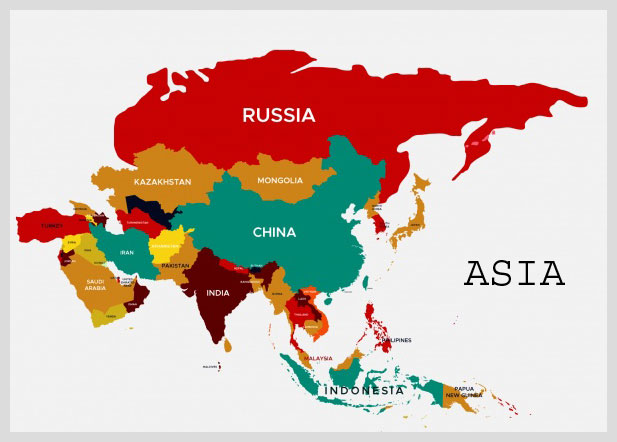
It is the world's largest and most diverse continent, covering about 30 percent of the land area on Earth.
The name Asia is ancient, and its origin has been variously explained. The Greeks used it to designate the lands situated to the east of their homeland. It is also believed that the name may be derived from the Assyrian word asu, meaning "east."
Asia is bounded by the Arctic Ocean on the north, the Pacific Ocean on the east, the Indian Ocean on the south, the inland seas of the Atlantic Ocean--the Mediterranean and the Black--on the southwest, and Europe on the west. Asia is separated from North America to the northeast by the Bering Strait and from Australia to the southeast by the mingled waters of the Indian and Pacific oceans. The Isthmus of Suez unites Asia with Africa, and it is generally agreed that the Suez Canal forms the border between them. Two narrow straits, the Bosporus and the Dardanelles, separate Anatolia from the Balkan Peninsula.
Asia has the highest average elevation of the continents and contains the sharpest relief. The highest peak in the world, Mount Everest, which is 29,035 feet (8,850 metres) high; the lowest place on the Earth's land surface, the Dead Sea, which averages about 1,312 feet (400 metres) below sea level; and the world's deepest continental trough, occupied by Lake Baikal, which is 5,315 feet (1,620 metres) deep and whose bottom lies at 3,822 feet (1,165 metres) below sea level, are all located in Asia. These physiographic extremes and the overall predominance of mountain belts and plateaus are the result of Asia's prolonged and intense geologic activity. Asia is the youngest of the continents; broadly speaking, it consists of several ancient platform cores, which over time accumulated immense quantities of material around them and were subjected to a series of collisions with one another that resulted in uplifting along the zones of collision.
The mountain systems of Central Asia have provided the continent's great rivers with water from their melting snows.
Also as a result of this configuration, Asia's population is unevenly distributed. There is a concentration of population in western Asia as well as great concentrations in the Indo-Pakistan subcontinent and the eastern half of China and appreciable concentrations in the Pacific borderlands and on the islands; but vast areas of Central and North Asia have remained sparsely populated. Nonetheless, Asia, the most populous of the continents, contains almost three-fifths of the world's people.
Asia is the birthplace of all the world's major religions--Buddhism, Christianity, Hinduism, Islam, and Judaism--and of many minor ones. Of these, only Christianity developed primarily outside Asia; it exerts little influence on the continent, though many Asian countries have Christian minorities. Buddhism has had a greater impact outside its birthplace in India and is prevalent in various forms in China, Korea, Japan, the Southeast Asian countries, and Sri Lanka. Islam has spread out of Arabia eastward to South and Southeast Asia, as well as westward and southward to Africa. Hinduism has been mostly confined to the Indian subcontinent.
The enormous expanse of Asia and its abundance of mountain barriers and inland depressions have resulted in great differences among regions in existing conditions of solar radiation, atmospheric circulation, and climate as a whole. Climates in Asia range from that of the equatorial rain forest to that of the Arctic tundra. For the most part, the northern part of Asia is dominated by movement of polar continental air masses that travel from western Siberia to the northern Pacific. Winters here are long and harsh, summers are short and cool, and the annual precipitation is light. A similar climate is characteristic of the Tibetan Plateau and other uplands. The interior regions have middle-latitude desert or semiarid climates, with harsh winters and warm to hot summers and an average annual precipitation of less than 230 mm (less than 9 in). The southern and eastern margins of the continent, however, are characterized by monsoonal air movements from the cold interior east and south in winter and from the oceans north toward the warmer land in summer. For the most part the margins of Asia have cool to cold, dry winters and hot, humid summers, with a strong concentration of rainfall in the summer months.
Most of Asia is economically underdeveloped. The majority of the continent's population is employed in agriculture, but most agricultural activity is characterized by low yields and low labor productivity. Relatively few people in Asia are employed in manufacturing. In general, urban centers and their industries are not well integrated economically with the rural sector. Transportation systems, both within countries and between them, are poorly developed. A number of exceptions exist, and they are important. Japan has successfully modernized its economy, as have Taiwan, South Korea, Singapore, and, to a lesser extent, Malaysia and Thailand.
Given its diverse nature, Asia prides about myriad cuisine. Click here to get the feel of it:
Among the peoples of Central Asia, folk dancing occurs as a form of entertainment at social occasions, such as festivals, weddings, and other celebrations, and private parties. Often impromptu, folk dances are sometimes performed without the accompaniment of musical instruments, and the performers rely on singing and footwork to maintain the rhythm.
Formalized folk dance does not appear to have evolved among nomadic peoples of the steppe and desert regions, but such dances did develop among the sedentary agriculturists, particularly in the Himalayan regions, where troupes of amateur performers were formed for local entertainment. Some dances were performed by a group of men and women forming a circle; in others, the dancers faced each other in lines. The dance steps and body movement were performed according to a stylized routine, and the rhythmic beat was accented by a measured stamp of the foot.
Indian Independence Day is also a major event and a national holiday.
Try out the other sections

 Mother's Day
 Craft Ideas for Kids
 Rhymes & Poems
 Benefits of Yoga for Kids
 Stories for Kids
 School Projects & Homework Help