

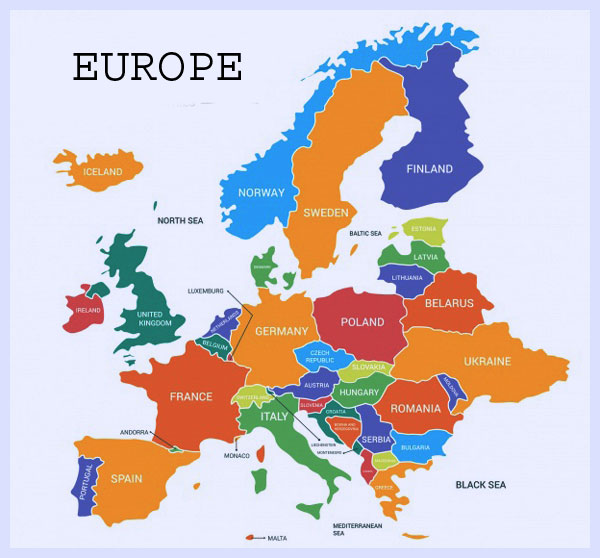
Geographically small, covering about 10,390,000 square kilometres (4,010,000 sq mi) , Europe is home to two-thirds of a billion people representing a shifting mosaic of cultures, languages. Europe is bounded to the north by the Arctic Ocean, to the west by the Atlantic Ocean, to the south by the Mediterranean Sea, and to the southeast by the waterways adjoining the Mediterranean to and including the Black Sea, and the Caucasus Mountains (in Caucasia).It witnessed two world wars, its division by the Cold War, and a decade of conflict in the Balkans in the 20th century.
The European Union now consists of 25 member countries and its citizens proudly identify themselves as Europeans. The challenge facing Europe in the 21st century is to create a model of peace and prosperity-built on freedom and diversity-that embraces all its countries.
The vast majority of Europe's inhabitants are of the European (or Caucasoid) geographic race, characterized by white or lightly pigmented skins and variability in eye and hair colour and by a number of biochemical similarities; there is also an increasing number of people of African and Asian ancestry, although their proportion of the population is still small. The origins of the Europeans as a distinct group may never be learned. It is known, however, that the continent had a scanty population of now-extinct hominid species before modern humans appeared some 40,000 years ago and that throughout its prehistoric period it received continual waves of immigrants from Asia.
European festivals are as numerous as they are varied. More than a distraction from the mundane everyday life, they are the very stuff of everyday life!
For recipes Click Here
Try out the other sections

 Mother's Day
 Craft Ideas for Kids
 Rhymes & Poems
 Benefits of Yoga for Kids
 Stories for Kids
 School Projects & Homework Help