

Total area -6,878,000 square miles (17,814,000 square kilometres).
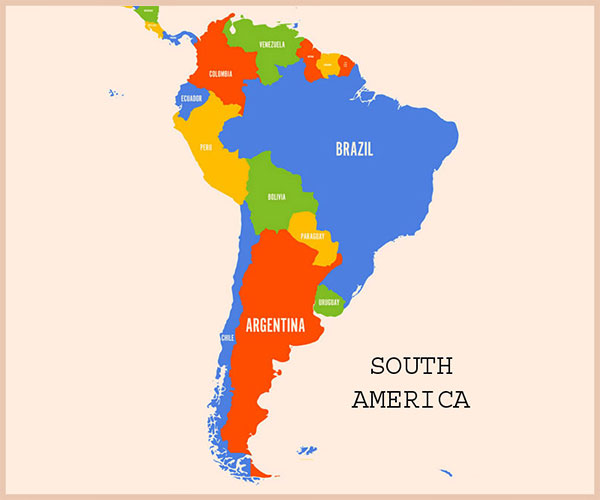
The fourth largest of the world's continents, the continent is compact and roughly triangular in shape, being broad in the north and tapering to a point--Cape Horn, Chile--in the south.
South America is bounded by the Caribbean Sea to the northwest and north, the Atlantic Ocean to the northeast, east, and southeast, and the Pacific Ocean to the west. In the northwest it is joined to North America by the Isthmus of Panama. Drake Passage, south of Cape Horn, separates South America from Antarctica.
The name America is derived from that of the Italian merchant and navigator Amerigo Vespucci, one of the earliest European explorers of the New World. The term America originally was applied only to South America, but the designation soon was applied to the entire landmass. Because Mexico and Central America share an Iberian heritage with nearly all of South America, this entire region frequently is grouped under the name Latin America.
South America consists of two dissymmetric parts. In the larger, eastern portion are found a number of stable shields forming highland regions, separated by large basins (including the vast Amazon basin). The western portion is occupied almost entirely by the Andes Mountains. The Andes--formed as the South American Plate moved westward and forced the oceanic plate to the west under it--constitute a gigantic backbone along the entire Pacific coast of the continent. The basins east of the Andes and between the eastern highlands have been filled with immense quantities of sediment washed down by the continent's great rivers and their tributaries.
The great range in elevation produces an unrivaled diversity of climatic and ecological zones, which is probably the most prominent characteristic of South American geography.
Temperature: Warm
Most of South America is in warm for most of the year. In most areas, it is tropical weather. It never gets too cold and is usually warm. However, there are areas of South America where it does get cold and the temperature drops below freezing. The Andes Mountain region has cold temperatures.
Weather: Mostly wet
Most of South America receives plenty of rain. There are areas that receive downpours and seem to be constantly wet, like the rain forest. However, there are also areas that receive little or no rain. In fact, there are some areas that are just about the driest areas on Earth!
South American animal life is very rich and well diversified.
Freshwater fishes are numerous, with about 2,700 species. The Amazonian fishes may approach 1,500 species in number. Among the dominant groups are characins , which include the flesh-eating piranha; gymnotids, South American cyprinoid fishes that include the electric eel;catfishes; cyprinodonts, a large family of small scaly-headed soft-finned fishes; and cichlids, a family consisting chiefly of fishes that somewhat resemble sunfish.
Birds are represented by 89 families and some 3,000 species--a much higher figure than in Africa or Asia, which justifies the application of the name bird continent to South America. Unique birds include rheas (large, tall, flightless birds that resemble ostriches), curassows (large arboreal birds distantly related to the domestic fowl), hoatzins (a brownish crested bird, having claws on the digits of the wing when young), oilbirds, motmots (bright-coloured birds related to kingfishers), jacamars (small, bright-coloured birds), and many passerine (perching) birds. Hummingbirds are also found aplenty with more than 120 species in Ecuador alone.
Click here to know more about South American wildlife.
Holidays, fiestas and festivals, whether religious or secular, hold a favored place here. Enjoy!
The original inhabitants of South America are believed to have descended from the same Asiatic peoples who migrated to North America from Siberia during the most recent (Wisconsin) ice age. Few of these peoples, however, survived the arrival of Europeans after 1500, most succumbing to disease or mixing with people of European and (especially in Brazil) African origin. Some parts of the continent are now industrialized, with modern cities, but the people of most regions still follow an agricultural way of life. The wealth of mineral products and renewable resources is considerable, yet economic development in most of the continent lags behind the more industrially advanced regions of the world. Nonetheless, considerable concern has arisen about the rapidly increasing and often destructive exploitation of these resources.
Click Here For Recipes
Try out the other sections

 Mother's Day
 Craft Ideas for Kids
 Rhymes & Poems
 Benefits of Yoga for Kids
 Stories for Kids
 School Projects & Homework Help