
Predicting Sleep: A Regression Study
School Project • Predicting Sleep Patterns


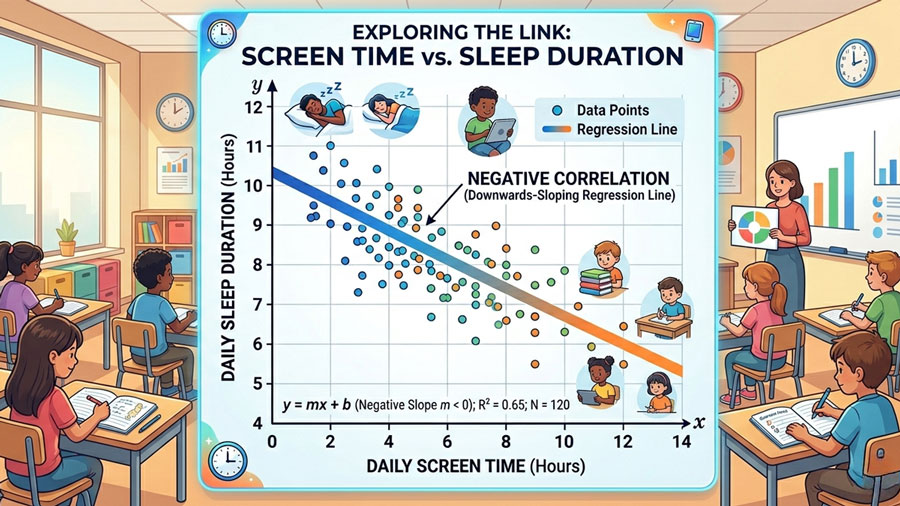
Is your phone keeping you awake? This project uses Linear Regression to quantify the relationship between digital usage (hours) and sleep duration (hours). We aren't just looking for a trend; we are building an equation to predict it.
Bivariate Analysis
Students survey their peers to collect pairs of data $(x, y)$. Using the **Method of Least Squares**, they calculate the regression line:
Frequently Asked Questions
Q: What is the objective of this regression study?
A: The project aims to quantify the relationship between screen time and sleep duration using Linear Regression and create a predictive model based on collected data.
Q: What is Linear Regression?
A: Linear Regression is a statistical method used to model and predict the relationship between an independent variable, such as screen time, and a dependent variable, such as sleep duration.
Q: What is the Method of Least Squares?
A: The Method of Least Squares is a mathematical technique used to find the regression line that minimizes the total squared differences between observed and predicted values.
Q: What does the regression equation y = mx + c represent?
A: The equation represents the line of best fit for the data, where y is the predicted sleep duration, x is screen time, m is the slope, and c is the intercept.
Q: What does a correlation coefficient close to -1 indicate?
A: A correlation coefficient close to -1 indicates a strong negative relationship. As screen time increases, sleep duration tends to decrease.
Q: Why is bivariate analysis used in this project?
A: Bivariate analysis helps examine the relationship between two variables—screen time and sleep duration—to identify trends and build predictive models.
 Durga Puja
 CLAT Aspirants
 Craft Ideas for Kids
 Benefits of Yoga for Kids
 School Projects & Homework Help
 Hobbies: Philately, Fishing, Camping
 Fun and Jokes