
Story Summary
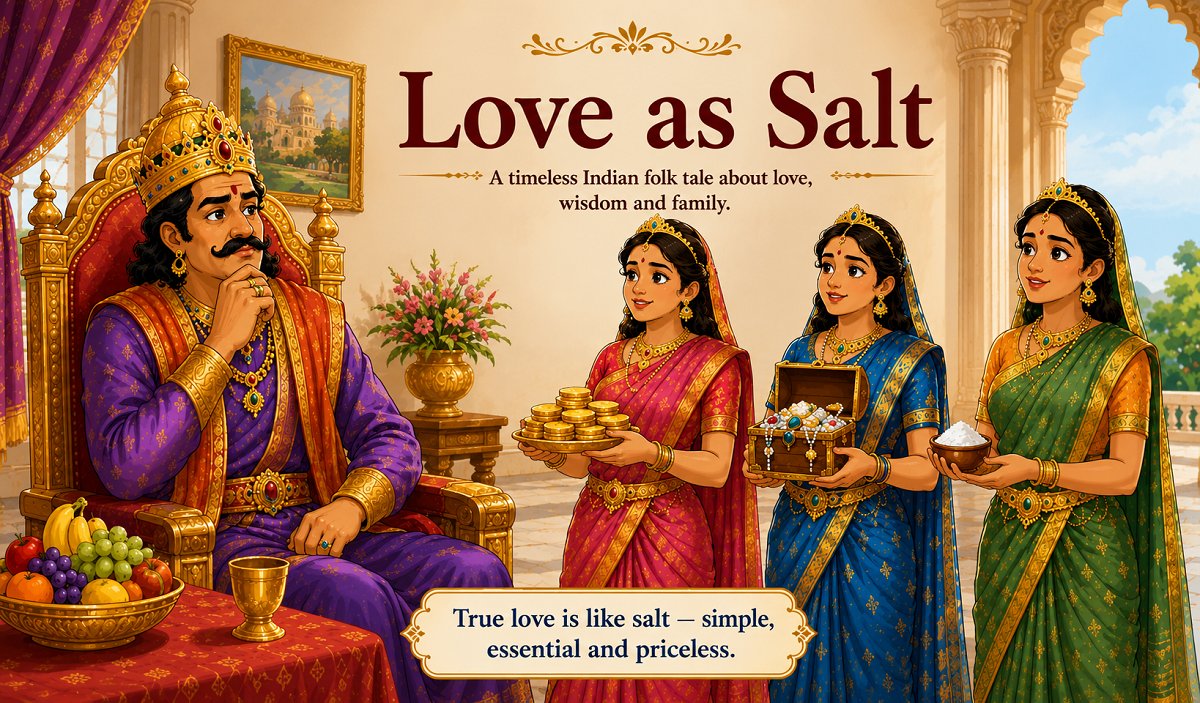
A proud king asks his three daughters how much they love him. The eldest compares her love to gold; the second to diamonds. But the youngest, the most honest of all, says she loves him as much as she loves salt. Enraged by what he sees as an insult, the king banishes her to the forest. There she meets and marries a kind merchant. Years later, the king stumbles upon their home while lost in the forest. Without revealing who she is, the princess orders a sumptuous feast - but instructs the cook to add no salt to any dish. The king, unable to eat the tasteless food, is suddenly overcome with understanding: salt, like his youngest daughter's love, is invisible and taken for granted - until it is gone.
Full Story
A very long time ago, there lived a king and his three daughters. One day, the king wanted to find out which of his daughters loved him the most. So, he called his daughters and asked, "How much do each of you love me, my dears?"
"I love you as much as I love diamonds!" said the second. On hearing this the King was even happier.
But the youngest daughter said simply, "I love you as much as I love salt, dear father."
On hearing this, the King was furious. "How can you say something like that?" he shouted at his youngest daughter. "In your eyes my value is only as much as mere salt?" He was so angry and humiliated that he banished his youngest daughter to the forest.
Sad and dejected, the princess began to wander in the forest. Suddenly, she heard the sound of a horse galloping. Frightened, she hid in the hollow of a tree. The horse halted near the tree and a young man alighted. He had seen the princess hiding behind the tree. As soon as they both saw each other, they fell in love.
The princess then narrated her woeful story. "I love my father very much, but he doesn't understand!" she sobbed. "One day he will," consoled the trader. Soon they were married and the youngest princess lived in a beautiful mansion with her husband, the merchant.
Then one day, it so happened that the king lost his way while hunting. For two days, he kept wandering in the forest. Then, as fate would have it, he reached the trader's mansion. Hungry and tired, he approached the trader and sought his help.
Although the trader knew that the king was none other than his father-in-law, he kept quiet about it. "I shall arrange for your food, Your Majesty!" he said and went to his wife, the princess. The trader told her about the king's arrival and asked her to prepare a great feast.
The princess understood at once. She went to the kitchen and oversaw the preparation of many rich, elaborate dishes - succulent meats, fragrant rice, warm breads, and sweet curries - all completely without salt.
When the famished king sat down before the lavish feast, he could not have been more relieved. But the moment the first mouthful touched his tongue, something was horribly wrong. Every dish was flat, tasteless, and impossible to swallow. He tried another - and another. He could not eat a single bite.
It was then that the princess stepped forward and revealed herself. The king stared at his daughter with tears in his eyes, finally understanding what she had meant all those years ago. Salt is not glamorous. It does not sparkle like gold or dazzle like diamonds. But without it, even the grandest feast is nothing. And that was exactly how she loved him - quietly, essentially, and utterly indispensably.
The king embraced his daughter and begged her forgiveness. From that day forward, he never again judged love by the grandeur of its words, but by the quiet constancy of its presence.
Key Characters
- The King: A proud ruler
- The Youngest Princess: Wise, honest, and quietly courageous.
- The Merchant: A kind and perceptive young trader who rescues the princess
- The Elder Daughters: Their flattering comparisons to gold and diamonds please their father
Moral of the Story
True love, like salt, is indispensable but easy to overlook. We rarely notice what is quietly essential until it is taken away. The story teaches children that the most profound love is often expressed through honesty and steady presence, not through flattery or grand gestures. It also reminds us never to judge a person's worth by the surface beauty of their words.
Why Kids Love This Story
- The unfair banishment feels deeply relatable. Children instinctively understand the injustice of being punished for telling the truth. They immediately root for the princess.
- The salt-free feast is brilliantly clever. The princess doesn't lecture her father - she lets him discover the truth for himself. Children recognise and love the quiet brilliance of this plan.
- A satisfying redemption arc. The king's tears and the joyful reunion give children that warm, earned sense of justice being restored.
- It makes kids think about everyday things differently. "What else do I take for granted, like salt?" is a genuinely exciting question for a curious young mind.
- A real-life parallel to fairy tales they know. The structure - three daughters, a forest exile, a royal reunion - echoes stories like King Lear and Cinderella, giving it a familiar fairy-tale feel with a uniquely Indian flavour.
FAQs About the Story
Where does 'Love as Salt' come from?
'Love as Salt' is a traditional folk tale from Punjab, the northwestern region of India. It belongs to the oral storytelling tradition of the Punjab and reflects the region's deep values of honesty, humility, and family loyalty. Closely related versions of this story exist in European folklore too - most famously in Shakespeare's King Lear.
What age group is this story suitable for?
This folk tale is suitable for children aged 5 and above. Its simple language, vivid characters, and emotionally satisfying ending make it ideal for early primary school readers and read-aloud sessions. The moral about the nature of love also makes it an excellent discussion piece for older children and classrooms.
What does salt symbolise in the story?
Salt in this story symbolises love that is essential, quiet, and selfless - present in everything but never demanding attention. In Punjabi culture, salt also carries deep social meaning: sharing someone's salt means being under their protection and care. The phrase "namak halal" (loyal to the salt) means to be faithful and grateful to those who shelter you, making the princess's comparison even more profound than it first seems.