
Story Summary
The myth of Niobe is one of the most sobering stories in the entire Greek tradition - a queen at the height of earthly fortune who destroys herself and her family through a single act of arrogant defiance. It is a story about the fragility of everything we are proud of, and the wisdom of knowing where pride ends and folly begins.
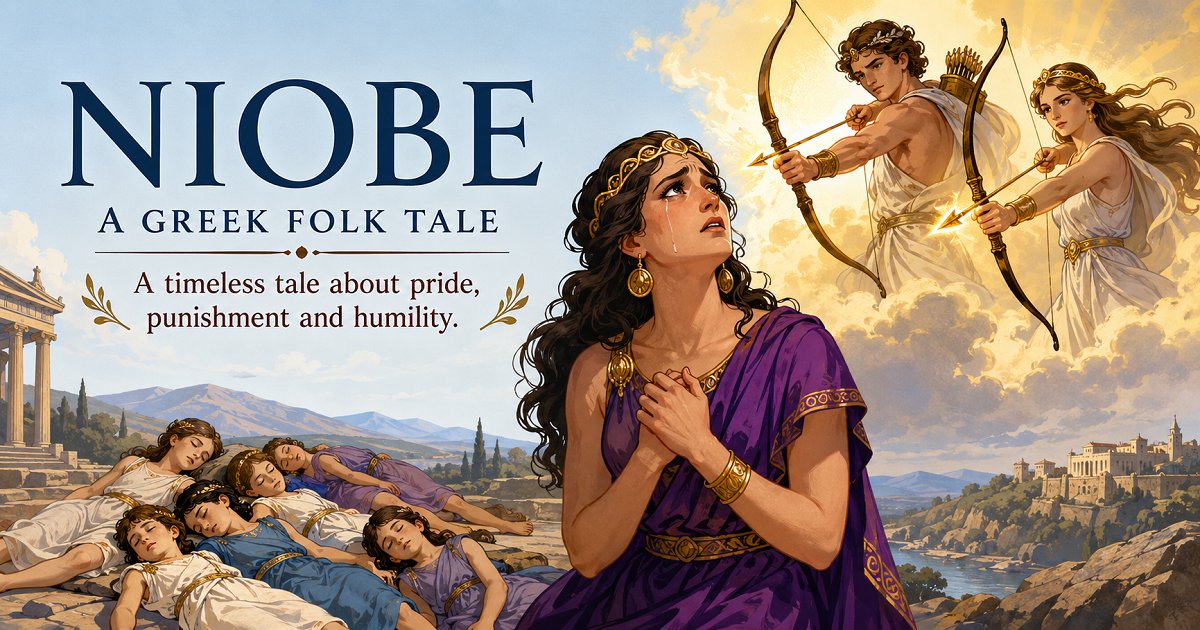
Full Story
There are so many tales of the vanity of kings and queens that the half of them cannot be told.
There was Cassiopeia, queen of Aethiopia, who boasted that her beauty outshone the beauty of all the sea-nymphs, so that in anger they sent a horrible sea-serpent to ravage the coast. The king prayed of an oracle to know how the monster might be appeased, and learned that he must offer up his own daughter, Andromeda. The maiden was therefore chained to a rock by the sea-side, and left to her fate. But who should come to rescue her but a certain young hero, Perseus, who was hastening homeward after a perilous adventure with the snaky-haired Gorgons. Filled with pity at the story of Andromeda, he waited for the dragon, met and slew him, and set the maiden free. As for the boastful queen, the Gods forgave her, and at her death she was set among the stars. That story ended well.
But there was once a queen of Thebes, Niobe, fortunate above all women, and yet arrogant in the face of the gods. Very beautiful she was, and nobly born, but above all things she boasted of her children, for she had seven sons and seven daughters.
Now there came the day when the people were wont to celebrate the feast of Latona, mother of Apollo and Diana; and Niobe, as she stood looking upon the worshippers on their way to the temple, was filled with overweening pride.
"Why do you worship Latona before me? What does she possess that I have not in greater abundance? She has but two children, while I have seven sons and as many daughters. Nay, if she robbed me out of envy, I should still be rich. Go back to your houses; you have not eyes to know the rightful goddess."
Such impiety was enough to frighten any one, and her subjects returned to their daily work, awestruck and silent.
But Apollo and Diana were filled with wrath at this insult to their divine mother. Not only was she a great goddess and a power in the heavens, but during her life on earth she had suffered many hardships for their sake. The serpent Python had been sent to torment her; and, driven from land to land, under an evil spell, beset with dangers, she had found no resting-place but the island of Delos, held sacred ever after to her and her children. Once she had even been refused water by some churlish peasants, who could not believe in a goddess if she appeared in humble guise and travel-worn. But these men were all changed into frogs.
It needed no word from Latona herself to rouse her children to vengeance. Swift as a thought, the two immortal archers, brother and sister, stood in Thebes, upon the towers of the citadel. Near by, the youth were pursuing their sports, while the feast of Latona went neglected. The sons of Queen Niobe were there, and against them Apollo bent his golden bow. An arrow crossed the air like a sunbeam, and without a word the eldest prince fell from his horse. One by one his brothers died by the same hand, so swiftly that they knew not what had befallen them, till all the sons of the royal house lay slain. Only the people of Thebes, stricken with terror, bore the news to Queen Niobe, where she sat with her seven daughters. She would not believe in such a sorrow.
"Savage Latona," she cried, lifting her arms against the heavens, "never think that you have conquered. I am still the greater."
At that moment one of her daughters sank beside her. Diana had sped an arrow from her bow that is like the crescent moon. Without a cry, nay, even as they murmured words of comfort, the sisters died, one by one. It was all as swift and soundless as snowfall.
Only the guilty mother was left, transfixed with grief. Tears flowed from her eyes, but she spoke not a word, her heart never softened; and at last she turned to stone, and the tears flowed down her cold face forever.
Moral of the Story
The myth is a definitive lesson in hubris - the reckless pride that places a mortal above their rightful station. Niobe's error is not simply that she was proud of her children; pride in one's family is natural. Her error is that she used her blessings as weapons against a goddess, and continued to do so even as the punishment began. The story teaches that gratitude should accompany good fortune, and that refusing to bend ultimately leads to being broken.
Key Characters
- Niobe: Queen of Thebes - beautiful, nobly born, and mother of fourteen children.
- Latona (Leto): The divine mother of Apollo and Diana.
- Apollo: God of the sun and archery, son of Latona and Zeus.
- Diana (Artemis): Goddess of the moon, the hunt, and archery - Apollo's twin sister.
- Cassiopeia: Queen of Aethiopia, introduced as a counterpoint.
Why Kids Love This Story
- A villain you almost feel sorry for. Niobe is arrogant and foolish, but she is also a mother who loves her children. That contradiction makes her one of mythology's most complex figures - and one of the most human.
- The sheer drama of inevitability. The moment Niobe opens her mouth at the festival, the reader knows disaster is coming. The mounting dread - son by son, daughter by daughter - is almost unbearable to read.
- A lesson delivered through story, not lecture. The myth makes the idea of hubris viscerally real. Children who read it never forget what the word means - or what it costs.
- An unforgettable ending. Turning to stone while still weeping is one of mythology's most haunting images. It captures the idea of a grief so immense that the human body cannot contain it.
- Smart storytelling. The contrast with Cassiopeia - who did something similar and got off lightly - is a masterclass in narrative tension. Why did Niobe not stop when she still could? Readers find themselves asking the same question.
- Connection to the wider world of myth. The story introduces Perseus, Andromeda, Apollo, Diana, and the island of Delos all in a few paragraphs - it opens the door to a whole universe of connected stories.
FAQs About the Story
Who is Niobe in Greek mythology?
Niobe was the queen of Thebes, celebrated throughout the ancient world for her beauty, noble descent (she was the daughter of Tantalus), and extraordinary fertility - she had seven sons and seven daughters. She is remembered in myth for her fatal act of hubris: publicly claiming to be greater than the goddess Latona (Leto) because she had more children.
Why was Niobe punished by the gods?
Niobe interrupted a public religious ceremony honouring Latona and declared that she deserved greater worship because she had fourteen children against Latona's two. This was a direct insult to a divine being and a violation of the sacred duty to honour the gods. Apollo and Diana - Latona's two children - took immediate and devastating vengeance.
What happened to Niobe's children?
Apollo descended on Thebes and struck down all seven sons with his golden arrows as they competed at their sports. Then Diana shot all seven daughters with her silver bow, the deaths described in the myth as silent and swift as snowfall. All fourteen children died, one by one, before their mother's eyes.