
Story Summary
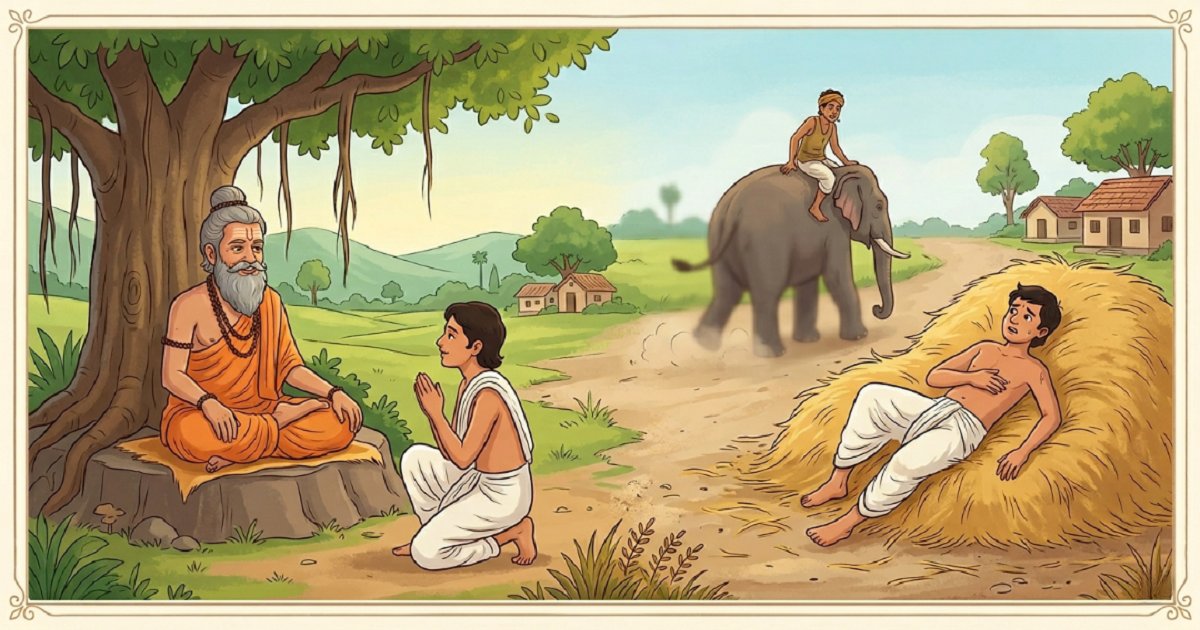
A devoted pupil at an ashram is taught by his guru that God exists in everything and everyone. Taking this lesson too literally, he stands in the path of a charging elephant - certain it will not harm him because God dwells within it. The elephant flings him aside. When he returns to his guru, bruised and bewildered, the answer he receives changes everything he thought he understood about faith.
Full Story
There once was a wise saint who lived in an ashram deep in the countryside. He had several devoted pupils who studied under him, learning the ways of the world and the nature of God.
One morning, a young devotee posed a question that had been troubling him. "Guruji, where is God?"
"Everywhere, my son," the Guru replied calmly.
"Everywhere?" the devotee asked, puzzled. "In everything you see. And inside everyone too," the Guru continued with a serene smile.
The devotee turned the idea over in his mind all day. That evening, walking home, he was still lost in thought. "How can God be in everything?" he wondered. "In the trees? In the dust? In me?"
Suddenly, the sound of pounding hooves broke through his thoughts. An enormous elephant came thundering down the road. Atop the animal sat a frantic mahout, shouting with all his might: "The elephant has gone mad! Move out of the way! Get out of the road!"
For a moment, the devotee's heart lurched with fear. Then an idea took hold of him.
"Guruji told me that God is in everything," he reasoned. "That means God is in that elephant. And God is in me as well. God cannot attack God. So the elephant will not harm me. I have nothing to fear."
With serene confidence - and considerable foolishness - he planted his feet in the middle of the road and stood his ground. The mahout screamed warning after warning. "Move, you foolish man! He will trample you! You will be crushed to death!"
The devotee smiled and did not move.
The elephant reached him. Mad with fury, the animal wrapped its trunk around the devotee and, before the young man could even cry out, flung him aside like a bundle of straw.
Fortunately, he landed on a soft haystack at the roadside and was unhurt - though deeply shaken. As he lay there, trembling with shock and relief, his Guru and fellow students came rushing towards him.
"What happened? Why on earth did you stand there?" the Guru asked.
"Guruji," the devotee said, still shaking, "you told me that God was in everything and in everyone. If God was inside the elephant, why did He fling me aside like that?"
The Guru looked at the young man with patient, kind eyes.
"Yes," he said gently. "God is indeed in the elephant. But God is also in the mahout who kept warning you to move. Why did you not listen to him?"
The devotee fell silent. He had no answer.
Key Characters
- The Guru: A wise saint of the ashram.
- The Devotee: Sincere, eager, and earnest - but dangerously literal.
- The Elephant: A force of untamed nature.
- The Mahout: The voice of practical wisdom
Moral of the Story
Faith without wisdom is blindness. If God truly lives in all things, then God also speaks through the voices of those who warn us, guide us, and care for us. True devotion is not the absence of reason - it is reason illuminated by love.
Why Kids Love This Story
- Big, dramatic action - A charging elephant, a man who won't move, and a spectacular (but harmless) ending. Pure drama.
- A satisfying twist - The guru's final question flips everything the devotee - and the reader - assumed. That reversal is delicious.
- Relatable silliness - Children recognise the feeling of taking something too literally. The devotee's logic is funny because it makes perfect sense - until it doesn't.
- Gentle wisdom - The lesson doesn't lecture. It unfolds naturally from the story itself, leaving children to make the connection themselves.
- Vivid Indian setting - Ashrams, elephants, mahouts, dusty roads - the sensory richness of rural Bengal brings the world alive.
- A story you remember - Long after the details fade, the image of a man standing still before a charging elephant stays with you.
FAQs About the Story
Where does this story originate?
This is a traditional folk tale from Bengal (present-day West Bengal, India and Bangladesh), rooted in the Vedantic philosophical tradition - Sarvam Khalvidam Brahma, meaning "all this is indeed Brahman (God)." The tale is strongly associated with the teachings of Sri Ramakrishna Paramahamsa, the 19th-century Bengali mystic, who is said to have told this very parable to his disciples.
What age group is this story suitable for?
This story is suitable for children aged 6 and above. Its simple narrative and vivid imagery make it accessible to early readers, while its philosophical depth keeps older children and adults engaged. It is widely used in school moral science classes across India.
What does the guru's final reply teach children?
The guru's reply - "God is also in the mahout who warned you" - teaches that wisdom cannot be selective. If you believe God is everywhere, you must find God's guidance in practical, everyday warnings, in the advice of elders, and in common sense. Faith and reason must work together. Neither is complete without the other.