
Story Summary
A man in Maharashtra keeps a magnificent long beard and considers it the very mark of his dignity and wisdom. One candlelit night, he reads a book containing a single devastating line: a man with a long beard is a fool. What follows is a masterclass in panic, vanity, and spectacularly poor decision-making - as he attempts to destroy the evidence and ends up proving the point instead.
Full Story
Once upon a time, in a small town in Maharashtra, there lived a man who possessed something he considered his greatest treasure: a long, magnificent beard. Every single morning, without fail, he would wash it carefully, comb it with great attention, and stroke it slowly, stretching his neck with satisfaction.
"My long beard makes me look scholarly and dignified," he would murmur to himself, smiling at his own reflection. In his mind, the beard was not merely hair - it was a symbol of learning, wisdom, and standing. A man with such a beard, surely, commanded respect.
One evening, the man settled down in his favourite chair with a book and a candle for company. He read contentedly until, quite without warning, his eyes landed on a sentence that stopped him cold.
"A man with a long beard is a fool."
He blinked. He rubbed his eyes. He opened them wide and read the line again. Then once more. It said exactly what he thought it said. There was no misreading it. There was no charitable interpretation. The book had delivered its verdict with calm, maddening clarity.
The man walked to the window, holding his beloved beard in his hand, staring out into the dark. "How can I believe such a remark!" he wondered, his pride bruised and smarting. "If it is true, then I am a fool! What a stupid thought!" He tried to brush the idea away.
But the sentence would not leave him. It returned every time he closed his eyes. He paced the room. He sat back down. He stood up again. The more he tried to convince himself the book was wrong, the less convincing the argument became.
"I always believed a long beard was a sign of intelligence. Was I living under a delusion all these years?" The thought made him genuinely miserable.
Finally, the man made a decision. If the beard was the cause of his folly, then the beard had to go.
"What is the use of nurturing something that makes me a fool?" he declared, with the grim determination of a man who has committed to a plan without thinking it through.
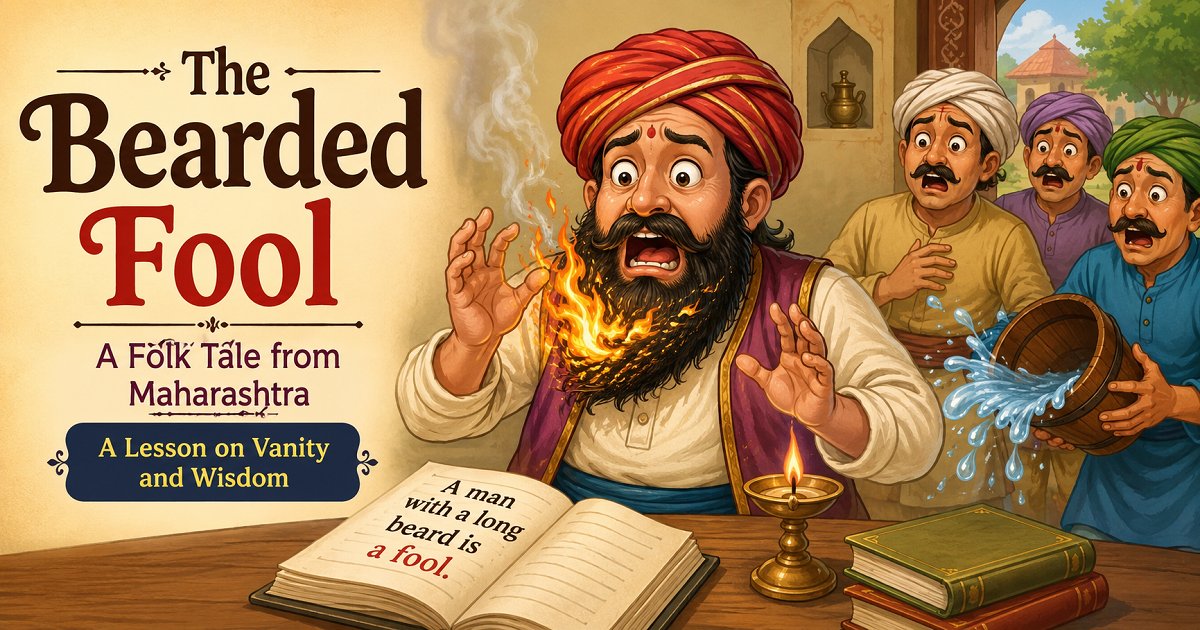
He walked to the candle, took the tip of his long beard between his fingers, and held it to the flame.
It caught fire instantly.
"Eeeaaaaa!" he shrieked - he had not anticipated quite how swiftly hair burns. Before he could react, the fire had raced up the length of his beard. His moustache followed. A spark leapt upward and, with terrible efficiency, set his hair alight as well.
His cries brought the neighbours running. They threw bucket after bucket of water at the man until the fire was out. He stood there, soaking and singed, his prized beard gone, his hair gone, his dignity comprehensively gone.
"How did this happen?" the neighbours demanded.
The man took a long, slow breath. He looked at the book, still open on the table. Then he looked at his neighbours.
"I read in a book that a man with a long beard is a fool," he said quietly. "And indeed - I have proved it."
Key Characters
- The Bearded Man: Vain, anxious, and deeply attached to his own self.
- The Book: The silent antagonist.
- The Candle: The instrument of the man's own ruin.
- The Neighbours: The audience for the man's greatest moment of self-awareness.
Moral of the Story
Vanity clouds judgement. When pride governs our decisions, we stop thinking clearly - and in our rush to protect or destroy an image, we often bring about the very outcome we feared. The biggest fool is not the man with the beard, but the man who cannot think before he acts.
Why Kids Love This Story
- Pure slapstick - A man sets his own beard on fire. There is no way to read that without laughing. The physical comedy is immediate and vivid.
- A perfect punchline - The man's final words, "and indeed I have proved it", land with the timing of a great joke. Children who see it coming still love it when it arrives.
- Satisfying self-defeat - Nobody punishes the man. He punishes himself. That self-inflicted quality makes children feel smart for spotting what he should have done.
- Relatable vanity - Most children know the feeling of caring too much about how they look to others. The story exaggerates that feeling to delightful, ridiculous extremes.
- A lesson that doesn't lecture - The story never tells you what to think. It shows you a man, lets him make his choices, and trusts you to draw the conclusion. That respect for the reader feels good.
- Short and unforgettable - The story is brief enough to hold even a restless child's attention, and the image of a man burning his own beard stays in the memory for years.
FAQs About the Story
Where does this folk tale originate?
This is a traditional folk tale from Maharashtra, western India. Maharashtrian folk literature is rich with humorous moral parables known as lok katha (people's stories), which use comic situations to deliver sharp lessons about human vanity, greed, and gullibility.
What is the twist ending of this story?
The twist is the man's own confession. After his neighbours extinguish the fire, he calmly tells them: "I read that a man with a long beard is a fool - and indeed I have proved it." His attempt to escape the label of fool is the very act that earns it. The punchline is delivered by the character himself, which makes it doubly satisfying.
What does the beard symbolise in this story?
The beard represents vanity and the way we attach our sense of worth to outward appearances. The man equates his beard with intelligence and dignity - symbols that exist only in his own mind. When that belief is challenged, he cannot think rationally. It is a study in how fragile, and how dangerous, excessive pride can be.