
Story Summary
A Brahmin's generous heart leads him to carry a lost crocodile to the sacred Ganga - only to find the reptile's gratitude has very sharp teeth. Two judges side with the crocodile's grim philosophy, and the situation looks hopeless. Then a sly fox arrives with a question so simple it changes everything.
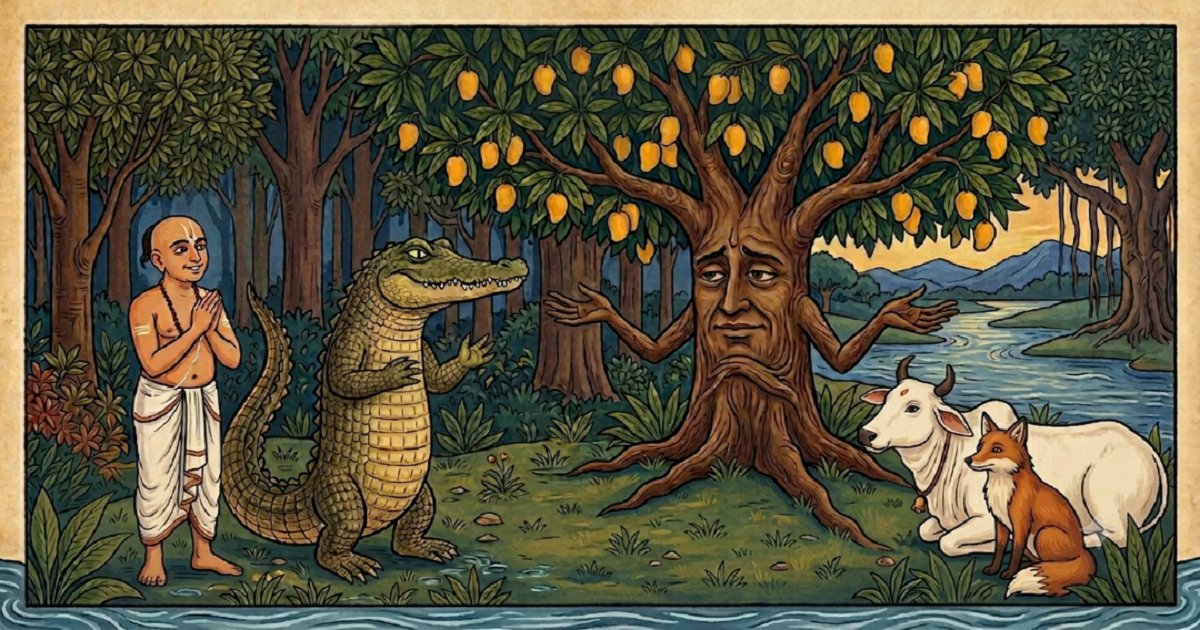
Full Story
One day, a Brahmin was travelling through a dense forest. A crocodile saw him and called out, Help me, O Brahmin! I have been separated from my parents, who live in the holy river Ganga! But I do not know the way. Please take me there!
The Brahmin was a kind man. He put the crocodile into a large sack, heaved it onto his back, and carried him all the way to the river. Here you are!
he said, releasing the crocodile from the sack.
As soon as the crocodile was free, he turned on the Brahmin with menacing eyes. Get ready to be eaten!
he said.
The Brahmin was stunned. How can you eat me? I just helped you!
But the crocodile had already caught hold of his leg and dragged him towards the water. How ungrateful of you!
cried the Brahmin. At this, the crocodile replied coolly, I am not ungrateful. I am simply following the great practice: eat anything that will sustain you.
I do not agree with that practice - it is barbaric!
said the Brahmin. Let us find impartial judges to decide. If three judges say this practice holds good, you may eat not only me, but my entire family.
The selfish crocodile thought: If I eat this Brahmin now, I will miss the golden chance of devouring his entire family!
So he released the Brahmin's leg and agreed to seek three judges.
The two set off together through the forest. First, they came across a mango tree. The Brahmin narrated everything that had happened and asked, Is it fair to eat anything that sustains you?
The mango tree replied, Yes! Humans sit in my shade, eat all my fruits, and then cut me down for firewood. That is the way of the world.
The first verdict was against the Brahmin. The crocodile smiled with satisfaction.
A few miles ahead, they found a cow. The Brahmin asked her the same question. Yes,
said the cow. I give humans milk every day of my life. When I grow old and can give no more, they abandon me to be killed by wild animals.
Two verdicts against the Brahmin. The crocodile laughed. Hahaha! Two of the judges have approved! Only one remains!
They walked further still, and came across a fox sitting calmly by the road. The Brahmin told him the whole story and asked the same question. The fox listened carefully, then tilted his head thoughtfully.
Before I answer,
said the fox, I have one small question. How could such a large crocodile possibly have fitted inside such a small sack? It seems quite impossible to me.
Impossible?
snorted the crocodile. Nonsense! I'll show you exactly how it was done.
And he crawled proudly into the sack to demonstrate.
The fox gave the Brahmin a quiet look. The Brahmin understood at once. He picked up a large boulder and dropped it into the sack. The wicked crocodile was punished for his selfishness and ingratitude, and the Brahmin walked free.
The fox, as it happened, ate well for many days. And the Brahmin went home and never again put his trust in those who cry for help with a crocodile's smile.
Moral of the Story
Ingratitude and selfishness carry their own punishment. No matter how powerful the wicked may seem, a single moment of clever thinking - tuned to their pride - can undo them completely.
Key Characters
- The Brahmin: A kind, devout traveller whose trust in others nearly costs him his life.
- The Crocodile: Treacherous, selfish, and fatally proud.
- The Fox: The classic trickster of Indian folk tradition.
- The Mango Tree & Cow: Both carry legitimate grievances against human ingratitude.
Why Kids Love This Story
- A courtroom drama in the jungle. The three-judge structure gives the story a building sense of dread - two verdicts go against the hero, and the tension is almost unbearable by the time the fox appears. Children feel the stakes keenly.
- The fox's brilliant trick. The moment the fox feigns disbelief about the sack is pure comic genius. Children almost always laugh - and then immediately understand exactly what is about to happen, which makes it even more satisfying.
- Justice that feels earned. The crocodile isn't punished by chance or divine intervention - he is undone by his own pride and greed. Children find this deeply satisfying because the punishment fits the character flaw perfectly.
- The power of the right question. The fox's masterstroke is not an answer but a question. This resonates powerfully with children who are learning that clever thinking often means questioning the problem rather than accepting its terms.
- The mango tree and cow add real-world weight. Their complaints about human ingratitude are genuine, and children feel the moral complexity
FAQs About the Story
How did the fox save the Brahmin?
The fox pretended to find it impossible to believe that such a large crocodile could have fitted into the small sack. The crocodile, goaded by vanity, climbed back into the sack to prove it. The Brahmin then dropped a large boulder into the sack, ending the threat. It is a masterclass in using an opponent's pride against them.
Why did the mango tree and cow support the crocodile?
Both the mango tree and the cow had genuine grievances: the tree was cut down after years of providing fruit and shade; the cow was abandoned after giving milk all her life. Their bitterness at human ingratitude led them to validate the crocodile's cynical worldview. The story does not dismiss their pain - it simply shows that real suffering can still lead to unjust conclusions.
Why did the crocodile agree to seek judges?
Pure greed. When the Brahmin offered that if the judges sided with the crocodile he could eat the Brahmin's whole family, the crocodile saw a chance to multiply his meal many times over. The same selfishness that made him betray his rescuer also made him delay eating him - and that delay cost him everything.